|
PATRIAGORA
πατριά - Patria | Family + Market | Agora - ἀγορά
The Family Creates a Free Market without “Church” or “State”
Liberty Under God
Anarcho-Theocracy
| This website supports 100% pure Laissez-faire Capitalism: no government bailouts or regulation. | This website supports the Christian heterosexual Family as the incubator of civilization. |
| We've been brainwashed in government-run schools to believe that • "Theocracy" (lit., "God Rules") is tyranny and • "Anarchy" is chaos and violence. |
This website opposes the "separation of church and state" because this website opposes the institutions of "church" and "state." |
| The State prohibits teachers in government-run schools from teaching students that God says "Thou shalt not steal." | The Homseschooling Family passes on to the next generation "the Laws of Nature and of Nature's God." |
| When Families obey "the Laws of Nature and of Nature's God" (which Blackstone said "are to be found only in the holy scriptures"), God orchestrates the cosmos in a symphony of abundance: the "Invisible Hand" of "Divine Providence." | There is order in the well-governed Family, which creates society blessed by God with Health, Education, Welfare, Security, and Commerce -- without the necessity for "the government." This is the Biblical meaning of "salvation." |
social theory
law under patriarchy
no ch/st
William Blackstone said that "The Laws of Nature and of Nature's God" (as mentioned in the Declaration of Independence) could be found only in the Bible. Human beings know right from wrong "by nature," but our created nature is not the source of right and wrong. Our nature as beings created in the Image of God merely gives testimony to that source. The source of right and wrong is God as revealed in the Bible. This is why the U.S. Supreme Court, soon after the Constitution was ratified, said that in a Christian nation our public schools must teach the Bible as a "divine revelation." Vidal v. Girard's Executors, 43 U.S. 126, 200 (1844).
America's Founders abolished their government because it had crossed the line and become a "tyranny." They declared that human beings created in the Image of God have a duty to abolish any government that becomes a tyranny.
But then America's Founders created another government to replace the one they abolished. They didn't do this because the Bible commanded them to create a "civil government." They claimed the Bible did so command them, but at this point they were reading the Bible through Greco-Roman glasses.
Distinguishing Biblical Law from "natural law" is the key to making America great again.
In 1892, the U.S. Supreme Court proudly acknowledged that America was a Christian nation.
More specifically, America was a Protestant nation.
Even more specifically, America was a Calvinist nation.
Page Smith was a historian, winner of the Bancroft Prize. In his book Religious Origins of the American Revolution (Scholars Press, 1976), Smith says the passage in the book of Micah about “every man…under his vine and under his fig tree” was
the most potent expression of the colonist’s determination to be independent whatever the cost,…having substantial control over his own affairs. No theme was more constantly reiterated by writers and speakers in the era of the Revolution.
The American Revolution might thus be said to have started, in a sense, when Martin Luther nailed his 95 theses to the church door at Wittenberg. It received a substantial part of its theological and philosophical underpinnings from John Calvin’s Institutes Of The Christian Religion and much of its social history from the Puritan Revolution of 1640-1660, and, perhaps, less obviously, from the Glorious Revolution of 1689.
Put another way, the American Revolution is inconceivable in the absence of that context of ideas which have constituted radical Christianity. The leaders of the Revolution in every colony were imbued with the precepts of the Reformed faith.
Indeed, he adds, in early America, the Reformation
left its mark on every aspect of the personal and social life of the faithful. In the family, in education, in business activity, in work, in community and, ultimately, in politics, the consequences of the Reformation were determinative for American history.
As remote or repugnant as Puritanism may be to some, Smith says “it is essential that we understand that the Reformation in its full power was one of the great emancipations of history.”
America became the most prosperous and admired nation in history because it was a Calvinist Theocracy. You were trained by your government-approved teachers to be offended and appalled at that claim. And it is unfortunate that Calvin and his progeny were not consistent Christian Theocrats. They tried to combine "Jerusalem and Athens." Instead of a pure "Theocracy," which literally means "God governs," they wanted clergymen to govern. They got this erroneous idea not from the Bible, but from the Greco-Roman tradition of "natural law" which America's Founders read into the Bible.
What follows is a wholesale revision of Reformed Social Theory. It is probably most accessible to those who call themselves "Christian Reconstructionists" or "Theonomists." Others have never considered these ideas.
It will take approximately 25 hours to read this page and the supporting documents to which it links.
I am acutely aware of the fact that the thesis of this page is very controversial. I have learned from experience that this thesis ends friendships. If I'm mistaken about this, I haven't seen the proof. People will tolerate someone who makes a mistake, but they won't tolerate someone who clings to a mistake and defends it fanatically and dogmatically. I don't blame my former friends. Years ago I myself would not have read this obviously "dangerous" and "heretical" page. But I have come to believe not only that the thesis is true, but that it is vitally important.
Let me sum up this whole page, but work up to the thesis step by step.
"Biblical Law is not the same as Humanistic Law"
If you're a "Christian Reconstructionist," you say "Duh." Nothing controversial about that claim. Let me re-state it:
"Hebrew Law is not the same as Roman Law"
Again, not too controversial.
So let me ask, What is the main difference between Moses and Isaiah on the one hand, and Aristotle and Seneca on the other?
Obviously there is a great epistemological difference: Isaiah is a prophet of God, and Aristotle is a mouthpiece of autonomous Man.
In addition to the epistemological question "How do we know?" (answer: we look to the Bible as the Word of God), there is the socio-political question: "What do we know?" (when we look at the Bible).
I can state the difference clearly and succinctly, but the implications of this thesis are staggering and controversial.
Here are three verses which contain the germ of my thesis:
Romans 1:25
who exchanged the truth of God for the lie, and worshiped and served the creature rather than the Creator, who is blessed forever. Amen.Isaiah 33:22
For the LORD is our Judge, The LORD is our Lawgiver, The LORD is our King; He will save us;1 Samuel 8:4-5,7
Then all the elders of Israel gathered together and came to Samuel and said to him, "Make us a king to judge us like all the nations."
And the LORD said to Samuel, "Heed the voice of the people in all that they say to you; for they have not rejected you, but they have rejected Me, that I should not reign over them.
In the eyes of Greco-Roman humanist tradition, Hebrew society is fundamentally anarchistic. It lacks a human archist. God alone is society's legitimate Archist. For an explication of the term "archist," see this link:
Biblical Anarchism: It is a SIN to Have a Creature-Government
In 1 Samuel 8, Israel found this conclusion completely unacceptable. All the nations around Israel had visible civil rulers, or "gods." They worshiped and served the civil creature rather than the Creator who chose the people of Israel. Israel at the time of Samuel rejected the LORD as their Judge, Lawgiver, King, and Savior. Israel at the time of Peter also rejected Jesus as the national Christ, preferring a christ who would defeat the Roman occupation government and set up a government that was essentially similar to the governments of the gentiles, essentially creaturely. Jesus had to say to Peter, “Get behind Me, Satan! You are an offense to Me, for you are not mindful of the things of God, but the things of men” (Matthew 16:23).
This is what Jesus says to the Protestant Reformers, the Puritans, and today's Christian Reconstructionists, all of whom substituted the political theory of Nimrod and Aristotle for the "anarchist" theory of the God of the Bible.
The two links above ("Anarchism" and "gods") contain the argument of this page by looking at the civil structure of society. This page focuses more on legal epistemology: How do we know God's blueprint for society? There are two alternatives: Biblical Law (found in the pages of Scripture) and "Natural Law" (found in the pages of Aristotle and the Harvard Law Review). The Reformers and Puritans were syncretists: they pulled law from the Bible and from the "Natural Law" tradition.
|
What indeed has Athens to do with Jerusalem? What concord is there between the Academy and the Church?... Our instructions come from “the porch of Solomon”.... |
R. J. Rushdoony was a vigorous critic of humanism and statism, and accused the Reformers of statism and blasphemy for their departures from Biblical Law in favor of "The Academy."
The Reformers divided Biblical Law into three categories, "Moral," "Ceremonial," and "Judicial" or "Civil." But "Civil Law" or "Judicial Law" is a category that comes from Roman Law, (or "Natural Law"), not Hebrew Law (or "Biblical Law"). The story of the Hebrews is very different from the story of the Greeks or the Romans. The Bible is not the same book as Aristotle's Politics.
When Jesus asked to see a tribute coin (Matthew 22:15-22; Mark 12:13-17; Luke 20:20-26) He was shown a coin which declared Caesar to be "Pontifex Maximus" -- High Priest. Biblically speaking, we are all priests and kings (Revelation 1:6; 5:10). Biblically speaking, no human being is a priest or a king, Caesar's claim to the contrary notwithstanding. Christ alone is Priest and King.
When I claim that the concept of "The State" is unBiblical, my claim generates many questions or rebuttals. You might find this webpage poorly organized because the first question that comes to your mind may not be the first objection I deal with. Ideally, we could sit down together and have a conversation, and I could answer your questions one by one as they arise in your mind. Thanks for your patience. I think it will ultimately be rewarded.
The rest of this page explores the differences between Biblical Law and "Natural Law" -- between Jerusalem and Athens.
| Micah 4:1-7
1 But it shall come to pass, |
I want you to believe the Bible is the Word of God, and be able to defend that belief with confidence. A well-known mega-church wants to teach you to
I'll go with that.
Here are three verses that can guide us. In addition to being my goals for you, I would appreciate it if they would be your goals for me.
First consider Acts 17:10-12
Now these [The Bereans] were more noble than those in Thessalonica,
in that they received the Word with all readiness of the mind,
searching the Scriptures daily, whether these things were so.
The Bereans appeared to be like modern libertarians, with their bumper-sticker that says "QUESTION AUTHORITY." The Apostles gave them the Gospel of Jesus Christ, but the Bereans didn't just take the Apostles' word for it. The Bereans checked what they were told against a higher authority, the Scripture. The Bereans are more dogmatic authoritarians than those who mindlessly accept the word of clergy or creeds.
Additionally, the Bereans studied the Bible "daily." The verses on that link show that daily engagement with the Bible is an imperative.
Next, Proverbs 18:17
The first to state his case seems right until another comes forward and examines him.
I think certain doctrines seem right to you, largely because you've been taught these doctrines your entire life. I want you to examine those doctrines. Similarly, I think I've got a case, and I would be grateful if you could expose the errors in my thinking.
This attitude makes one a better Christian, as seen in our third text:
Just as iron sharpens iron,
friends sharpen the minds of each other.
Proverbs 27:17
My goal in this article is to be your "friend." I hope you'll be my friend as well, and challenge my thinking in a loving way.
I think we can benefit from opinions which are contrary to our own. They force us to think.
I am not against "authorities" or "experts." I rely on them and quote them. An "expert" can be your friend and sharpen you, but you might have to pay the expert ("mentor," "professor" "seminary"). This article is free. May you be sharpened. May we be friends.
Bible scholars often divide Old Testament laws into three categories:
• "Moral"
• "ceremonial"
• "civil" (or "judicial")
Our thesis is that there is no such thing as "civil law" in the Bible. That concept comes from Greco-Roman law and was imported into Christian thinking by the scholastic theologians of the Roman Catholic Church.
Unfortunately, the Protestant "Magisterial" Reformers did not reform this thinking.
How do theologians determine whether a given law is "moral," "ceremonial," or "civil?"
In many ways, our application is determined by our classification. We apply a law differently (or not at all) depending on how we classify it.
You might get the impression talking to some "Theonomists" or "Christian Reconstructionists" that the world's problems could be solved if we could just implement "the judicial laws" of the Bible. This means executing all the trouble-makers in the world, rather than waiting for God to convert them by the preaching of the Word.
You might also get the impression that "the judicial law" occupies about 1/3 of all of God's Law (consisting of "Moral Law," "ceremonial law" and "civil law" or "judicial law").
The problem originates in chapter 19 of the Westminster Confession of Faith, and ultimately traces back to medieval scholastics, who imported Roman Law into Christendom from Athens and Rome.
The Westminster Larger Catechism is much better than chapter 19 of the Confession of Faith. It is much more "Theonomic"-sounding. (It isn't really, if it is interpreted in terms of chapter 19 of the Confession, but it sounds pretty "Theonomic.")
Jews say there are 613 commandments. Here is a good list:
I think it's worth an evening to read them all, and to see how that website has them classified.
There are several categories of those laws which the Westminster Standards would likely call "ceremonial."
This means 352 out of the 613 commandments are "ceremonial." The remainder 261, are either "moral" or "judicial" laws.
I have arranged the 613 commandments in Biblical order here:
Notice that the three categories are often mixed together. One verse might have "moral," "ceremonial," and "civil" elements. There certainly is not a stand-alone "judicial code" as there is in modern law.
But Are There Only 613 Commandments? <-- That link shows that the Westminster Larger Catechism has at least 430 Commandments, and this does not include the "ceremonial law," which is omitted from the exposition of the Larger Catechism, because those laws can no longer be followed as written, but must be obeyed through Christ, "the Lamb of God" (John 1:29). Those 430 commandments would be either "moral laws" or "judicial laws."
Rushdoony spoke of "the Law-Word of God," meaning every Word of God functions in some sense as "law." There are 30,000 verses in the Bible. In some sense, then, there are 30,000 laws in the Bible. In the Bible, Poetry is law, because it is the poetry of our Sovereign. Historical narrative is law, because our Lord and King is conveying an account of history in order to command us. These laws pertain to every area of life.
Discerning Our Duty in the Law-Word of God
Before we can properly obey these 30,000 laws, our duty is to properly interpret and apply all these laws. Some of these verse-laws pertained to the "ceremonial law." Some of these verse-laws were not "standing laws," but were temporary imperatives for the readers of those verse-laws in the day when they were written.
One way to classify a given law might be to ask two questions: "Who?" and "When?"
Obviously this analysis breaks down in the case of Ceremonial and Civil Law:
No theologian who affirms the continued existence of "civil law" believes that it expired when Christ became King in the same way a ceremonial law expired when Christ became Priest.
The command to shed the blood of murderers was given to the family (not just "civil magistrates"), as there was no civil magistrate in the days of Noah.
Presumably this command was also given to Adam, which
is why Cain the murderer feared that everyone would kill him (Genesis 4:14).
So some laws which might be called "civil laws" were at some point "familial" or "patriarchal" laws, not a monopoly in the hands of "civil magistrates."
Gary North, commenting on chapter 19 of the Westminster Confession of Faith, suggests an alternative scheme:
|
So there would be six categories of law:
Everyone agrees that "the ceremonial law" or "redemptive law" can be fulfilled only in Christ. The requirement to bring a lamb to the temple can be obeyed only by faith in Jesus, "the Lamb of God who takes away the sin of the world" (John 1:29).
The problem is with the "judicial" or "civil" category. Perhaps another problem is labeling "ceremonial" law as "judicial" law and claiming a contemporary obligation or application.
Theonomist Greg Bahnsen wrote of another qualification of all three categories of law (moral, ceremonial, and judicial as well as civil, ecclesiastical, and familial):
|
There is generally no disagreement over these two categories.
What remains to be determined is
This paper makes three arguments:
If all laws which might be categorized as "civil laws" fall into one or more of these categories, then there is no such thing as "civil law." All such laws are either "moral" or "ceremonial," or they are "ecclesiastical" or "familial," or they are "not standing laws" at all. If a "freed market" creates some institution which is neither family nor church, but is described as a "civil" institution, the observance of a non-"ceremonial" "moral" law cannot be restricted to this "civil" institution as a monopoly. Considering "capital punishment" as an example: if anyone should shed the blood of a murderer (that is, if that requirement is not a "ceremonial" requirement), then everyone should shed the blood of a murderer, and the obligation is not restricted to a "civil" monopoly.
The Patriarchal Power of "Capital Punishment" -- The Death Penalty Debate - Appendix A
That question will strike many as "whack-a-doodle." The idea that we can abolish all "government" strikes most people as crazy.
Rushdoony makes the important point that there are many forms of "government," and "civil" government is just one form.
But what if "civil" government is not a Biblical form of government? What if the Bible requires social order to be provided by other sources of government -- like church, state, business, etc. -- and prohibits the formation of what we call "civil government?"
Virtually all Theonomists will agree that there is no earthly "priesthood" in our day, as there was under the Old Covenant. If the priesthood has been abolished, then the "ceremonial" laws related to the priesthood cannot be in force today. What if there are no "civil priests" in our day -- what if there are no laws which must be and can only be administered by a civil monopoly?
The Reformers believed that there was "civil government" in Israel under the Old Covenant, and that there must be "civil government" today. The Puritans quoted Greco-Roman philosophers, and read the Bible through a Greco-Roman lens. But what if kings and other "civil" offices or laws were as temporary as Levitical priests? Clearly, as Bahnsen says above, some "civil laws" were not "standing laws," but were "particular directions for an individual (e.g., the order for Samuel to anoint David at a particular time and place) or positive commands for distinct incidents (e.g., God's order for Israel to exterminate certain Canaanite tribes at a certain point in history)." What if all laws which are considered "civil laws" were never "standing laws," but were all laws for particular times or short-term situations? What if laws which are considered "civil laws" were required to be administered by Levitical priests?
What if there are no laws that a Godly society must follow that can only be administered by a "civil" monopoly, but could also be administered by any other institution: church, family, business, etc.?
As I said above, This effort is a wholesale revision of Reformed Social Theory. This webpage is just a conversation-starter in that effort.
Romans 13:1 famously says, "The powers that be are ordained of God."
There are two meanings of the word "ordained."
The word "ordained" can mean "authorized," "condoned," or "commanded." The claim of this essay is that God never "ordained" "civil government" in this way.
The word "ordained" can refer to God's providential acts in history. For example, God "ordained" (predestined) the rise of "civil governments" in Genesis 14. But this does not mean that God authorized, condoned, or commanded these governments to exist or act as they are described as acting in Genesis 14.
Going back further, we can say that God providentially "ordained" the creation of Babylon in Genesis 10 and 11, and all the other empires formed by the "nations" outside Israel. Daniel 2 says that Jesus destroyed all these empires. Acts 2 (tongues at Pentecost) says that Jesus reunited the languages of Genesis 11.
In every case, the creation of these "civil governments" was a sin. It is the claim of this essay that the creation of "civil government" by human beings is always a sin. (And the verses which the Reformers and Puritans used as "proof-texts" for the current existence of "civil government" were actually describing other sources of government, such as family or the priesthood, and do not provide a continuing obligation for the formation of "civil government.")
These are examples of a "providential ordination," which in no way implies command or moral approval of the person or act that God "ordained." In fact, the Bible is replete with examples of God ordaining evil:
In the Bible, God never "ordained" "civil government," where "ordained" means "authorized," "condoned," or "commanded."
Romans 8:28 says God ordains evil for our good:
God "ordains" and "sanctifies" EVIL "for our good"but it's still evil, and God condemns those who do what He ordained them to do.
But they were all "ordained" to do what they did. Pilate and Assyria are part of a long chain of men and empires who violated God's moral law. The origin of "civil government" is sin.
Here is a required link in this study:
The Origin of "the State" ("Civil Government") - Political Philosophy 101 According to the BibleThe Reformers and Puritans were mistaken to claim that God requires us today to create and maintain "civil government." They got that idea from the Greco-Roman tradition and "eisegeted" that concept onto the Bible.
The original government for human society that had God's moral approval was "Patriarchy." God created human beings in families. Families govern their members. Families create businesses and govern their employees. Family Businesses resolve disputes with other Family Businesses.
We might call this "Patriagora":
πατριά - Patria | Family + Market | Agora - ἀγορά
For centuries after the advent of the Messiah, merchants governed themselves. This was called "Lex Mercatoria," or the "law of merchants." There was no "civil government" involved or necessary.
"Government" under Moses is often called a "Theocracy." It is theoretically possible for a "Theocracy" to have a "civil government," if God requires it, but in the case of the Mosaic Theocracy, there was no "civil magistrate."
Government: Patriarchal or Political?
The category of "civil law" or "judicial law" presupposes that God commanded mankind to form "civil government," empires or "states." This is a mistaken assumption. There is only one true King (Isaiah 33:22). The Gentiles ("nations" outside Israel) had their own "kings," and these were false gods. When Israel imported the concept of "civil government" into Israel, God said this was a rejection of God as Civil Governor (1 Samuel 8).
|
When we hear the phrase "separation of church and state" we understand a priestly or religious institution ("church") and a "secular" institution of power and violence ("state"). Go through the Bible from cover to cover. You will never hear God say to mankind, "Form States."
James Benjamin Green compiled a Harmony of the Westminster Standards, including the Confession of Faith, the Larger and Shorter Catechisms. In his exposition of Chapter XXIII on the Civil Magistrate in the Westminster Confession of Faith, Green correctly observes (concerning Romans 13:1), "It is not meant that God directly ordained the state by saying to man, Thou shalt set up a government or organize a commonwealth."
The formation of "the State" was and is an act of rebellion against God's commandments against murder, theft, and vengeance. "The State" does what we all know is sinful if it were to be done in our families, businesses, churches, and charities.
People think of the Bible as a "religious" text, but the Bible is mostly about politics. Yes, there are whole chapters about priests and sacrifices, but there are entire books about kings and judges, and prophecies against kings and empires. The Bible is only "religious" because "the State" is a false religion. Every state before the birth of Christ claimed to be religious. Emperors claimed to be divine mediators between the gods and men. When Jesus said "Render unto Caesar," the coin He referred to proclaimed that the emperor Caesar was "Pontifex Maximus" -- High Priest. The Bible is a political clash between the Kingdom of God and the kingdoms of man, or as Augustine put it, the City of God and the city of man. The Bible is also a religious clash between God's religion (James 1:27) and man's worship of political power and the Messianic State.
The word "civil" does not occur in the Bible in any English translation except the "Amplified" version and in some editor-added headings. The term "civil magistrate" is not in the Bible. That proves nothing in itself, but it is indicative of how Bible scholars approach this subject. First, they allow humanist scholarship to define the concept of "civil magistrate," and then they look for something in the Bible that resembles this humanist concept.
So how does humanist scholarship define the term "civil magistrate?"
First, "civil government" is A Monopoly of Violence.
Conversely,
All humanist scholars agree with these definitions.
In order for there to be "standing law" in the "civil" category, there must be people we would call "civil" in contrast to those we would call "familial" or "patriarchal" ("moral law") or "priestly" ("ceremonial law").
If you're still reading, I thank you.
There really is no "judicial law," as we argue further below. Only "moral" and "ceremonial" law.
And the "ceremonial law" pointed to the work of Christ, and must not be followed as a "civil" blueprint today.
We will argue below that Old Testament "holy wars" were "ceremonial," not "judicial," and not part of the abiding "moral law."
The Old Testament "ceremonial law" is priestly law. It is generally about cleansing from sin, or making "atonement" for sin. And this generally involves the shedding of blood. The "ceremonial law" was fulfilled by Christ when He shed His blood on the Cross. In our day, no other blood has any power to atone for sins.
In the Old Covenant, before Christ shed His blood, God required the shedding of blood of both man and beast to atone for sins. Some sins required more than the shedding of the blood of a dove or lamb. They required the shedding of the blood of the perpetrator himself. Today we call these ritual acts of bloodshed “capital punishment,” or in the case of entire nations in the Promised Land, "holy war." Old Testament "wars" were acts of cleansing or atonement on a national scale. These acts of sacrificial or ceremonial law are not "civil" laws, and are not "standing law" in our day.
Neither “capital punishment” or "holy war" are required or even permitted under the New Covenant.
I have learned over the years that there are two kinds of "Theonomists."
Some Theonomists want to see a monumental elevation of morality in society, and eventually the world. I am in this group. I think Rushdoony was in this group. R. J. Rushdoony thought John Adams was in this group. Rushdoony wrote the following:
|
|
In principle, Adams is advocating "Theocracy." Adams is saying we should be governed by God and His Law Book, the Bible.
The second type of Theonomist wants to see vengeance meted out against the bad guys. I can sympathize with "woodchipper memes." But I think this can become a mindset that is toxic. I'm against the vengeance mentality. When I say that, I can predict the Bible verses that will be thrown at me. I understand I have an obligation to incorporate these verses into my systematic theology. But the converse is true: those who dwell on vengeance must incorporate into their system the verses I'm going to marshal.
Thought experiment: America's Founding Fathers abolished their government. It had become a "tyranny." They replaced that government with one that turned out to be even more tyrannical. Were they under a Biblical obligation to replace the "civil government" they abolished with another "civil government?" What if America's Founders became convinced (as I argue here) that the entire concept of "civil government" is the creation of pagan philosophy, and they decided that they would not create a new "civil government," but would simply allow the now-freed market to provide social order?
John Adams signed a Declaration of Independence which says we have a duty -- not just a "right," but a duty -- to abolish any government that becomes a tyranny. America's Founders abolished their government. They said their government had crossed the line and had become a tyranny. If America's Founders could travel through time from their day to ours, they would be appalled at our government, then outraged, and then they would take immediate steps to abolish it. A government that confiscates two-thirds of everything we own and uses it to promote abortion and homosexuality would surely qualify as "tyranny" in the eyes of America's Founders. (But who is arguing for abolition in our day? I am.)
|
In principle, John Adams, in the quote above, is also advocating "anarchy." A society without "The State" and its law books.
No, he wasn't advocating "anarchy" directly. Adams' purpose was just to praise the Bible. He would probably say it was just "hyperbole."
The Bible as the "only law book?"
Nobody in government today would ever say what Adams said, not even in "hyperbole":
"We should take the Bible for our only law book."
That's too "radical." That's "extremist." It's "homophobic." Or something. Only a "domestic terrorist" or "insurrectionist" would say something like that. (The Signers of the Declaration of Independence would be highly disappointed that Trump's January 6 insurrectionists really had no intention at all of discharging their duty to abolish a tyrannical anti-Christian regime.)
John Quincy Adams, in an “Oration on the Life and Character of Gilbert Motier de la Fayette,” Delivered at the request of both Houses of the Congress of the United States, before them, in the House of Representatives at Washington, on the 31st of December, 1834, said:
The war was revolutionary. It began by the dissolution of the British Government in the Colonies; the People of which were, by that operation, left without any Government whatever.
J. Q. Adams was exaggerating. America was not "left without any Government whatever." Americans had "government" -- self-government. James Madison, "the Father of the Constitution," is reported to have said this:
We have staked the whole future of American civilization, not upon the power of government, far from it. We have staked the future of all of our political institutions upon the capacity of each and all of us to govern ourselves ... according to the Ten Commandments of God.
Americans would be well-governed not because they had laws, statutes, executive orders, regulations, and Supreme Court opinions from a "civil government," but because they had the Bible. 19th-century legal theorist Lysander Spooner said that the Constitution "has either authorized such a government as we have [i.e., tyranny], or it has been powerless to prevent it. In either case, it is unfit to exist." The current Constitution has been an astonishing failure. Thomas Jefferson said we should have a new constitution every 20 years. If we were starting over, creating a new society, what kind of constitution should we choose? I would say we have learned a lesson from the last 200 years. Laissez-faire capitalism (or something pretty close to that) during the first 100 years after the Constitution made America the most prosperous and admired nation in history. The second century, seeing the rise of secular progressivism, turned our prosperity into bankruptcy and our admiration into loathing and ridicule. This 200-year experiment, combined with the economic theory of great economists like Ludwig von Mises and Murray Rothbard, has surely proven that there is nothing human beings need in a society that cannot be provided by a free market, and requires some degree of socialism.
Rushdoony authored a book called Institutes of Biblical Law [read] [buy], explaining how the Bible had been used as a law book in John Adams' day (and throughout the history of Christendom), and how the Bible could be used today. Rushdoony's "law book" is not the same kind of "law book" as those found in a law library, containing statutes and decrees of government, enforced by violent earthly enforcers. Rushdoony's book explains how to take the Bible as our only law book.
The reason we don't need a library of books on compulsion and violence is because there is no verse in the Bible that anyone can point to and say,
This verse gives me the right to
and be assured God will not hold me guilty of sin for doing such things." |
Joe Biden cannot say that. Vladimir Putin cannot say that. No human being on planet earth in our day can say that. If you take the Bible seriously, that claim has staggering implications. Can you find such a verse in the Bible that Putin can legitimately point to?
The reason why so many Christian scholars believe that "civil government" is legitimate is because they have drawn their views from Roman law rather than Hebrew Law (now Christian Law). They draw their views from Athens rather than Jerusalem; from "the Academy" rather than from the Scriptures.
In most cases, those who are committed to the existence of "civil government" ("the public sector," "the monopoly of violence") find "civil law" in what is actually the "ceremonial law." This is because Moses did not create a "civil government." He created a Levitical priesthood, and he also set down laws for slave-like patriarchs who were dysfunctional and were about to be destroyed in the wilderness. Neither one of these law-categories are "standing law" which we are obligated to observe today.
Government: Patriarchal or Political?The Declaration of Independence (1776) says we have a duty -- not just a "right," but a duty -- to abolish any government that crosses the line and becomes a "tyranny." Those men would say the U.S. crossed that line decades ago, and should be abolished A.S.A.P.
Some Theonomists would say the Bible is a blueprint for the construction of a new Civil Government to replace the one Samuel Adams and John Hancock would abolish.
I disagree with that claim, and I'll show why below.
I was born in the year of Sputnik. That was the year "the space race" began, which was a subset of "the Cold War." "The Cold War" and "the War on Terror" killed millions of innocent non-combatant civilians around the world. Tens of millions of people were crippled or left homeless. James 1:27 says that true religion takes care of widows and the fatherless. What do we say about a government that creates widows and fatherless children on such a massive scale? The U.S. is clearly the world's most evil and dangerous terrorist group. (You might say North Korea is more evil, but it's not more dangerous. The average human being on planet earth is more likely to have her God-given rights infringed by someone on the payroll of the U.S. government than any other government, drug cartel, terrorist organization, or organized crime syndicate.) And yet you and I were taught that the U.S. government is the best in the world. And we still believe it.
The United States is the Enemy of God and Humanity
And yet I resist that conclusion, and still retain the patriotism I was raised with. Jesus would not be a patriotic American. He was not raised with any such loyalty. I still tend to approach the facts with emotion. We are the products of government-run schools, and it will be hard for us to hear what the Bible is actually saying.
We must be like the Bereans. (Acts 17:11)
I am against the indiscriminate mass murder of innocent civilians. How could I be a follower of Christ the Prince of Peace and not be? But that opposition to war raises red flags (!) for many gung-ho Americans. I must be some kind of "pacifist" or even a "commie."
I am on the opposite side of the political spectrum from "commie," but I accept the epithet "pacifist." I think it was becoming a Theonomist that led me to become a pacifist.
I was mentored by R.J. Rushdoony along with David Chilton. I substituted for Rushdoony on occasion in the weekly pulpit from which he delivered the Institutes of Biblical Law. At one time I wrote a regular column in The Chalcedon Report. Gary North published several of my articles. Greg Bahnsen tutored me one-on-one in the quixotic quest to be ordained in the OPC under the apprentice model rather than the modern seminary model. (It was his idea. He only knew me as a Christian Reconstructionist and "Chalcedon Scholar." He didn't realize I had by this time become an anarcho-pacifist.)
"Theonomy" ("God's Law") is not a theory about "civil government." It is a theory about the whole Bible and how it should be interpreted and applied. Bahnsen's discussion of the civil magistrate is just one man's "application" (p. 315) of the Theonomic thesis to the State. Theonomy stands in opposition to ideas like "dispensationalism" which relegates God's Word before the incarnation to the status of "God's Word (Emeritus)."
It was Jon Zens who pointed me to studies on the Anabaptists by Leonard Verduin, and how the Reformers opposed Theonomy and put the Anabaptists to death.
Theonomic Anabaptists [That's a whole book. I didn't include it in my "25 hour" estimate.]
I eventually became a pacifist. If people call you a "pacifist" because you're opposed to indiscriminate mass murder and destruction of property (General William Tecumseh Sherman: "War is hell," i.e., total disorder, burning chaos, lawlessness), then you will eventually be labeled an "anarchist." And I have come to accept that label as well.
"Vengeance Theonomists" give the impression that the central feature of Theonomy is an omnipresent Orwellian State that barbarically punishes the smallest infraction following "the judicial laws" of the Old Testament. This is a faulty representation of the views of Rushdoony. If the current federal budget is $5 trillion, a more Biblical budget would be $454,545,454.5454545 (according to my calculator, following the number in Confronting the New Critics of Christian Reconstruction [see the text at footnote 18]). Call it $500 million. This is about the size of the federal government in 1899 for today's population of 300+ million people. Every Democrat in the U.S. would say that's a call for "anarchy." So would Republicans. I would argue that's still unBiblically large.
Biblical Law says "Thou shalt not steal," and "Thou shalt not kill."
Simple commands, but profound, and universally resisted.
"Civil Government" is a unique entity in human society that claims to have a right to disobey these commandments.
But
there isn't a single verse in the Bible that any human being on planet earth today can point to and rationally say "This verse assures me that if I hurt people and take their stuff, God will not be condemning, judgmental, or angry with me for doing so, but will say 'Well
done thou good and faithful servant,' because I call myself (or am called by my friends) a 'Minister of Justice.'"
One of the most persuasive arguments against Theonomic anarchism are the commands to "be subject" to the State (e.g. Romans 13:1). Don't such commands prove that the State is good? Isn't the State "ordained by God?" This is the answer to many erroneous interpretations of Romans 13, which has been used to justify massive state evil.
As I became a pacifist, I realized that when Jesus said "resist not evil" He did not thereby legitimize evil. When Peter told his readers (1 Peter 2) to obey even wicked slavemasters, he was not justifying wicked slavemasters. And when Paul spoke in Romans 13 of being subject to the demonic Roman Empire, and when Jesus said "Render unto Caesar," neither was saying that Caesar was morally or legally justified in his military invasion of Israel before Christ was born, in which thousands of Jews were slaughtered, Israel's national sovereignty was replaced with an undemocratic military dictatorship, in which centurions could enslave Israelites at will for conscripted labor, and plunder them with demands for tribute. As pacifists, Christians are commanded to "be subject" to evil acts of which the perpetrators are commanded to repent. The State should repent itself out of existence.
1. Christians are commanded to submit to evil in the Lord.
God's command to the State is always the same: 2. Forcible deprivation of life, liberty, or property of others is always sinful.
Q: Why would Christians seek to imitate these pagan models?
3. Socialism is always wrong.
|
||||||||||||||||||||||||||||||
Chapter 19 of the Westminster Confession says that the "sundry judicial laws . . . expired together with the State of Israel." Although the Larger Catechism cites numerous "judicial laws" as though they were still obligatory, Rushdoony says that Chapter 19 of the Confession makes "nonsense" of these citations, since "The main function of this re-introduction of the Mosaic law is to buttress the power of the state with the death penalty, the duty of obedience, and the like," not in a Theonomic manner, but in a statist manner following the legal philosophy of Greco-Roman law.
Rushdoony's critique is based on Van Til's "Theonomy-Autonomy" dichotomy, and Van Til's critique of "natural law." Background on "natural law" is essential to understand why non-Theonomic Reformers and Puritans were unBiblical.
Here is the argument that there is no such thing as "judicial law" or "civil law" in Scripture -- only "moral law." This argument is symbiotic with the claim that the State was the invention of rebellious gentiles, not something commanded by God to Israel. If God gave no "civil magistrate," it stands to reason God gave no "civil law." Jesus speaks of "the kings of the gentiles" (Mark 10:42-45). 1 Samuel 8 records Israel's desire for "a king like the gentiles." It was rebellious gentiles who first created "the State."
James Jordan, "Appendix E: Salvation and Statism," in The Law of the Covenant, 240-42 (1984), This
Book in PDF, HTML
|
James B. Jordan, “Calvinism and ‘The Judicial Law of Moses': An Historical Survey,” Journal of Christian Reconstruction 5(1978-79):19:
|
There was no "civil government" in Israel until 1 Samuel 8, which expressly declares that the desire for a "civil" government is a rejection of God, who alone should be our King, Lawgiver, and Judge (Isaiah 33:22).
Since there was no "civil government," Moses gave no "civil law" or "judicial law." When Moses predicted that Israel would apostatize and ask for a king like the pagans (Deuteronomy 17, like much of the latter half of the book, is more like a "curse" than a mere "prophecy"), he did not legitimize their apostasy by handing down a corpus of "civil law." He gave a few commands to the king which would not be obeyed and would only serve to confirm the depth of Israel's rejection of God as King. God had His purposes for allowing this apostasy. Some kings, like David, served as a type of the coming Messiah. But it was not one of God's purposes to create a permanent "civil service" structure.
It is helpful to incorporate North's insights in his distinction between three kinds of religion (in Moses and Pharaoh):
In the Bible, the original social structure is Patriarchy: the Family. To the Family was given the command to "exercise dominion" (Genesis 1:26-28). When one "nuclear family" ("patria") engages in commerce with another "nuclear family," a market emerges: "agora." We might speak of this as "patriagora" — family + market
Franz Oppenheimer, in his book The State: Its History and Development Viewed Sociologically, distinguishes between "Economic Man" and "Political Man."
These categories match North's religions:
"Escapist Religion" emerges when "economic man" seeks to evade the responsibilities of dominion and God's Law, and he retreats into "Escapist Religion."
Escapist Man is easily seduced by the claims of "Political Man" that the
"civil government" created by "Political Man" will take care of "Escapist Man."
In Luke 22:25 Jesus said to His disciples, "The kings of the Gentiles exercise lordship over them; and they that exercise authority upon them are called benefactors." According to Thayer's Greek Dictionary, "benefactor" is a
title of honour, conferred on such as had done their country service, and upon princes, equivalent to Soter, Pater Patriae.
"Pater Patriae" means "father of his country." Soter is the Greek word for "Savior."
Luke 2:11
For unto you is born this day in the city of David a Soter [σωτὴρ], which is Christ the Lord.
"We're from the government. We're here to help"
is equivalent to
"We're from the government. We're here to save."
"Escapist Man" happily accepts this offer.
In practice, Luke 22:25 should read: "The kings of the Gentiles exercise lordship over them; and they that exercise authority upon them are called Saviors." This is the frosting on the cake of our "three branches of government" which parallel Isaiah 33:22 :
| For the LORD is our Judge, | = "Judicial Branch" |
| The LORD is our Lawgiver, | = "Legislative Branch" |
| The LORD is our King; | = "Executive Branch" |
| He will save us | = "Benefactor" |
Christians have accepted the categories of "the kings of the gentiles" -- the Emperors, Pharaohs, and Führers -- operating under "natural law" -- rather than the categories of the Bible. In the Bible there is only "moral law" and "ceremonial law."
To return to Deuteronomy 17/1 Samuel 8, it was not God's purpose to create a permanent "civil government" in Israel. The coming Messiah, Jesus the King, was "the Last Adam" who would destroy all kings [pdf] (1 Corinthians 15), end "power religion" (and escapist religion) and restore man to his original Edenic dominion mandate.
The case for "anarcho-capitalism" is the case for "pacifism." The intellectually-consistent pacifist believes in 100% pure laissez-faire capitalism and 0% socialism/fascism/Keynesianism. We've been trained by archists to be wary of both "pacifism" and "anarchism," but the Bible advocates both. Let's begin the case for pacifism with a short essay by R.J. Rushdoony:
Christianity: Religion of Peace
|
Rushdoony does not advocate "pacifism" or "anarchism." Rushdoony was born in 1916, in the midst of World War I, the year "anarchist" (but non-pacifist) Emma Goldman was arrested, ahead of the "Espionage Act" the criminalized opposition to Woodrow Wilson's World War. Rushdoony always believed that "anarchists" were bomb-throwing assassins, and "pacifists" were socially-irrelevant pietists.
But Rushdoony is correct when he says "The “Vine & Fig Tree” imagery are thus essential to scripture." The imagery pervades Scripture, but few people are talking about it. One reason few people talk about the “Vine & Fig Tree” imagery is eschatological: premillennarians don't know how to incorporate Micah's prophecy in their "prophecy charts." Are we morally obligated to beat our swords into plowshares today, or do we wait for the Second Coming? The other reason is political: don't we need "the sword" to ensure "national security?" And if we are morally required to eradicate "the sword" from our lives, wouldn't that result in "anarcho-capitalism," which is an economy based on peace, cooperation, forgiveness, and the absence of vengeance. We've all been trained (in schools run by archists) to believe that without "the sword," that is, without The State, society would collapse into chaos and lawlessness -- the opposite of a peaceful society. Rushdoony too often halted between an anarcho-pacifist Bible and pro-State "conservatism."
Peace is God's promise to make His people "lie down in safety." "Peace" in the Bible is not just some kind of "inner peace," but is most often a political promise of social peace. It is a promise to keep us free from socialism, fascism, and militarism of all stripes. Complete freedom from statism is "anarcho-capitalism."
Let's look at Micah's peaceful “Vine & Fig Tree” imagery.
Our favorite Vine & Fig Tree passage:
| Micah 4:1-7
1 But it shall come to pass, |
George Washington's diaries are available online at the Library of Congress. The LOC.GOV website introduces Washington's writings with these words:
No theme appears more frequently in the writings of Washington than his love for his land. The diaries are a monument to that concern. In his letters he referred often, as an expression of this devotion and its resulting contentment, to an Old
Testament passage. After the Revolution, when he had returned to Mount Vernon, he wrote the Marquis de Lafayette on Feb. 1, 1784:
This phrase occurs at least 11 times in Washington's letters.
|
|
| The phrase occurs a number of times in Scripture. These references are visual reminders of the Hebrew word for salvation, which means |
|
| When today's Americans hear the word "salvation," they usually think about going to heaven when they die. When the writers of the Bible used the word "salvation," they wanted you to be thinking about dwelling safely under your own Vine & Fig Tree during this life -- much more often than they wanted you to be thinking about what you'll be doing in the afterlife. |
The Bible is replete with this theme.
Notice in the following verses, social/political/military peace is promised. This is part of the Biblical doctrine of "salvation": freedom from archists. No fear of archists and the sword they bear. ("Archist" defined)
Micah 4:4
But they shall sit every man under
his vine and under his fig tree;
and
none shall make them afraid:
for the mouth of the LORD of hosts hath spoken it.
Paul told the Romans that Caesar did not bear the sword in vain.
No empire ever bears the sword in vain. No matter how pagan or how lawless the State is, God is controlling it for His purposes. Saddam Hussein did not bear weapons of mass destruction in vain.
God sends the sword against His enemies. Even against His own people, when His people become His enemies by their idolatrous lust for the pagan empires.
Conversely, God promises not to send the sword against the Godly. Then they will "dwell in their land safely," with no archists "to make them afraid." Romans 13 speaks of "fear" as a central aspect of archist domination.
Micah 4:4
But they shall sit every man under
his vine and under his fig tree;
Notice that in some of the verses above, living "safely" but without true faith is a prelude to judgment. God executes His judgment through archists.
The word "pacifism" comes from the Latin word for "peace" -- pax (genitive pacis). It does not come from the word "passive." Indeed, Biblical pacifists are active in overcoming violence, but they overcome evil with good (Romans 12:14-21). The pacifist believes that killing is evil. The pacifist is active in preventing killing, but when push comes to shove, it is better to be killed than to kill. This was the example and teaching of Jesus.
"Everybody knows" that Jesus commanded His disciples to be "pacifists." He commands us to
People who want to be respected by Presidents, Generals, Political Science Professors, and Defense Industry CEOs claim Jesus was only talking about our "personal" or "spiritual" side, but His commandments are not to be followed by those who are in positions of public responsibility. As a result, since I was born, the government of the United States has killed, crippled, or made homeless TENS of MILLIONS of innocent non-combatant civilians around the world. The prophets of the Old Testament would say that "The United States" is the modern parallel to Babylon or Assyria of old. The U.S. is the enemy of God and humanity.
Believing that "a friend of the world is the enemy of God" (James 4:4), I don't care if I'm respected by the “military-industrial-congressional” complex (as Dwight Eisenhower at one point called it),
A logically consistent Christian pacifist is also an anarchist, for two reasons: first, a pacifist is against violence, and "the State" is institutionalized, systematic violence; second, Jesus prohibits His followers from being "archists" An "archist" is one who believes he has a right to impose his own will on others. Chiefly, the "archist" imposes his will on others through the machinery of "the State," which includes fines, prisons, torture, executions, armed invasions, and terrorism. The Christian, on the contrary, believes it is always sinful to impose your own will on others by initiating force or threatening violence. (We are to be servants, not "archists." Mark 10:42-45.) I know, that sounds "weird." "Anarchism?"
What are the necessary conditions for us to beat "swords into plowshares" (Micah 4:1-5)? At least a plurality -- if not a majority -- of voters would have to become pacifist/anarchists to vote all the politicians and generals out of office. They would most likely come to this point as a result of conversion to Christian pacifism -- not by becoming atheists, criminals, and meth-heads. The typical cartoon "anarchist" character is a caped, bearded, bomb-throwing assassin. The Christian anarchist is a pacifist who takes personal responsibility to become the servant of others. In America, we would need 200 million church-going Christians to repudiate their support for the MIC and stop their cheerleading for war. At this point, who is going to sign up to help "evil take over?" If Germans had been Christian pacifists, who would have run the trains that took the Jews to the concentration camps? Who would have run the concentration camps? Who would have gone door-to-door rounding up Jews? Hitler could not have done it himself. He needed "sensible," "practical," "realistic" Lutherans who didn't buy into all this "Christian pacifist" nonsense. Christians who limited Jesus to their "personal," "non-public" lives.
Christian Theocracy: The Only Path to Liberty -- Does Anarchy Lead to Chaos?
If you take Jesus seriously, the unbelieving world (and most church-goers) will say you're "unrealistic," "impractical," and "utopian." They will call you a "pacifist" and an "anarchist."
The Westminster Larger Catechism elaborates on the implications of the Sixth Commandment, "Thou shalt not kill." It is pretty much a pacifist manifesto. But the Westminster Divines included three excuses for not being a pacifist, and these three exceptions to the rule against killing virtually swallow up the entire rule:
We will cover capital punishment and war in a minute.
When God says "Thou shalt not kill," it is clear that God abhors killing. Why did God destroy Sodom and Gomorrah? Most Christians know the Biblical answer. Or think they do. Why did God destroy the world at the time of Noah? The Bible says it was because "great men" were committing "violence" (Genesis 6). Who does most of the killing in the world? "The State" -- rich and powerful people -- through war and capital punishment (or other "police actions," like those in Korea and Vietnam). Very few people are killed in "self-defense," and most of those killings are by non-pacifist private citizens who are imitators of state action. "If the government can do it, so can I." They graduated from government-run "public" schools.
No pacifist I've ever met is opposed to defending oneself against violence. If you have a shield, and some evil man is approaching you with a sword, no pacifist says you cannot use your shield to protect yourself against his sword. But if he gets tired of hitting his sword on your shield and says, "I need to take a break," you cannot bash his skull open with your shield while he sleeps, even though that would prevent him from resuming his attack after his nap. You can defend yourself by running away. "Thou shalt not kill."
What is called "self-defense" is almost always pure vengeance, and vengeance is prohibited by Scripture.
Some will say that Old Testament verses on "Holy War" show that "self-defense" and "national defense" are permitted in our day.
Rushdoony said
If you were to go through scripture and collect the passages that deal with peace, you would find it surprising how many such passages there are. Very clearly, peace is a central purpose of God's plan for man and the earth. Peace as scripture describes it is first and foremost peace with God. Then when man is at peace with God, there is peace between man and man, and man and nature.
Let's look at some of those verses.
|
The Bible is a pacifist manifesto. From cover to cover it opposes war. People use the Bible to justify war based on the flimsiest evidence. A few verses plucked from here and there in an anarcho-pacifist Bible. They're missing the Big Picture. The Big Picture is a “Vine & Fig Tree” world. It is our duty to bring this world to life in our day, and not to wait passively and inactively for a Second Coming of Christ.
(Isaiah 9:6-7) For unto us a child is born, unto us a son is given: and the government shall be upon his shoulder: and his name shall be called Wonderful, Counsellor, The mighty God, The everlasting Father, The Prince of peace. {7} Of the increase of his government and peace there shall be no end, upon the throne of David, and upon his kingdom, to order it, and to establish it with judgment and with justice from henceforth even for ever. The zeal of the LORD of hosts will perform this.
(Luke 2:8-14) And there were in the same country shepherds abiding in the field, keeping watch over their flock by night. And, lo, the angel of the Lord came upon them ... and the angel said unto them, Fear not: for, behold, I bring you good tidings
of great joy, which shall be to all people. For unto you is born this day in the city of David a Saviour, which is Christ the Lord. And suddenly there was with the angel a multitude of the heavenly host praising God, and saying,
Glory to God in the highest, and
peace on earth, good will toward men.
(Luke 1:77-79) To give knowledge of salvation unto his people by the remission of their sins, {78} Through the tender mercy of our God; whereby the dayspring from on high hath visited us, {79} To give light to them that sit in darkness and in the shadow of death, to guide our feet into the way of peace.
(Matthew 5:9) Blessed are the peacemakers: for they shall be called the children of God.
(Luke 6:27-28) But I say unto you which hear, Love your enemies, do good to them which hate you, {28} Bless them that curse you, and pray for them which despitefully use you.
(Hebrews 12:14) Follow peace with all men, and holiness, without which no man shall see the Lord:
(Leviticus 26:6) I will give you peace in the land, and you will be able to sleep with no cause for fear. I will rid the land of [tyrants and those who seek to impose their will on others by force] and keep your enemies out of your land.
(Proverbs 16:7) When man's ways please the LORD, He maketh even his enemies to be at peace with him.
(1 Peter 2:21-23) For even hereunto were ye called: because Christ also suffered for us, leaving us an example, that ye should follow His steps: {22} Who did no sin, neither was guile found in His mouth: {23} Who, when He was reviled, reviled not again; when He suffered, He threatened not; but committed Himself to Him that judgeth righteously:
(Romans 12:17-20) Recompense to no man evil for evil. Provide things honest in the sight of all men. {18} If it be possible, as much as lieth in you, live peaceably with all men. {19} Dearly beloved, avenge not yourselves, but rather give place unto wrath: for it is written, Vengeance is mine; I will repay, saith the Lord. {20} Therefore if thine enemy hunger, feed him; if he thirst, give him drink:
(Hosea 2:18) And in that day will I make a covenant for them with the beasts of the field, and with the fowls of the heavens, and with the creeping things of the ground; and I will break the bow and the sword and warfare out of the earth, and will make them to lie down safely.
(1 Peter 3:9) Do not repay evil for evil or abuse for abuse; but, on the contrary, repay with a blessing. It is for this that you were called--that you might inherit a blessing.
(Psalm 34:14) Depart from evil, and do good; seek peace, and pursue it.
(Psalm 35:20) For they do not speak peace, but they conceive deceitful words against those who are quiet in the land.
(Psalm 37:11) But the meek shall inherit the earth; and shall delight themselves in the abundance of peace.
(Psalm 37:37) Mark the perfect man, and behold the upright: for the end of that man is peace.
(Psalm 72:7) In his days shall the righteous flourish; and abundance of peace so long as the moon endureth.
(Psalm 85:10) Mercy and truth are met together; righteousness and peace have kissed each other.
(Psalm 119:165) Great peace have they which love thy law: and nothing shall offend them.
(Psalm 120:2-7) Deliver my soul, O LORD, from lying lips, and from a deceitful tongue.{5} Woe is me, {6} My soul hath long dwelt with him that hateth peace. {7} I am for peace: but when I speak, they are for war.
(Psalm 122:6-8) Pray for the peace of Jerusalem: they shall prosper that love thee. {7} peace be within thy walls, and prosperity within thy palaces. {8} For my brethren and companions' sakes, I will now say, peace be within thee.
(Proverbs 3:17) The ways of Wisdom are ways of pleasantness, and all her paths are peace.
(Proverbs 12:20) Deceit is in the heart of them that imagine evil: but to the counsellors of peace is joy.
(Isaiah 26:12) O LORD, you will ordain peace for us, for indeed, all that we have done, you have done for us.
(Isaiah 32:17-18) And the work of righteousness shall be peace; and the effect of righteousness quietness and assurance for ever. {18} And my people shall dwell in a peaceable habitation, and in sure dwellings, and in quiet resting places;
(Isaiah 48:18) O that thou hadst hearkened to my commandments! then had thy peace been as a river, and thy righteousness as the waves of the sea:
(Isaiah 48:22) There is no peace, saith the LORD, unto the wicked.
(Isaiah 52:7) How beautiful upon the mountains are the feet of him that bringeth good tidings, that publisheth peace; that bringeth good tidings of good, that publisheth salvation; that saith unto Zion, Thy God reigneth!
(Isaiah 54:13) And all thy children shall be taught of the LORD; and great shall be the peace of thy children.
(Isaiah 55:12) For ye shall go out with joy, and be led forth with peace: the mountains and the hills shall break forth before you into singing, and all the trees of the field shall clap their hands.
(Isaiah 57:19) I create the fruit of the lips; peace, peace to him that is far off, and to him that is near, saith the LORD; and I will heal him.
(Ephesians 2:14-17) For he is our peace, who hath made both one, and hath broken down the middle wall of partition between us; {15} Having abolished in his flesh the enmity, even the law of commandments contained in ordinances; for to make in himself of twain one new man, so making peace; {16} And that he might reconcile both unto God in one body by the cross, having slain the enmity thereby: {17} And came and preached peace to you which were afar off, and to them that were nigh.
(Isaiah 59:8) The way of peace they know not; and there is no judgment in their goings: they have made them crooked paths: whosoever goeth therein shall not know peace.
(Isaiah 60:17) For brass I will bring gold, and for iron I will bring silver, and for wood brass, and for stones iron: I will also make thy officers peace, and thine exactors righteousness.
(Isaiah 66:12) For thus saith the LORD, Behold, I will extend peace to her like a river, and the glory of the Gentiles like a flowing stream: then shall ye suck, ye shall be borne upon her sides, and be dandled upon her knees.
(Ezekiel 34:25) And I will make with them a covenant of peace
(Ezekiel 37:26) Moreover I will make a covenant of peace with them; it shall be an everlasting covenant with them: and I will place them, and multiply them, and will set my sanctuary in the midst of them for evermore.
(Daniel 4:1) Nebuchadnezzar the king, unto all people, nations, and languages, that dwell in all the earth; peace be multiplied unto you.
(Daniel 6:25) Then king Darius wrote unto all people, nations, and languages, that dwell in all the earth; peace be multiplied unto you.
(Nahum 1:15) Behold upon the mountains the feet of him that bringeth good tidings, that publisheth peace! O Judah, keep thy solemn feasts, perform thy vows: for the wicked shall no more pass through thee; he is utterly cut off.
(Haggai 2:9) The glory of this latter house shall be greater than of the former, saith the LORD of hosts: and in this place will I give peace, saith the LORD of hosts.
(Zechariah 6:13) Even he shall build the temple of the LORD; and he shall bear the glory, and shall sit and rule upon his throne; and he shall be a priest upon his throne: and the counsel of peace shall be between them both.
(Zechariah 8:16) These are the things that ye shall do; Speak ye every man the truth to his neighbour; execute the judgment of truth and peace in your gates:
(Zechariah 8:19) Thus saith the LORD of hosts; The fast of the fourth month, and the fast of the fifth, and the fast of the seventh, and the fast of the tenth, shall be to the house of Judah joy and gladness, and cheerful feasts; therefore love the truth and peace.
(Zechariah 9:10) And I will cut off the chariot from Ephraim, and the horse from Jerusalem, and the battle bow shall be cut off: and he shall speak peace unto the heathen: and his dominion shall be from sea even to sea, and from the river even to the ends of the earth.
(Malachi 2:5-6) My covenant was with him of life and peace; and I gave them to him for the fear wherewith he feared me, and was afraid before my name. {6} The law of truth was in his mouth, and iniquity was not found in his lips: he walked with me in peace and equity, and did turn many away from iniquity.
(Malachi 2:6) The law of truth was in his mouth, and iniquity was not found in his lips: he walked with me in peace and equity, and did turn many away from iniquity.
(Romans 1:7) To all that be in Rome, beloved of God, called to be saints: Grace to you and peace from God our Father, and the Lord Jesus Christ.
(Romans 2:10) But glory, honour, and peace, to every man that worketh good, to the Jew first, and also to the Gentile:
(Romans 3:10-18) As it is written, There is none righteous, no, not one: {11} There is none that understandeth, there is none that seeketh after God. {12} They are all gone out of the way, they are together become unprofitable; there is none that doeth good, no, not one. {13} Their throat is an open sepulchre; with their tongues they have used deceit; the poison of asps is under their lips: {14} Whose mouth is full of cursing and bitterness: {15} Their feet are swift to shed blood: {16} Destruction and misery are in their ways: {17} And the way of peace have they not known: {18} There is no fear of God before their eyes.
(Romans 8:6) For to be carnally minded is death; but to be spiritually minded is life and peace.
(Romans 10:15) And how shall they preach, except they be sent? as it is written, How beautiful are the feet of them that preach the gospel of peace, and bring glad tidings of good things!
(Romans 14:17-19) For the kingdom of God is not meat and drink; but righteousness, and peace, and joy in the Holy Ghost. {18} For he that in these things serveth Christ is acceptable to God, and approved of men. {19} Let us therefore follow after the things which make for peace, and things wherewith one may edify another.
(Romans 15:33) Now the God of peace be with you all. Amen.
(Romans 16:20) And the God of peace shall bruise Satan under your feet shortly. The grace of our Lord Jesus Christ be with you. Amen.
(1 Corinthians 1:3) Grace be unto you, and peace, from God our Father, and from the Lord Jesus Christ.
(1 Corinthians 14:33) For God is not the author of confusion, but of peace, as in all churches of the saints.
(2 Corinthians 1:2) Grace be to you and peace from God our Father, and from the Lord Jesus Christ.
(2 Corinthians 10:3-5) For though we walk in the flesh, we do not war after the flesh: {4} (For the weapons of our warfare are not carnal, but mighty through God to the pulling down of strong holds;) {5} Casting down imaginations, and every high thing that exalteth itself against the knowledge of God, and bringing into captivity every thought to the obedience of Christ;
(2 Corinthians 13:11) Finally, brethren, farewell. Be perfect, be of good comfort, be of one mind, live in peace; and the God of love and peace shall be with you.
(Galatians 1:3) Grace be to you and peace from God the Father, and from our Lord Jesus Christ,
(Galatians 5:22) But the fruit of the Spirit is love, joy, peace, longsuffering, gentleness, goodness, faith,
(Galatians 6:16) And as many as walk according to this rule, peace be on them, and mercy, and upon the Israel of God.
(Ephesians 1:2) Grace be to you, and peace, from God our Father, and from the Lord Jesus Christ.
(Ephesians 4:3) Endeavouring to keep the unity of the Spirit in the bond of peace.
(Ephesians 6:15) And your feet shod with the preparation of the gospel of peace;
(Ephesians 6:23) peace be to the brethren, and love with faith, from God the Father and the Lord Jesus Christ.
(Philippians 1:2) Grace be unto you, and peace, from God our Father, and from the Lord Jesus Christ.
(Philippians 4:9) Those things, which ye have both learned, and received, and heard, and seen in me, do: and the God of peace shall be with you.
(Colossians 1:2) To the saints and faithful brethren in Christ which are at Colosse: Grace be unto you, and peace, from God our Father and the Lord Jesus Christ.
(Colossians 1:20) And, having made peace through the blood of his cross, by him to reconcile all things unto himself; by him, I say, whether they be things in earth, or things in heaven.
(Colossians 3:15) And let the peace of God rule in your hearts, to the which also ye are called in one body; and be ye thankful.
(1 Thessalonians 1:1) Paul, and Silvanus, and Timotheus, unto the church of the Thessalonians which is in God the Father and in the Lord Jesus Christ: Grace be unto you, and peace, from God our Father, and the Lord Jesus Christ.
(1 Thessalonians 5:23) And the very God of peace sanctify you wholly; and I pray God your whole spirit and soul and body be preserved blameless unto the coming of our Lord Jesus Christ.
(2 Thessalonians 1:2) Grace unto you, and peace, from God our Father and the Lord Jesus Christ.
(2 Thessalonians 3:16) Now the Lord of peace himself give you peace always by all means. The Lord be with you all.
(1 Timothy 1:2) Unto Timothy, my own son in the faith: Grace, mercy, and peace, from God our Father and Jesus Christ our Lord.
(1 Timothy 2:2) For kings, and for all that are in authority; that we may lead a quiet and peaceable life in all godliness and honesty.
(2 Timothy 1:2) To Timothy, my dearly beloved son: Grace, mercy, and peace, from God the Father and Christ Jesus our Lord.
(2 Timothy 2:22) Flee also youthful lusts: but follow righteousness, faith, charity, peace, with them that call on the Lord out of a pure heart.
(Titus 1:4) To Titus, mine own son after the common faith: Grace, mercy, and peace, from God the Father and the Lord Jesus Christ our Saviour.
(Philemon 1:3) Grace to you, and peace, from God our Father and the Lord Jesus Christ.
(James 3:17-18) But the wisdom that is from above is first pure, then peaceable, gentle, and easy to be entreated, full of mercy and good fruits, without partiality, and without hypocrisy. {18} And the fruit of righteousness is sown in peace of them that make peace.
(Hebrews 13:20) Now the God of peace, that brought again from the dead our Lord Jesus, that great shepherd of the sheep, through the blood of the everlasting covenant,
(1 Peter 1:2) Elect according to the foreknowledge of God the Father, through sanctification of the Spirit, unto obedience and sprinkling of the blood of Jesus Christ: Grace unto you, and peace, be multiplied.
(1 Peter 3:11) Let him eschew evil, and do good; let him seek peace, and ensue it.
(1 Peter 5:14) Greet ye one another with a kiss of charity. Peace be with you all that are in Christ Jesus. Amen.
(2 Peter 1:2) Grace and peace be multiplied unto you through the knowledge of God, and of Jesus our Lord,
(2 Peter 3:14) Wherefore, beloved, seeing that ye look for such things, be diligent that ye may be found of him in peace, without spot, and blameless.
(2 John 1:3) Grace be with you, mercy, and peace, from God the Father, and from the Lord Jesus Christ, the Son of the Father, in truth and love.
(3 John 1:14) But I trust I shall shortly see thee, and we shall speak face to face. Peace be to thee. Our friends salute thee. Greet the friends by name.
(Jude 1:2) Mercy unto you, and peace and love, be multiplied.
(Revelation 1:4) John to the seven churches which are in Asia: Grace be unto you, and peace, from him which is, and which was, and which is to come; and from the seven Spirits which are before his throne;
More Bible Verses about War, Peace, and Pacifism:
For deeper understanding, look up these scripture verses in your own Bible and read them in context.
The Bible is a pacifist manifesto. Those who defend war take a few verses out of their theological context and ignore the rest of the Bible.
Thou shalt not kill
(The Hebrew word translated "Kill" is not limited to "murder." See, e.g., Deuteronomy 4:42.)
Matthew 5
3 “Blessed are the poor in spirit,
For theirs is the kingdom of heaven.
4 Blessed are those who mourn,
For they shall be comforted.
5 Blessed are the meek,
For they shall inherit the earth.
6 Blessed are those who hunger and thirst for righteousness,
For they shall be filled.
7 Blessed are the merciful,
For they shall obtain mercy.
8 Blessed are the pure in heart,
For they shall see God.
9 Blessed are the peacemakers,
For they shall be called sons of God.
10 Blessed are those who are persecuted for righteousness’ sake,
For theirs is the kingdom of heaven.11 “Blessed are you when they revile and persecute you, and say all kinds of evil against you falsely for My sake. 12 Rejoice and be exceedingly glad, for great is your reward in heaven, for so they persecuted the prophets who were before you.
38 “You have heard that it was said, ‘An eye for an eye and a tooth for a tooth.’ 39 But I tell you not to resist an evil person. But whoever slaps you on your right cheek, turn the other to him also. 40 If anyone wants to sue you and take away your tunic, let him have your cloak also. 41 And whoever compels you to go one mile, go with him two. 42 Give to him who asks you, and from him who wants to borrow from you do not turn away.
43 “You have heard that it was said, ‘You shall love your neighbor and hate your enemy.’44 But I say to you, love your enemies, bless those who curse you, do good to those who hate you, and pray for those who spitefully use you and persecute you, 45 that you may be sons of your Father in heaven; for He makes His sun rise on the evil and on the good, and sends rain on the just and on the unjust. 46 For if you love those who love you, what reward have you? Do not even the tax collectors do the same? 47 And if you greet your brethren only, what do you do more than others? Do not even the tax collectors do so? 48 Therefore you shall be perfect, just as your Father in heaven is perfect.
Luke 6
27 “But I say to you who hear: Love your enemies, do good to those who hate you, 28 bless those who curse you, and pray for those who spitefully use you. 29 To him who strikes you on the one cheek, offer the other also. And from him who takes away your cloak, do not withhold your tunic either. 30 Give to everyone who asks of you. And from him who takes away your goods do not ask them back. 31 And just as you want men to do to you, you also do to them likewise.
32 “But if you love those who love you, what credit is that to you? For even sinners love those who love them. 33 And if you do good to those who do good to you, what credit is that to you? For even sinners do the same. 34 And if you lend to those from whom you hope to receive back, what credit is that to you? For even sinners lend to sinners to receive as much back. 35 But love your enemies, do good, and lend, hoping for nothing in return; and your reward will be great, and you will be sons of the Most High. For He is kind to the unthankful and evil. 36 Therefore be merciful, just as your Father also is merciful.
37 “Judge not, and you shall not be judged. Condemn not, and you shall not be condemned. Forgive, and you will be forgiven. 38 Give, and it will be given to you: good measure, pressed down, shaken together, and running over will be put into your bosom. For with the same measure that you use, it will be measured back to you.”
The Sovereignty of God - Providence
Deuteronomy 20:1
“When you go out to battle against your enemies, and see horses and chariots and people more numerous than you, do not be afraid of them; for the Lord your God is with you, who brought you up from the land of Egypt. (See more on Deuteronomy 20.)Leviticus 26:6
I will give peace in the land, and you shall lie down, and none will make you afraid;Micah 4:3-4
3 they shall beat their swords into plowshares,
and their spears into pruning hooks;
nation shall not lift up sword against nation,
neither shall they learn war anymore;
4 but they shall sit every man under his vine and under his fig tree,
and no one shall make them afraid,Jeremiah 30:10
10 “Then fear not, O Jacob my servant, declares the Lord,
nor be dismayed, O Israel;
for behold, I will save you from far away,
and your offspring from the land of their captivity.
Jacob shall return and have quiet and ease,
and none shall make him afraid.Hosea 2:18
18 And I will abolish the bow, the sword, and war from the land, and I will make you lie down in safety.Zephaniah 3:13
13 those who are left in Israel;
they shall do no injustice
and speak no lies,
nor shall there be found in their mouth
a deceitful tongue.
For they shall graze and lie down,
and none shall make them afraid.”More verses: "none to make them afraid"
More verses: "dwell safely"
1 Samuel 8:11-13
11 And he said, “This will be the behavior of the king who will reign over you: He will take your sons and appoint them for his own chariots and to be his horsemen, and some will run before his chariots. 12 He will appoint captains over his thousands and captains over his fifties, will set some to plow his ground and reap his harvest, and some to make his weapons of war and equipment for his chariots. 13 He will take your daughters to be perfumers, cooks, and bakers.Psalm 20:7
Some trust in chariots, and some in horses; But we will remember the name of the Lord our God.Psalm 46:9
He makes wars cease to the end of the earth; He breaks the bow and cuts the spear in two; He burns the chariot in the fire.Psalm 76:6
At Your rebuke, O God of Jacob, Both the chariot and horse were cast into a dead sleep.Isaiah 31:1 Alas for those who go down to Egypt for help and who rely on horses, who trust in chariots because they are many and in horsemen because they are very strong, but do not look to the Holy One of Israel or consult the LORD!
Matthew 10.28 And do not fear those who kill the body but cannot kill the soul; rather fear him who can destroy both soul and body in hell. 29 Are not two sparrows sold for a penny? And not one of them will fall to the ground without your Father’s will. 30 But even the hairs of your head are all numbered. 31 Fear not, therefore; you are of more value than many sparrows.
Romans 8.37 No, in all these things we are more than conquerors through him who loved us. 38 For I am convinced that neither death, nor life, nor angels, nor rulers, nor things present, nor things to come, nor powers, 39 nor height, nor depth, nor anything else in all creation, will be able to separate us from the love of God in Christ Jesus our Lord.Colossians 1.16 for in him [the son] all things in heaven and on earth were created, things visible and invisible, whether thrones or dominions or rulers or powers—all things have been created through him and for him.
Hebrews 1.2-3 In these last days [God] has spoken to us by a Son, whom he appointed heir of all things, through whom he also created the worlds. 3 who being the brightness of His glory and the express image of His person, and upholding all things by the word of His power, when He had by Himself purged our sins, sat down at the right hand of the Majesty on high,Luke 12:22 And he said to his disciples, "Therefore I tell you, do not be anxious about your life, what you shall eat, nor about your body, what you shall put on.
Luke 6:37 "Judge not, and you will not be judged; condemn not, and you will not be condemned; forgive, and you will be forgiven;
Luke 6:42 Or how can you say to your neighbor, ’Friend, let me take out the speck in your eye,’ when you yourself do not see the log in your own eye? You hypocrite, first take the log out of your own eye, and then you will see clearly to take the speck out of your neighbor’s eye.
Overcoming Evil
1 Peter 3.8 Finally, all of you, have unity of spirit, sympathy, love of the brethren, a tender heart and a humble mind. :9 Do not return evil for evil or reviling for reviling; but on the contrary bless, for to this you have been called, that you may obtain a blessing.
Romans 12.17-21 Do not repay anyone evil for evil, but take thought for what is noble in the sight of all. 18 If it is possible, so far as it depends on you, live peaceably with all. 19 Beloved, never avenge yourselves, but leave room for the wrath of God; for it is written, "Vengeance is mine, I will repay, says the Lord." 20 No, "if your enemies are hungry, feed them; if they are thirsty, give them something to drink; for by doing this you will heap burning coals on their heads."
21 Do not be overcome by evil, but overcome evil with good .
1Thessalonians 5:15 See that none of you repays evil for evil, but always seek to do good to one another and to all.
|
THE ROOTS OF WAR
James 4
4 Where do wars and fights come from among you? Do they not come from your desires for pleasure that war in your members? 2 You lust and do not have. You murder and covet and cannot obtain. You fight and war. Yet you do not have because you do not ask. 3 You ask and do not receive, because you ask amiss, that you may spend it on your pleasures.4 Adulterers and adulteresses! Do you not know that friendship with the world is enmity with God? Whoever therefore wants to be a friend of the world makes himself an enemy of God.Galatians 5.19-23 Now the works of the flesh are clear, which are these: evil desire, unclean things, wrong use of the senses, 20 Worship of images, use of strange powers, hates, fighting, desire for what another has, angry feelings, attempts to get the better of others, divisions, false teachings, 21 Envy, uncontrolled drinking and feasting, and such things: of which I give you word clearly, even as I did in the past, that they who do such things will have no part in the kingdom of God. 22 But the fruit of the Spirit is love, joy, peace, a quiet mind, kind acts, well-doing, faith, 23 Gentle behavior, control over desires: against such there is no law.
Matthew 6.24 You cannot serve God and mammon.
Luke 4.5 Then the devil led Jesus up and showed him in an instant all the kingdoms of the world. 6 And the devil said to him, "To you I will give their glory and all this authority; for it has been given over to me, and I give it to anyone I please. 7 If you, then, will worship me, it will all be yours."
THE WAY OF PEACE
Luke 2:14 Glory to God in the highest, and on earth peace among men of good-will.
John 14.27. Peace I leave with you, My peace I give to you; not as the world gives do I give to you.
Matthew 5.9. Blessed are the peacemakers: for they shall be called sons of God.
James 3.18. The fruit of righteousness is sown in peace for them that make peace.
Romans 10.15. How beautiful are the feet of them that preach the gospel of peace.
Ephesians 6.14 f. Stand therefore . . . having shod your feet with the preparation of the gospel of peace.
Ephesians 4.1-3 I therefore, the prisoner in the Lord, beseech you to walk worthily of the calling wherewith you were called, with all lowliness and meekness, with longsuffering, forbearing one another in love; giving diligence to keep the unity of the Spirit in the bond of peace.
Hebrews 12.14 Follow after peace with all men, and the sanctification without which no man shall see the Lord.
Romans 16.20. The God of peace shall bruise Satan under your feet shortly.
2 Corinthians 13.11 Finally, brethren . . . be perfected; be comforted; be of the same mind; live in peace: and the God of love and peace shall be with you.
Philippians 4.7 The peace of God, which surpasses all understanding, will guard your hearts and minds through Christ Jesus..
THE VICTORY of SELFLESSNESS
Matthew 11:29. Take My yoke upon you and learn from Me, for I am gentle and lowly in heart, and you will find rest for your souls.
Philippians 2:5 10. Have this mind in you, which was also in Christ Jesus: who, existing in the form of God, counted not the being on an equality with God a thing to be grasped, but emptied himself, taking the form of a servant. He humbled himself, becoming obedient even unto death, yea, the death of the cross. Wherefore also God highly exalted him, and gave unto him the name which is above every name; that in the name of Jesus every knee should bow.
Matthew 5:3, 5. Blessed are the poor in spirit: for theirs is the kingdom of heaven. Blessed are the meek: for they shall inherit the earth.
Matthew 5:25-28. You know that the rulers of the Gentiles lord it over them, and their great ones exercise authority over them. Not so shall it be among you: but whosoever would become great among you shall be your minister; and whosoever would be first among you shall be your servant: even as the Son of man came not to be ministered unto, but to minister, and to give his life a ransom for many.
Matthew 23.12 Whosoever shall exalt himself shall be humbled; and whosoever shall humble himself shall be exalted.
1 Peter 5:5 -6. God resists the proud, But gives grace to the humble. Therefore humble yourselves under the mighty hand of God, that He may exalt you in due time.
THE COMMANDMENT OF LOVE
Matthew 22:37-40 Jesus said to him, ‘You shall love the LORD your God with all your heart, with all your soul, and with all your mind.’ This is the first and great commandment. And the second is like it: ‘You shall love your neighbor as yourself.’ On these two commandments hang all the Law and the Prophets.
Galatians 5.14 The whole law is fulfilled in one word, even in this; you shall love your neighbor as yourself.
Romans 13.10, 8 Owe no one anything, except to love one another; for the one who loves another has fulfilled the law. The commandments ... are summed up in this word, 'Love your neighbor as yourself.'
Matthew 5.44 But I say to you, Love your enemies and pray for those who persecute you, 45 so that you may be sons of your Father who is in heaven; for he makes his sun rise on the evil and on the good, and sends rain on the just and on the unjust.
John 13:34 f. A new commandment I give unto you, that you love one another; even as I have loved you, that you also love one another. By this shall all men know that you are my disciples.
1 John 4:20 If a man say, I love God, and hates his brother, he is a liar: for he that loves not his brother whom he has seen, cannot love God whom he has not seen.
I Corinthians 13.4 f. Love suffers long and is kind; love does not envy; love does not parade itself, is not puffed up; does not behave rudely, does not seek its own, is not provoked, thinks no evil; ... bears all things, believes all things, hopes all things, endures all things. Love never fails.
1 Thessalonians 3.12. The Lord make you to increase and abound in love toward one another, and toward all men.
1 Peter 1:22. Seeing you have purified your souls in your obedience to the truth unto unfeigned love of the brethren, love one another from the heart fervently.
1 Peter 4.8. Above all things be fervent in your love among yourselves; for love covers a multitude of sins.
THE DUTY OF FORGIVENESS
Luke 23:34. Jesus said, 'Father forgive them; for they know not what they do.'
Mark 11.25 Whenever you stand praying, forgive, if you have anything against any one; that your Father also which is in heaven may forgive you your trespasses.
Luke 17.3 f. If your brother sin, rebuke him; and if he repent, forgive him. And if he sin against you seven times in the day, and seven times turn again to you saying, I repent; you shall forgive him.
Colossians 3.12 Therefore, as the elect of God, holy and beloved, put on tender mercies, kindness, humility, meekness, longsuffering; bearing with one another, and forgiving one another, if anyone has a complaint against another; even as Christ forgave you, so you also must do.
Ephesians 4:31f. Let all bitterness, and wrath, and anger, and clamor, and railing, be put away from you, with all malice: and be you kind one to another, tenderhearted, forgiving each other, even as God also in Christ forgave you.
|
CHRIST S WAY OF MEETING EVIL
1 Peter 2.21 For to this you have been called, because Christ also suffered for you, leaving you an example, that you should follow in his steps.
22 He committed no sin; no guile was found on his lips. 23 When he was reviled, he did not revile in return; when he suffered, he did not threaten; but he trusted to him who judges justly.
Matthew 26.47 And while [Jesus] was still talking, Judas, one of the twelve, came, and with him a band armed with swords and sticks, from the chief priests and those in authority over the people. 48 Now the false one had given them a sign saying, The one to whom I give a kiss, that is he: take him. 49 And straight away he came to Jesus and said, Master! and gave him a kiss. 50 And Jesus said to him, Friend, do that for which you have come. Then they came and put hands on Jesus, and took him. 51 And one of those who were with Jesus put out his hand, and took out his sword and gave the servant of the high priest a blow, cutting off his ear. 52 Then says Jesus to him, Put up your sword again into its place: for all those who take the sword will come to death by the sword. 53 Does it not seem possible to you that if I make request to my Father he will even now send me an army of angels? (BBE)
John 18.36 Jesus answered, My kingdom is not of this world: if my kingdom were of this world, then would my servants fight, that I should not be delivered to the Jews: but now is my kingdom not from hence. (KJV)
John 12:47. I came not to judge the world, but to save the world.
Luke 9:54 f. When his disciples saw this, they said, Lord, would you that we bid fire to come down from heaven, and consume them? But He turned and rebuked them.
1 Corinthians 4:12. Being reviled, we bless; being persecuted, we endure; being defamed, we intreat.
James 4:12. One only is the lawgiver and judge, even he who is able to save and to destroy: but who are you that judge your neighbor?
Matthew 7:12 In everything do to others as you would have them do to you; for this is the law and the prophets.Luke 6:27 f. Love your enemies, do good to them that hate you, bless them that curse you, pray for them that despitefully use you.
Matthew 5.39. Resist not him that is evil: but whosoever smites you on your right cheek, turn to him the other also.
I Corinthians 6:7. Why not rather take wrong? Why not rather be defrauded?
2 Timothy 2:24. The Lord s servant must not strive, but be gentle towards all forbearing in meekness, correcting them that oppose themselves.
Romans 12:14 f. Bless them that persecute you; bless, and curse not. . . . Render to no man evil for evil.... If you can, so far as it depends on you, live at peace with all the world... Beloved, never avenge yourselves, but leave room for the wrath of God; for it is written, "Vengeance is mine, I will repay, says the Lord." But if your enemy hunger, feed him; if he thirst, give him to drink: for in so doing you shall heap coals of fire upon his head. Be not overcome of evil, but overcome evil with good.
1 Thessalonians 5.15 . See that none render unto any one evil for evil; but always follow after that which is good, one toward another, and toward all.
1 Peter 3:8 f. Finally, be you all like-minded, compassionate, loving as brethren, tenderhearted, : humble minded not rendering evil for evil, or reviling for reviling; but contrariwise blessing; for hereunto were you called, that you should inherit a blessing.
THE WAY OF THE CROSS
Romans 5:8. God commends his own love towards us, in that, while we were yet sinners, Christ died for us.
Hebrews 12 :2. Jesus the author and perfecter of our faith, who for the joy that was set before him endured the cross, despising shame.
1 Peter 4.1. Forasmuch then as Christ suffered in the flesh, arm you yourselves also with the same mind.
2 Corinthians 4:8 10. We are pressed on every side, yet not straitened; perplexed, yet not unto despair; pursued, yet not forsaken; smitten down, yet not destroyed; always bearing about in the body the dying of Jesus, that the life also of Jesus may be manifested in our body.
Matthew 16:24 If any man would come after me, let him deny himself and take up his cross, and follow me....
Hebrews 13.12f. Wherefore Jesus also, that he might sanctify the people through his own blood, suffered without the gate. Let us therefore go forth unto him without the camp, bearing his reproach.John 15:13 Greater love hath no man than this, that a man lay down his life for his friends.
THE MINISTRY OF RECONCILIATION
Romans 5.8,10 8 But God shows his love for us in that while we were yet sinners Christ died for us.... 10 For if while we were enemies we were reconciled to God by the death of his Son, much more, now that we are reconciled, shall we be saved by his life;
and not only so, but we also rejoice in God through our Lord Jesus Christ, through whom we have now received the reconciliation.
Colossians 1:19 f. It was the good pleasure of the Father that in him should all the fulness dwell; and through him to reconcile all things unto himself, having made peace through the blood of his cross.
Ephesians 2:14 17. He is our peace, who made both one, and broke down the middle wall of partition, having abolished in his flesh the enmity . . . that he might create in himself of the two one new man, so making peace; and might reconcile them both in one body unto God through the cross, having slain the enmity thereby: and he came and preached peace to you that were far off, and peace to them that were nigh.
2 Corinthians 5:18 f. All things are of God, who reconciled us to himself through Christ, and gave .unto us the ministry of reconciliation; to wit, that God was in Christ reconciling the world unto himself, not reckoning unto them their trespasses, and having committed unto us the word of reconciliation.
THE FAMILY OF NATIONS
Ephesians 3.15 I bow my knees unto the Father, from whom every family in heaven and on earth is named.
Ephesians 4:25. Wherefore, putting away falsehood, speak you truth each one with his neighbor: for we are members one of another.
1 Corinthians 12:13. In one spirit were we all baptized into one body, whether Jews or Greeks, whether bond or free; and were all made to drink of one Spirit.
Romans 10:12. For there is no distinction between Jew and Greek: for the same Lord is Lord of all, and is rich unto all that call upon him.
Galatians 3:28. There can be neither Jew nor Greek, there can be neither bond nor free, there can be no male or female: for you are all one man in Christ Jesus.
Colossians 3.11 There cannot be Greek and Jew, circumcision and uncircumcision, barbarian, Scythian, bondman, freeman; but Christ is all, and in all.
THE MORAL EQUIVALENT OF WAR
1 Timothy 6.12. Fight the good fight of faith, lay hold on the life eternal.
1 John 5.4 This is the victory that has overcome the world, even our faith.
2 Corinthians 10:3-5. For though we walk in the flesh, we do not war according to the flesh for the weapons of our warfare are not of the flesh, but mighty before God to the casting down of strong holds ; casting down imaginations, and every high thing that is exalted against the knowledge of God, and bringing every thought into captivity to the obedience of Christ.
Ephesians 6.12f For our wrestling is not against flesh and blood, but against the principalities, against the powers, against the world rulers of this darkness, against the spiritual hosts of wickedness in the heavenly places. Wherefore take up the whole armor of God, that you may be able to withstand in the evil day, and, having done all, to stand.
2 Timothy 2:3. Take your part in suffering hardship, as a good soldier of Christ Jesus.
2 Timothy 4:7 f. I have fought the good fight, I have finished the course, I have kept the faith: henceforth there is laid up for me the crown of righteousness, which the Lord, the righteous judge, shall give to me at that day: and not only to me, but also to all them that have loved his appearing.
|
|
"If a thief is caught in the act of breaking into a house and is struck and killed in the process, the person who killed the thief is not guilty of murder.
But if it happens in daylight, the one who killed the thief is guilty of murder.
Matthew Henry
Yet, if it was in the day-time that the thief was killed, he that killed him must be accountable for it (Exod. 22:3), unless it was in the necessary defence of his own life. Note, We ought to be tender of the lives even of bad men;
Reformation Study Bible
The daytime thief was readily identifiable and killing was not justified.
Keil and Delitzsch Biblical Commentary on the Old Testament
Clarke's Commentary on the BibleIn the latter case the slayer contracted blood-guiltiness, because even the life of a thief was to be spared, as he could be punished for his crime, and what was stolen be restored according to the regulations laid down in Exodus 22:1 and Exodus 22:4.
Barnes' Notes on the BibleIf a thief be found - If a thief was found breaking into a house in the night season, he might be killed; but not if the sun had risen, for then he might be known and taken, and the restitution made which is mentioned in the succeeding verse
If a thief, in breaking into a dwelling in the night, was slain, the person who slew him did not incur the guilt of blood; but if the same occurred in daylight, the slayer was guilty in accordance with Exodus 21:12. The distinction may have been based on the fact that in the light of day there was a fair chance of identifying and apprehending the thief.
The New Testament was written in the last days of the Old Covenant. The "night" of the Old Age was passing (Hebrews 8:13), and we are now to live in the Day (Romans 13:11-13; Luke 1:78; Malachi 4:2; Revelation 22:5; 1 John 2:8). Christians who live in the Day do not need to kill. God will hold us to the higher standard.
“And [Jesus] came and preached peace to you which were afar off, and to them that were nigh. For through him we both [Jews and Gentiles] have access by one Spirit unto the Father” (Ephesians 2:17-18).
This is the truly “good news” of the Star of Jacob, the Star of Bethlehem, and the King which it announces.
The American Vision: Why a Star?
Civilization depends on getting people to be more like Jesus. It cannot depend on the creation of a strong state.
Having set forth the case for "pacifism," we'll now see that Old Testament verses describing "holy war" were never intended to be used after the Cross to justify war. Our conclusion:
"Holy War" was a priestly act and part of the "ceremonial law," not the "moral law."
I believe the Bible should be used as a blueprint for all political policies. I don't believe it should be mis-used, however.
As we saw above, Theonomist Greg Bahnsen wrote:
- We should presume that Old Testament standing laws26 continue to be morally binding in the New Testament, unless they are rescinded or modified by further revelation.
26. Standing law" is used here for policy directives applicable over time to classes of individuals (e.g., do not kill; children, obey your parents; merchants, have equal measures; magistrates, execute rapists), in contrast to particular directions for an individual (e.g., the order for Samuel to anoint David at a particular time and place) or positive commands for distinct incidents (e.g., God's order for Israel to exterminate certain Canaanite tribes at a certain point in history).
Exterminating Canaanites was not a "standing law."
These commands were also not faithfully executed by Israel. As a result of their sins, they had continuing battles, none of which constitute "standing laws" or any kind of example for today's warfare.
Further, these wars were not "military" in the modern secular sense. They were religious and priestly. They were part of the "ceremonial law."
The Old Testament "ceremonial law" is priestly law. It is generally about cleansing from sin, or making "atonement" for sin. And this generally involves the shedding of blood. The "ceremonial law" was fulfilled by Christ when He shed His blood on the Cross. In our day, no other blood has any power to atone for sins.
In the Old Covenant, before Christ shed His blood, God required the shedding of blood of both man and beast to atone for sins. Some sins required more than the shedding of the blood of a dove or lamb. They required the shedding of the blood of the perpetrator himself. Today we call these ritual acts of bloodshed “capital punishment,” or in the case of entire nations in the Promised Land, "holy war." Old Testament wars were acts of cleansing or atonement on a national scale.
Neither “capital punishment” or "holy war" are required or even permitted under the New Covenant. Let's look first at "capital punishment." [go to "holy war"]
Many laws which are labeled "Judicial Law" or "Civil Law" are actually priestly law, or "ceremonial law." If there is any modern applicability to these laws, they are patriarchal, or market laws. They are not socialist laws.
Suppose in a fit of anger, I murder your son.
You cite Genesis 9:4-6 for the proposition that my blood should be shed:
Genesis 9:4-6 -- Blood must be shed
But you shall not eat flesh with its life, that is, its blood. 5 Surely for your lifeblood I will demand a reckoning; from the hand of every beast I will require it, and from the hand of man. From the hand of every man’s brother I will require the life of man. 6 Whoever sheds man's blood, By man his blood shall be shed; For in the image of God He made man.
But suppose you don't know that I was the one who murdered your son. Nobody knows this. It's an "unsolved homicide." Should you urge your civil government -- and its Levitical priests -- to follow Deuteronomy 21:1-9?
Deuteronomy 21:1-9 -- Blood must be shed in the case of an Unsolved Homicide
5And the priests the sons of Levi shall come near; for them the LORD thy God hath chosen to minister unto Him, and to bless in the Name of the LORD; and by their word shall every controversy and every stroke be tried: 4And the elders of that city shall bring down a heifer unto a rough valley, and shall strike off the heifer's neck there in the valley: 7Then they shall answer and say, “Our hands have not shed this blood, nor have our eyes seen it. 8 Provide atonement, O LORD, for Your people Israel, whom You have redeemed, and do not lay innocent blood to the charge of Your people Israel.” And atonement shall be provided on their behalf for the blood. 9 So you shall put away the guilt of innocent blood from among you when you do what is right in the sight of the LORD.
To my knowledge, no Christian advocates the literal observance of this law. Here's why.
Suppose I confess to the murder, and can supply evidence to back up my confession.
Should Numbers 35:33 be followed?
Numbers 35:33 -- Blood must be shed in cases of a Solved Homicide
33 So you shall not pollute the land where you are; for blood defiles the land, and no atonement can be made for the land, for the blood that is shed on it, except by the blood of him who shed it.
Should my blood be shed?
Who should shed my blood?
You?
You and your neighbors?
People calling themselves "the civil government?"
People calling themselves "priests the sons of Levi?
Since I provided the evidence against myself, and testified against myself, should I shed my own blood?
What if people calling themselves "the civil government" refuse to prosecute me, or a jury of my peers refuses to convict me, but I believe my blood needs to be shed to cleanse the land (Hebrew, כָּפַר kaphar, make atonement, Strong's #3722) Should I shed my own blood? Should the victim's family shed my blood?
What if you believe that only the blood of Jesus can cleanse the land of the shedding of innocent blood (which I shed).
Should people calling themselves "the civil government" threaten to hurt you if you don't pay (be taxed) for "executioners" to shed my blood, even if you don't want my blood shed?
Suppose I murder your son and I am Jeff Bezos, the wealthiest man in the world, and I promise to become your slave for life, and pay you $100 million a year for the rest of my life out of the money I earn at Amazon.com. Suppose you want the proceeds of my forced labor more than my shed blood? Should people calling themselves "the civil government" threaten to hurt you if you don't pay (be taxed) for "executioners" to shed my blood, even if you don't want my blood shed?
These are the questions every society must answer:
The Book of Hebrews says that the only blood which is efficacious in the eyes of God is the blood of Jesus. Anyone attempting to obey Biblical Laws such as Deuteronomy 21 and Numbers 35 by killing either an animal or a human being is not obeying those laws, but is in fact disobeying the Covenant and rejecting Jesus as the Christ and as "the Lamb of God, which taketh away the sin of the world." John 1:29
Hebrews 9
7 But into the second part the high priest went alone once a year, not without blood, which he offered for himself and for the people‘s sins committed in ignorance; 8 the Holy Spirit indicating this, that the way into the Holiest of All was not yet made manifest while the first tabernacle was still standing. 9 It was symbolic for the present time in which both gifts and sacrifices are offered which cannot make him who performed the service perfect in regard to the conscience— 10 concerned only with foods and drinks, various washings, and fleshly ordinances imposed until the time of reformation [definitively ended, AD 70 with the destruction of the earthly Jerusalem temple].
11 But Christ came as High Priest of the good things to come, with the greater and more perfect tabernacle not made with hands, that is, not of this creation. 12 Not with the blood of goats and calves, but with His own blood He entered the Most Holy Place once for all, having obtained eternal redemption. 13 For if the blood of bulls and goats and the ashes of a heifer, sprinkling the unclean, sanctifies for the purifying of the flesh, 14 how much more shall the blood of Christ, who through the eternal Spirit offered Himself without spot to God, cleanse your conscience from dead works to serve the living God? 15 And for this reason He is the Mediator of the new covenant, by means of death, for the redemption of the transgressions under the first covenant, that those who are called may receive the promise of the eternal inheritance.
16 For where there is a testament, there must also of necessity be the death of the testator. 17 For a testament is in force after men are dead, since it has no power at all while the testator lives. 18 Therefore not even the first covenant was dedicated without blood . 19 For when Moses had spoken every precept to all the people according to the law, he took the blood of calves and goats, with water, scarlet wool, and hyssop, and sprinkled both the book itself and all the people, 20 saying, “This is the blood of the covenant which God has commanded you.” 21 Then likewise he sprinkled with blood both the tabernacle and all the vessels of the ministry. 22 And according to the law almost all things are purified with blood, and without shedding of blood there is no remission.
23 Therefore it was necessary that the copies of the things in the heavens should be purified with these, but the heavenly things themselves with better sacrifices than these. 24 For Christ has not entered the holy places made with hands, which are copies of the true, but into heaven itself, now to appear in the presence of God for us; 25 not that He should offer Himself often, as the high priest enters the Most Holy Place every year with blood of another— 26 He then would have had to suffer often since the foundation of the world; but now, once at the end of the ages, He has appeared to put away sin by the sacrifice of Himself. 27 And as it is appointed for men to die once, but after this the judgment, 28 so Christ was offered once to bear the sins of many. To those who eagerly wait for Him He will appear a second time, apart from sin, for salvation.
10 For the law, having a shadow of the good things to come, and not the very image of the things, can never with these same sacrifices, which they offer continually year by year, make those who approach perfect. 2 For then would they not have ceased to be offered? For the worshipers, once purified, would have had no more consciousness of sins. 3 But in those sacrifices there is a reminder of sins every year. 4 For it is not possible that the blood of bulls and goats could take away sins.
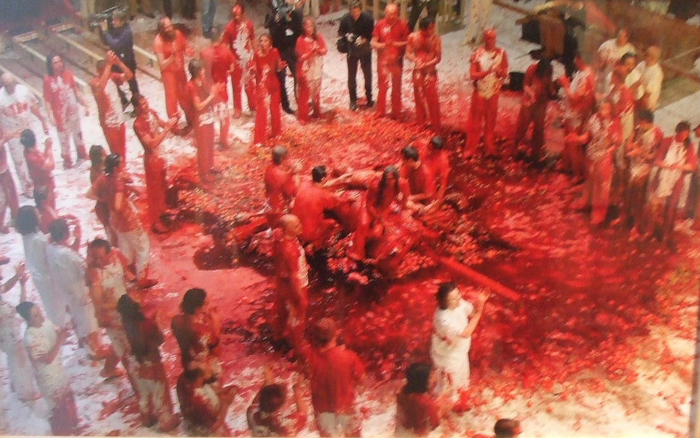
Christians who justify modern secular militarism and imperialism with Old Testament "holy wars" also use Romans 13 as an excuse for war in our day. This too is a mistake.
| The word “sword”[1] in the Bible does not usually (if ever) refer to individual penal sanctions (e.g., “capital punishment”). When the Bible says God is going to send “the sword” against a people, the reference is to an army, which will invade and plunder and/or take captive. The shedding of a criminal’s blood[2] performed the functions of all other ritual acts of bloodshed, prefiguring the atonement for sin secured by Christ’s blood in His execution.[3] “The Sword” often refers to national “capital punishment” (i.e., a shedding of blood[4]), which is the sacrifice of a sinful people who will not accept the Lord’s sacrifice and righteousness by faith. The sword of vengeance, which belongs to God[5], is the warfare whereby God slaughters a disobedient people in a fiery sacrifice,[6] relegating these idolatrous self-sacrifices and their dreams of Empire to the “dung-heaps” of history.[7] | 1. cf. Romans 13:4 2. Genesis 9:4-6 3. Numbers 35:31,33; Deuteronomy 21:1,9 4. Ezekiel 35:5-6 5. Romans 12:17-21; #81: 6. Deuteronomy 32:43 [NIV]; Judges 20:40; Isaiah 34:5-8; Jeremiah 46:10; Ezekiel 39:17-20; Zephaniah 1:7-8; Matthew 23:35 + Revelation 19:3 7. Exodus 29:14; Leviticus 16:27; Zephaniah 1:17-18 |
For Further Reading:
www.GodandtheDeathPenalty.com
God Ordains Evil
Is War Ever "Just?"
This
thesis is a linchpin.
If true, it destroys both war and capital punishment as legitimate functions of "the State," and effectively destroys the necessity or even legitimacy of "the State."
If false, it
is still true that all legitimate social functions (which would include vengeance, war, and capital punishment if this
thesis is false) can be carried out by the Family (patriarchy) in a Freed Market rather than the State (polis).
What follows are excerpts from leading "Christian Reconstructionists" showing that "holy war" was priestly and religious ("ceremonial"), not secular/civil.
Gary North,
Inheritance and Dominion
An Economic Commentary on Deuteronomy
LIMITS TO EMPIRE
The Whole Burnt Offering and Disinheritance
The Israelites were told to show no mercy to the nations inside Canaan's boundaries (Deut. 7:16). These nations had practiced such great evil that they had become abominations in the sight of God. "For all that do these things are an abomination unto the LORD: and because of these abominations the LORD thy God doth drive them out from before thee" (Deut. 18:12). The language of Deuteronomy 20:10-18 indicates that every living thing inside the boundaries of Canaan was to be killed: "thou shalt save alive nothing that breatheth." With respect to the first city to fall, Jericho, this law applied literally (Josh. 6:15-21). But it did not apply literally to the other cities of Canaan. After the destruction of Jericho, the first city inside Canaan to be defeated, cattle became lawful spoils for the Israelites. "And thou shalt do to Ai and her king as thou didst unto Jericho and her king: only the spoil thereof, and the cattle thereof, shall ye take for a prey unto yourselves: lay thee an ambush for the city behind it" (Josh. 8:2). The word "breatheth" did not apply to Canaan's cattle; it applied only to the human population. "And all the spoil of these cities, and the cattle, the children of Israel took for a prey unto themselves; but every man they smote with the edge of the sword, until they had destroyed them, neither left they any to breathe" (Josh. 11:14).
Jericho was the representative example of God's total wrath against covenant-breakers who follow their religious presuppositions to their ultimate conclusion: death.(3) Jericho came under God's total ban: hormah.(4) This was the equivalent of a whole burnt offering: almost all of it had to be consumed by fire. In the whole burnt offering, all of the beast was consumed on the altar (Lev. 1:9, 13), except for the skin, which went to the officiating priest (Lev. 7:8). Similarly, all of Jericho was burnt except for the precious metals, which went to the tabernacle as firstfruits (Josh. 6:24).(5) Nevertheless, because God wanted His people to reap the inheritance of the Canaanites, He allowed them to confiscate the cattle and precious goods of the other conquered Canaanite cities. This illustrated another important biblical principle of inheritance: "A good man leaveth an inheritance to his children's children: and the wealth of the sinner is laid up for the just" (Prov. 13:22). Canaan's capital, except in Jericho, was part of Israel's lawful inheritance. The Canaanites had accumulated wealth; the Israelites were to inherit all of it. This comprehensive inheritance was to become a model of God's total victory at the end of history. Their failure to exterminate the Canaanites, placing some of them under tribute instead (Josh. 16:10; 17:13), eventually led to the apostasy of Israel and the Assyrian and Babylonian captivities, just as Moses prophesied in this passage (vv. 17-18; cf. 7:1-5; 12:30-31).
The annihilation of every living soul in Canaan was mandatory. "And thou shalt consume all the people which the LORD thy God shall deliver thee; thine eye shall have no pity upon them: neither shalt thou serve their gods; for that will be a snare unto thee" (Deut. 7:16). This was a model of God's final judgment. But it was a model in the same way that Jericho was a model: a one-time event. Jericho was to be totally destroyed, including the animals; this was not true of the other cities of Canaan. Similarly, the Canaanites were to be totally annihilated; this was not true of residents of cities outside Canaan. In this sense, Jericho was to Canaan what Canaan was to cities outside the land: a down payment ("earnest") on God's final judgment -- final disinheritance -- at the end of time. This earnest payment in history on the final disinheritance is matched by the earnest payment in history on the final inheritance. This is surely the case in spiritual affairs.(6) Debates over eschatology are debates over the extent to which these earnest payments in history are also cultural and civilizational, and whether they image the final judgment, i.e., to what extent history is an earnest on eternity.(7)
James B. Jordan
Judges: God's War Against Humanism
Hormah
17. Then Judah went with Simeon his brother, and they struck the Canaanites living in Zephath, and utterly destroyed it. So the name of the city was called Hormah. Now we see Judah making good her bargain with Simeon. The destruction of Canaanite Zephath was total, so that the place was called Hormah.
This is not the only “Hormah,” for we read in Numbers 21:1-3 of a place that was also “devoted to destruction,” and as a result was called Hormah.
Hormah means “placed under the ban, totally destroyed.” To be placed under the ban is to be devoted to death. Just as the Nazirite was devoted to God in life (for instance, Samson, Samuel), so the banned person or city was devoted wholly to God in death. To put under the ban means to curse and to devote to total destruction.
The preeminent example of a city devoted to total destruction is Jericho, the story of which is recorded in Joshua 6:15-19. Everything living was to be killed, all the treasures brought to the house of God, and the city was to be burned with fire. No personal booty was allowed.
More light is shed on this matter in Deuteronomy 13:12-18. The apostate city is to be banned, and “then you shall gather all its booty into the middle of its open square and burn the city and all its booty with fire as a whole burnt sacrifice to the LORD your God; and it shall be a ruin forever. It shall never be rebuilt” (v. 16).
From this we learn that it was God’s fire, lit by Himself from heaven (Lev. 9:24; 2 Chron. 7:1), kept burning perpetually on the altar, which was used to ignite the city placed under the ban. (See also Gen. 22:6 and 1 Ki. 18:38.) The fact that God starts His fire shows that the sacrifice is His sacrifice, the sacrifice that He Himself provides to propitiate His own fiery wrath. Man has no hand in it, and only an ordained priest may handle it. Man is impotent in his salvation, so that man cannot even light the sacrificial fire. If he dares to do so, God destroys him (Lev. 10:1-2).
All men stand on God’s altar. Those who accept God’s Substitute, the very Lamb of God, Jesus Christ, can step off the altar and escape the fire. Jesus takes the fire for them. He becomes the whole burnt sacrifice. Those who refuse the Substitute, however, are left on the altar, and are burnt up by the fire of God. (See Gen. 19:24; Rev. 18:8; Rev. 20:14f.; and for further study, Heb. 12:29; Ex. 3:2-5; Heb. 12:18; Num. 11:1-3; Num. 16:35; Num. 21:6; Gen. 3:25; 2 Pet. 3:9-12; Rev. 8:3-5).
Thus, the destruction of Hormah was a priestly act, issuing from the flaming swords of the cherubic (priestly) guardians of the land, a revelation of God’s direct fiery judgment against the wicked. Not every city was to be destroyed in this fashion, but certain ones were, as types of the wrath of God. This horrible judgment, introduced here at the beginning of Judges, comes again in Judges 20:40, when it is an apostate Israelite city that is burnt up as a sacrifice to God.
- R. J. Rushdoony argued that Exodus 30 -- a man's payment of half a shekel upon reaching age 20 -- was a head tax. He was incorrect. The payment went to the priests, not to a civil magistrate ("captain"). The tip-off was that it was calculated as a shekel of the sanctuary, which was a separate, ecclesiastical coin. This was blood money. It was paid on a man's entry into God's holy army, which was both priestly and civil. I discuss this in Chapter 32 of Tools of Dominion: The Case Laws of Exodus (1990).
(That the army was "priestly" can be seen directly from Scripture. That the army was "civil" may be reading modern categories into the text.)
- The military was not necessarily a state function over against a Church function in the Old Covenant. Indeed, holy war was a specifically priestly function. The torching of cities is to be understood as taking God's fire off from His altar and applying His holy fiery wrath to his enemies. Thus, the torched cities were called "whole burnt sacrifices" in the Hebrew Old Testament (Deut. 13:16; Judg. 1:17, 20:40, in Hebrew). During the holy war, the men became temporary priests by taking the Nazirite vow (Num. 6; 2 Sam. 11:11 + Exo. 19:15; Deut. 23:9-14; Judg. 5:2, "That long locks of hair hung loose in Israel. . ."). This is all to say that the rendering of specific judgments is a sabbatical and priestly function, not a kingly one.... The sword of the state executes according to the judgments rendered by the priests....
Thus, the military duty is priestly, and a duty of every believer-priest. Both Church and state are involved in it, since the Church must say whether the war is just and holy, and the state must organize the believer-priests for battle. The mustering of the host for a census is, then, not a "civil" function as opposed to an ecclesiastical one, and the atonement money of Exodus 30 is not a poll tax, as some have alleged.
James Jordan, "Appendix D: State Financing in the Bible," in The Law of the Covenant, 231-32 (1984), at http://www.garynorth.com/freebooks/: HTML, DjVu.
related: Swords into Plowshares
That's a "Prima Facie" case against the State. I've never seen these arguments engaged. The traditional defense of "the State" is rooted in Natural Law, not Biblical Law. If you take the Bible seriously, those who occupy positions of political power should abdicate -- after preventing succession by abolishing their office entirely.
Traditional defenders of the State argue that this line of argument promotes "anarchism," and "everybody knows" that anarchism is chaos and is wrong.
The reply to this is simple:
The "Anarcho-Capitalist" objection to political "gods" has not been engaged and refuted.
Defenders of the "natural law" view of the State raise Romans 13, claiming that God would only require pacifism (submission and non-violence in the face of state violence) if the State is justified in its violence.
Anarcho-Capitalists respond:
"Civil Government" is a False god.
"Civil Law" is False Law
A moral Society depends on "Moral Law," not the shedding of blood by a "civil government."
The Westminster Divines failed to preserve the distinction between
Christian Civilization depends on Biblical Law (Jerusalem) Not "Natural Law" (Athens)
And it will come about in the last days
That the mountain of the House of the LORD
Will be established as the chief of the mountains
And it will be raised above the hills
And the peoples will stream to it.
And many nations will come and say,
"Come, let us go up to the mountain of the LORD
And to the House of the God of Jacob,
That He may teach us about His ways
And that we may walk in His paths."
For from Zion will go forth the Law
Even the Word of the LORD from Jerusalem.
Micah 4:1-7
Chapter 19 of the Westminster Confession says that the "sundry judicial laws . . . expired together with the State of Israel." Although the Larger Catechism cites numerous "judicial laws" as though they were still obligatory, Rushdoony says that Chapter 19 of the Confession makes "nonsense" of these citations, since "The main function of this re-introduction of the Mosaic law is to buttress the power of the state with the death penalty, the duty of obedience, and the like," not in a Theonomic manner, but in a statist manner following the legal philosophy of Greco-Roman law.
Rushdoony's critique is based on Van Til's "Theonomy-Autonomy" dichotomy, and Van Til's critique of "natural law." Background on "natural law" is essential to understand why non-Theonomic Reformers and Puritans were unBiblical.
Suppose a civil magistrate seeks to draft a criminal code regarding sexual conduct. Should the government's laws be based on Leviticus 18, or on the latest thinking from the Harvard Law School? Tragically, many Reformers and Puritans opted for Harvard, speaking in terms of "natural law" or "the law of Nations." This means the laws of Babylonians, Greeks, and Romans.
Leviticus 18 says that the gentile nations would be judged and destroyed if they did not act Theonomically. God's Law was not just for Israel. But the gentile nations didn't always agree with God's Law. Here is some evidence that the gentiles did not agree with God's Law on sexuality:
The Biblical Source of Western Sexual Morality
This might not surprise even anti-Theonomists, but the same is true for non-Christian political thought:
Greek Mythology: The Myth of Classical Politics
Getting government laws from these people is not just a "practical" mistake, it is rebellion against the Authority of God in His inscriptured Word.
This philosophical conflict has long been described as the conflict between Jerusalem (Christianity) and Athens (the Enlightenment). That was the title of Van Til's festschrift.
Gary North explains the foundational worldview assumptions of Roman culture:
(1) The legitimacy of homosexuality, especially the seduction of teenage boys by men over age 30;
(2) warfare as a man's supremely meaningful activity;
(3) polytheism;
(4) a personal demon as a philosopher's source of correct logic;
(5) slavery as the foundation of civilization;
(6) politics as mankind's only means of attaining the good life, meaning salvation;
(7) the exclusion of women from all aspects of public religion;
(8) the legitimacy of female infanticide.
The Harvard Law School contends that all of this "natural law" thinking is light-years more advanced than the "primitive" and "oppressive" laws of God in the Bible. And too many Reformers and Puritans agreed.
Defenders of "Christian Classical" education focus on humanists like Cicero or Socrates, who were critical of some of the worst features of Greco-Roman civilization, which Gary North lists above. These men do not represent Greco-Roman civilization as a whole; they are often critical of it. They do not base their criticisms on Biblical Law. Why do Christians identify with "classical" culture?
From the earliest church fathers to the most recent "process philosophy," Van Til built a body of work showing the compromise of Christians with unbelieving thought, primarily in the fields we call "philosophy" and "theology." Rushdoony applied Van Til's work to the State, and Gary North has done the same in the field of economics.
This is the big question in the "Theonomy Debate":
Is Natural Revelation Sufficient to Govern Culture?
Gary North,
Cooperation and Dominion: an Economic Commentary on Romans
Chapter 2, "The Work of the Law and Social Utility"
Natural Law Theory
Natural law theory originated after the conquest of the Greek city-states, first by Alexander the Great and then by Rome. Stoic political philosophers had to replace their theory of the autonomy of the polis and its laws. They wanted to find some theoretical foundation for their ethical system, which had previously relied on intellectual defenses based on the sovereignty of the polis. Natural law theory was their solution.(7)
Natural law theory assumes that there is a common logic among men. This common-ground logic is said to bind all men, so that by adopting it, we can persuade all rational men of truths regarding social and political ethics. Christian philosophers have adopted this idea. They have confused it with the work of the law written on all men's hearts, which is a doctrine of common-ground ethics, not common-ground logic. The main effect of natural law theory today has been to persuade Christians to abandon the Bible as the basis of civil law and to begin a quest for common civil laws and common civil sanctions.
The theoretical problem with natural law theory is that covenant-breakers suppress the truth in unrighteousness.(8) Their powers of reasoning have been negatively affected by sin. They begin with the assumption of their own intellectual autonomy. They cannot logically conclude from this assumption the existence of the absolutely sovereign God of the Bible and His binding law.(9) Natural law theory is a logical system that begins with the assumption of man's autonomy, which means that natural law theory has nothing in common with the assumption of God's sovereignty. Natural law theory assumes that covenant-breaking men can build and sustain a just society on the basis of natural laws, natural rights, and universal logic.
|
Natural law theory also assumes that sin and its effects have not adversely distorted the image of God in man. It assumes that fallen men do not actively suppress the truth. These two errors lead to a false conclusion, namely, that an appeal to common-ground logic can persuade fallen men. But if Paul was correct, how can natural men be persuaded to obey God, based on natural law theory? Paul entertained no such hope. "But the natural man receiveth not the things of the Spirit of God: for they are foolishness unto him: neither can he know them, because they are spiritually discerned" (1 Corinthians 2:14). God's law is spiritually discerned, but only by those who are spiritual -- and not even by very many of them, as the history of Christian political theory indicates. The work of God's law is naturally discerned to a degree sufficient to condemn men for disobeying it, but not sufficiently to enable them to build a biblically moral society. Paul makes it clear in Romans 1 that the natural man suppresses the testimony of creation regarding God the Creator, reinterpreting God to conform to his covenant-breaking interpretation of reality. Why should Christians believe that the natural man will not do the same thing with the work of the law written on his heart? Why should Christians believe that an appeal to natural law should be any more successful in bringing men to judicial truth than to theological truth?
Today, Christian scholars are among the few remaining defenders of natural law theory. Darwinism has undermined faith in natural law theory among most humanists. Autonomous, evolving nature is widely believed to offer no moral standards. Even the survival of a species is not a moral imperative. Darwinian nature has no moral imperatives. For Darwinism, there is no permanent natural law. Everything evolves, including ethics. Because man's social and physical environments change, says the Darwinist, any ethical standards that do not promote the survival of humanity must be abandoned if mankind is to survive, yet survival is not an ethical imperative of nature unless man somehow represents nature on behalf of . . . whom? Man? God? Nature?(10) There is no agreement among Darwinists regarding either the existence or the content of fixed ethical precepts that are derived from nature. Darwinian ethical systems are shaped by mankind's uniquely perceived requirement to survive in a constantly changing environment. This is the creed of social Darwinism, whether statist (e.g., Lester Frank Ward) or individualist (e.g., Herbert Spencer).(11) This is also the creed of free market economists, Rothbard excepted.(12)
Natural law theory is always an attempt to fuse Jerusalem and Athens. It is an attempt to reconcile autonomous man and the God of the Bible. No such reconciliation is possible. Because of God's common grace, covenant-breaking men are restrained in their suppression of the work of the law in their hearts. But, as they think more consistently with their presuppositions regarding God, man, law, consequences, and time, they become more hostile to the work of the law in their hearts. Logic does not persuade them.
7. Sheldon S. Wolin, Politics and Vision: Continuity and Innovation in Western Political Thought (Boston: Little, Brown, 1960), pp. 77-82. ^
9. This was a major argument in the philosophy of Cornelius Van Til. ^
10. The deeply religious movement known as the deep ecology movement specifically rejects the idea that mankind in any way represents nature or possesses legitimate authority over nature. A clear statement of this movement's views is Bill McKibben, The End of Nature (New York: Anchor Press/Doubleday, 1989). The book became a best seller. It has been translated into at least sixteen languages. ^
11. Gary North, The Dominion Covenant: Genesis (2nd ed.; Tyler, Texas: Institute for Christian Economics, 1987), Appendix A. ^
12. Rothbard defended the idea of permanent ethical standards, which he believed are derived from Aristotelian natural rights theory. Rothbard broke with Mises' utilitarianism and Hayek's social evolutionism. Murray N. Rothbard, The Ethics of Liberty (New York: New York University Press, [1982] 1998). On Hayek, see North, Dominion Covenant, Appendix B. ^
Natural law theory was born in a time of breakdown: the breakdown of faith in the Greek city-state. Alexander and then Rome had conquered them all. Stoic philosophers sought a substitute theory of the local religious rites-based theory of the city-state.
The substitute was a theory of universal mankind, an idea foreign to classical Greek politics. This universal humanity possesses a common reason, they argued. Common reason allows men to come to agreement about ethics and law. Natural law theory was an attempt by philosophers to provide legitimacy for a world empire.
Natural law theory died as a widely believed social philosophy when Darwin's theory of evolution through unguided natural selection destroyed intellectuals' faith in an ethically normative nature.
Today, only a few conservative social thinkers, a few Protestant conservatives, and followers of Murray Rothbard still proclaim faith in natural law theory as a ground for ethics and society.
WHAT'S THE PROBLEM?
Natural law theory has always suffered from the dualism of all Greek thought: law vs. change. The unchanging pure logic of Parmenides cannot be reconciled to the constant historical flux of Heraclitus. Greek philosophy never resolved this dualism. No humanist philosophy ever has, either.
The problem today is that the tiny handful of natural law theory defenders are trying to breathe life into a long-dead horse. They are wasting precious time. Natural law theory has never worked as the basis of any social order, but after Charles Darwin, the academic community abandoned natural law theory. Darwin taught that nature is impersonal and not normative. There is no universal ethics. There is only a constant struggle for personal survival. I have written about this in Appendix A of my book, The Dominion Covenant: Genesis.
Natural law theorists have yet to come up with a solution to this inconvenient fact: reason, meaning the never-proven, always sought-for "right reason" of natural law theory, has not led masses of people to adopt the same system of philosophy, ethics, or religion. Yet the theory rests on the assumption -- never proven -- that rational people can agree on these issues sufficiently to enable society to function both ethically and predictably, meaning rationally.
If the vast majority of men refuse to accept a concept of a fixed, universal common logic, let alone fixed, universal social and ethical laws, we cannot build a society based on natural law. This has always been true, but after Darwin's theory of natural selection, it has become more obvious to all but a handful of natural law defenders. They defend the idea of a universal theory of ethics and social order, the details of which have yet to be presented in a form that more than a few social theorists are willing to accept. Natural law theory requires logical universality to be true, yet the supposedly universal practical details of the system have never gained anything like a simple majority.
Christian social theorists (there are not many) are among the few remaining defenders of natural law theory. This is ironic, because natural law theory cannot be defended biblically. Paul wrote, "The natural man received not the things of the spirit of God" (I Corinthians 2:14a). He wrote that natural men turn to false Gods and suppress the truth that is in them (Romans 1:18-22). This undermines any theory of natural law for a consistently Christian society.
Natural law theory rests on these presuppositions, all of which are denied by the Bible: (1) the autonomy of man's mind; (2) the sufficiency of reason; (3) the autonomy of the universe; (4) the common ethics of all revealed religion. In short, the natural man does not need to receive the things of the spirit in matters of social theory and policy. In these areas, men do not need the things of the spirit, which are divisive. Natural men are therefore autonomous, and natural law theory rests on this presupposition.
POSSIBLE SOLUTIONS
We need a detailed history of natural law theory that reveals the perpetual conflict between fixed law ("Parmenides") and changing circumstances ("Heraclitus"). The book should demonstrate that natural law theory has always been afflicted by this unresolved dualism: law vs. flux, logic vs. history.
The Greeks did not solve this problem. The Greek city states exhausted themselves in continual warfare. Alexander the Great conquered them. Then Rome conquered the remains of his empire. Natural law theory was an attempt to provide meaning and hope in a world without the autonomous local Greek polis.
Show from the sources that Christianity imported natural law theory and tried to make it correspond to the Bible's revelational ethics. Show how the attempt failed because of (1) the conflict between biblical ethics and natural law categories, and (2) the inherent dualism of fixed rational law and historical flux.
The culmination of this failed attempt was Thomas Aquinas' philosophy. Show why the system he developed inevitably broke down: the Greek law vs. flux dualism and the Bible vs. Greek philosophy dualism.
Show why modern social theory since Edmund Burke has suffered from dualism: universal natural rights (French Revolution) vs. the constitutional rights of Englishmen or whoever (conservatism).
Show how Darwinism destroyed the acceptability of natural law theory among evolutionists.
WHERE TO BEGIN
Begin with the works of Cornelius Van Til. Start with In Defense of the Faith: A Survey of Christian Epistemology (In Defense of Biblical Christianity, Vol. 2). Then go to A Christian Theory of Knowledge. Or buy his CD-ROM, which is searchable: The Works of Cornelius Van Til.
For a survey of the dualisms in Greek, medieval, and modern (post-Kant) philosophy, consult Herman Dooyeweerd, In the Twilight of Western Thought (1960). For detailed discussions of specific philosophers and issues, consult his 4-volume study, A New Critique of Theoretical Thought (1953--58).
On the local religious rites-based origins of the Greek city-state, see Numa Denis Fustel de Coulanges, The Ancient City (1864).
On the breakdown of Roman philosophy, a standard treatment is Christianity and Classical Culture (1940), by Charles Norris Cochrane. It has been reprinted by Liberty Fund.
For late-medieval philosophy, a good introduction to its inherent dualism is the little-known book, Bradwardine and the Pelagians (1957), by Gordon Leff.
Then go to Otto von Gierke's standard book, Natural Law and the Theory of Society, 1500 to 1800 (1957).
On the substitution of the theory of evolution for natural law theory in economic theory, see my book (on-line, free), The Dominion Covenant: Genesis (1987), Appendix B.
Gary North
Boundaries and Dominion: An Economic Commentary on Leviticus
Chapter 14: Impartial Justice vs. Socialist
Economics
The issue of the absolute authority of God's specially revealed civil law challenges the competing theoretical structure of natural law, natural reason, and natural revelation. We need to ask: Can these three theoretical ideals serve as sufficient guides for establishing God's legal requirements? Or is direct revelation from the God of the Bible mandatory covenantally in the civil realm?
Let us take the easiest case to analyze. God told Adam that he was not to eat of the tree of the knowledge of good and evil. If natural law, natural reason, and natural revelation were sufficient to inform mankind of the judicial boundaries established by God, then why did God reveal to Adam this single binding law and its single negative sanction? Adam was morally perfect. His eyes were not yet blinded by sin. The creation was without blemish in Genesis 2. It did not yet provide misleading information to mankind. But God nevertheless revealed His law verbally to Adam. Why? Because natural law, natural reason, and natural revelation alone are not sufficient to enable men to know God's binding covenant law in its entirety. If this was true for Adam, then it is surely true today, since men possess only fallen reason, and the creation itself is under a curse.
Had God's civil laws been revealed in some way other than through direct verbal revelation to Moses by God, such as through the universal reason of mankind, there would have been no need for God to require that the whole law be read publicly in Israel every seventh year (Deut. 31:10-13). Men would already have known this requirement "rationally." But they did not know.(5) Then what do men know? They are responsible before God, so they must know something about God's law. Men always know enough about God's covenant law to get themselves condemned by God eternally -- the work of the law (not the law itself) written in their hearts (Rom. 2:14-15)(6) -- but not enough to enable them to build the kingdom of God in history. This is why those Christians who affirm natural law rather than biblical law as the sole authoritative moral standard for society almost always also explicitly deny that it is either possible or required by God that Christians build the kingdom of God in history as God's designated judicial agents.(7)
A Question of Judicial Subordination
The inherent ethical dualism of natural law theology has had catastrophic effects in history. The dualism between Bible-revealed personal Christian ethics and religiously neutral, universally perceivable civil law inescapably demobilizes Christians in society and simultaneously anoints pagans as the lawful interpreters of natural law. Ethical dualism inevitably places God's designated judicial agents -- Christians -- under the civil and cultural authority of Satan's designated judicial agents. Why? Because it places natural law, natural revelation, and natural reason above God's revealed law, His progressively restored creation,(8) and the mind of Christ (I Cor. 2:16).(9) There is no neutrality; there is always judicial hierarchy. Some law-order must be on top. Some transgressors of this law-order must be on the bottom. Christian natural law theorists in principle place a hypothetically neutral natural law on top and Christians on the bottom.
In the early stages of this cultural conquest by covenant-breakers, natural law theory is a highly useful tool for covenant-breakers in their epistemological and political disarming of Christians. The infiltrators applaud ethical dualism: separate ethical standards for believers and skeptics, but a common civil law-order for all. This common law-order must not be based on some "narrow" appeal to standards uniquely revealed in the Bible, an ethical handbook for covenant-keepers only. Dualism keeps Christians happily subservient to politically successful pagans in the name of Jesus. That is to say, dualism keeps Jesus covenantally subordinate to Satan on earth and in history. When Norman Geisler asks, "Whose ethical standard shall we use?" and immediately answers, "a moral law common to all men"(10) -- natural law for the natural man -- he has in principle delivered society into the hands of Satan's designated judicial agents in history. The natural man does not receive the things of the Spirit (I Cor. 2:14); therefore, the ethical dualist is logically compelled to affirm, the Holy Spirit has nothing judicially binding to say or do with society and politics. If He did, then the natural man, not being able to receive the things of the Spirit, would be spiritually unreliable to exercise civil authority. Political pluralism rests philosophically on ethical dualism, for it asserts the legitimacy of common citizenship based on religiously neutral civil law. Ethical dualism necessarily asserts the judicial irrelevance of the Holy Spirit to both social theory and political theory. For almost two millennia, ethical dualism has been the dominant outlook of the church's main spokesmen.(11)
There is no neutrality. The ethical dualist denies this with respect to civil law. By elevating natural law, natural reason, and natural revelation above God's inspired word for the purpose of establishing social and political theory, the Christian ethical dualist has anointed the covenant-breaker as the lawful master of the covenant-keeper in every area of life outside the four walls of the Christian church and the Christian family. But the consistent covenant-breaker is not about to honor these two fragile, judicially unprotected institutional boundaries, any more than Pontius Pilate honored the innocence of Jesus Christ against the Pharisees' court.
Here is the problem: Christian ethical dualists keep insisting, century after century, that the Pilates of this world are judicially reliable. The Pilates of this world are supposedly not in need of personal regeneration and the revelation of the Bible in order to carry out their lawful and judicially neutral cultural mandate in history. On the contrary, we are assured, they need only be faithful to "ancient Hindu, Chinese, and Greek writings," to cite Dr. Geisler's recommended primary sources.(12) This is why Christian ethical dualists are at war with biblical civil law, biblical civil sanctions, and covenantal postmillennialism.(13) Christian natural law theorists implicitly offer this daily prayer to God: "Thy kingdom not come, thy will not be done in earth as it is in heaven." (Unless, of course, they become really consistent and argue that natural law in principle should rule in heaven, too. Then their prayer becomes: "Thy kingdom come, thy will be done in heaven as it is on earth." We do not find such consistent ethical dualists.)
6. John Murray, The Epistle to the Romans, 2 vols. (Grand Rapids, Michigan: Eerdmans, 1959), I, pp. 72-76.
7. I have in mind all Protestant ethical dualists, from Martin Luther to Norman Geisler. Luther was amillennial; Geisler is premillennial-dispensational; both deny that God's kingdom can triumph in history through the Spirit-backed efforts of Christians. On Luther's ethical dualism between Christian ethics and civil ethics, see Charles Trinkaus, "The Religious Foundation of Luther's Social Views," in John H. Mundy, et al., Essays in Medieval Life (Cheshire, Connecticut: Biblo & Tannen, 1955); Gary North, "The Economics of Luther and Calvin," Journal of Christian Reconstruction, II (Summer 1975), pp. 76-89. On Geisler's equally dualistic ethics, see Norman L. Geisler, "Natural Law and Business Ethics," in Richard C. Chewning (ed.), Biblical Principles and Business: The Foundations (Colorado Springs: NavPress, 1989), pp. 157-74. Geisler explicitly identifies the work of the law (Rom. 2:14) with natural law: ibid., p. 158. God holds all men responsible for their acts; hence, Geisler concludes, if some men do not know about God's revealed law, God cannot lawfully condemn them. "If there is no natural law," Geisler says, "God is unjust." Ibid., p. 160. Geisler misunderstands biblical justice. Natural law, natural reason, and natural revelation are sufficient to condemn every sinful person to hell and the lake of fire, but they are insufficient to enable people to build the kingdom of God. God's system of sanctions for the reprobate is simple and clear: "Heads, I win; tails, you lose." For proof, see Romans 9:10-21.
8. Gary North, Is the World Running Down? Crisis in the Christian Worldview (Tyler, Texas: Institute for Christian Economics, 1988).
9. The mind of Christ is imputed to His people at the time of their conversion, and it is progressively revealed in history, both individually and corporately, through their covenantal faithfulness. Anyone who denies this progressive, corporate, intellectual sanctification must also deny the progress of the church's various theological confessions. I know of no Christian who is willing publicly to deny the progress of the confessions at least through 1647 or 1788.
10. Geisler, "Natural Law and Business Ethics," p. 157.
11. The main exceptions historically were the New England Puritans of the first generation, 1630-60. On their theocratic legal theory, see Charles Lee Haskins, Law and Authority in Early Massachusetts: A Study in Tradition and Design (New York: University Press of America, [1960] 1985).
12. Geisler, "Natural Law and Business Ethics," p. 158.
13. Gary North, Millennialism and Social Theory (Tyler, Texas: Institute for Christian Economics, 1990), ch. 12: "Our Blessed Earthly Hope in History."
See this: Little Things Everywhere
Powerful Essay by Gary North: Greek Mythology: The Myth of Classical Politics
American Vision / Gary DeMar
Question No. 6
ISN'T NATURAL LAW RATHER THAN BIBLICAL LAW
THE STANDARD OF RIGHTEOUSNESS FOR
THE NATIONS?
From Christian Reconstruction: What It Is, What It Isn't, by Gary DeMar
Norman L. Geisler, an ardent opponent of Christian Reconstruction, wants us to believe that "Government is not based on special revelation, such as the Bible." Instead, he maintains, "it is based on God's general revelation to all men.... Thus, civil law, based as it is in the natural moral law, lays no specifically religious obligation on man."1 According to Geisler, civil governments are obligated to follow only natural law.
What is natural law? As one might expect, there are numerous definitions of natural law depending on which tradition one turns to. Should we follow the natural law system advocated by Cicero, Plato, Sophocles, Aristotle, Aquinas, Montesquieu, Blackstone, Grotius, Pufendorf, or Locke? After taking all of the systems into account, the following definition adequately represents the many natural law theories: "Natural law theory rests on the assumption that man has an innate quality - reason which enables him to perceive and live by natural laws which are 'self-evident truths' manifested in our natural surroundings."2
1. Geisler, "Dispensational Premillennial View of Law and Government," in J. Kerby Anderson, ed., Living Ethically in the 90s (Wheaton, IL: Victor Books, 1990), p. 157.
2. Rex Downie, "Natural Law and God's Law: An Antithesis," The Christian Lawyer IV, 4 (Winter 1973). Republished in The Journal of Christian Reconstruction, V, Symposium on Politics, ed. Gary North (Summer 1978), pp. 81-2.
But there is a problem. While the above definition might work in a Christian context, where people generally understand (1) that rebellious man's autonomous reason should not be trusted, and (2) that there are certain absolute values. In non-Christian cultures, righteous natural law is an impossibility. The reason? As the late Chief Justice Fred M. Vinson declared, in expressing the implication of a consistent evolutionary theory of law and justice, "Nothing is more certain in modern society than the principle that there are no absolutes. . . ."3 Natural law depends on an existing theological framework that takes into account God's sovereignty and ethical absolutes.
In addition there are several other problems with a natural law ethical position. First, how does one determine what laws found in general revelation are natural laws that conform to God's will? Is it possible that Christian natural law advocates are using the Bible as a grid in the construction of their natural law ethic? But what grid is being used by non-Christians? In a consistently evolutionary system, there can be no natural law, only evolving law determined by those presently in power, usually the State.
Second, how do we get people to agree on the content of "natural law" and how these laws should apply? Do we opt for a lowest common denominator type of law like "Do good to all men"? Should we agree that murder is wrong but not war and capital punishment since each of these would violate the general law of "do good to all men"? Does natural law, for example, tell us that abortion is wrong?
Third, what if we find a common set of laws in "nature" that contradict the Bible? As we will see below, polygamy can be supported as a natural law ethic, as can slavery, since most nations from time immemorial have practiced both. Would we, if we followed natural law, give up monogamy for polygamy? Would we give up freedom for slavery?
3. Dennis v. United States, 341 U.S. 494 (1951) at 508 in Eugene C. Gerhart, American Liberty and "Natural Law" (Boston, MA: The Beacon Press, 1953), p. 17. Time magazine commented July 23, 1951, pp. 67-68): "Whatever the explanation, Kentuckian Vinson's aside on morals drew no dissent from his brethren on the supreme bench. And no wonder. The doctrine he pronounced stems straight from the late Oliver Wendell Holmes, philosophical father of the present Supreme Court." Quoted in ibid., p. 165, note 2.
Fourth, what if a "natural law" agrees specifically with a biblical law that is religious? For example, nearly all nations have some prohibition against worshipping other gods (e.g., Daniel 3:1-30). After Nebuchadnezzar realized the error of his ways in requiring the Israelites to bow down to a false god, he then made a law that prohibited anyone from speaking "anything offensive against the God of Shadrach, Meshach and Abednego" (v. 29). The penalty was pretty stiff: They "shall be torn limb from limb and their houses reduced to a rubbish heap" (v. 29). If Nebuchadnezzar turned to the Bible for the construction of this law, then his example would be proof that biblical law was applied to a non-Israelite nation. Since, as Geisler maintains, "civil law, based as it is in the natural moral law, lays no specifically religious obligation on man,"· Nebuchadnezzar must have been acting out the dictates of a natural law ethic. Therefore, magistrates, based on biblical law or natural law, could punish people for overtly religious crimes against Jehovah. But this is the one thing that natural law advocates do not want.
Fifth, natural law "does not furnish a specific consensus of ethical judgment."5 Ultimately, it comes down to "what the individual conscience dictates; and consciences differ."6 In order for natural law to function in any rational and workable way, there must be a generally held common belief system. When Catholic scholars, the foremost advocates of natural-law theory, made the State subject to natural law, there existed, in the words of Woodrow Wilson, a "common devotion to right.'" But what is the source of that "common devotion to right"? What if that "common devotion to right" is no longer accepted by rulers and the courts?
Sixth, and finally, let us suppose that we can derive a body of law from nature. This would only tell us what the law is, or actually, what might be. Can we determine what we ought to do from what is or might be right?
4. Geisler, "A Premillennial View of Law and Government," p. 157.
5. William Aylott Orton, The Liberal Tradition (New Haven, CT: Yale University Press, 1945), p. 95. Quoted in Gary North, Political Polytheism: The Myth of Pluralism (Tyler, TX: Institute for Christian Economics, 1989), p. 126.
6. Idem.
7. Quoted in Orton, idem.
Why have some Christians opposed biblical law in favor of "natural law"? Norman Geisler writes: "In brief, because not everyone accepts the Bible, but no one can avoid natural law, which is 'written on [the] hearts' of all men (Rom. 2:14-15). Only believers accept the Bible. But business must be done with unbelievers. Therefore, it is necessary for us to have some common ethical ground on which to engage in commercial transactions with them."8 There are numerous unproven assumptions here, but the two most glaring ones are (1) "not everyone accepts the Bible" and (2) "but no one can avoid natural law." Does everyone have to accept a standard before it is legitimate or it can be enacted into law? What if the majority of the people do accept the Bible? Would this mean that a nation could then implement biblical laws over natural laws? Aren't Christians told to "disciple the nations," to teach the nations all that Jesus commanded? Instead of avoiding the Bible, why not make it a point of discussion, showing unbelievers that the Bible has answers to all of life's problems. We could just as easily assert that not everyone accepts natural law (which is true). Does this then nullify Geisler's natural law ethic?
8. Norman L. Geisler, "Natural Law and Business Ethics," Biblical Principles and Business: The Foundations, ed. Richard C. Chewning (Colorado, CO: NavPress, 1989), p. 157.
Let us put Geisler's second assertion to the test. He would maintain that prohibitions against murder are natural laws. If "no one can avoid natural law," then why do people still murder? And when there was a prevailing biblical ethic in this nation, we had fewer murders, rapes, thefts, drug related crimes, illegitimate births, abortions, etc. People murder because they want to murder regardless what any law states, including biblical law and most certainly natural law. But because biblical law has sanctions attached to it - both temporal and eternal - there are more reasons not to murder under a system of biblical law than under natural law.
If the natural law is a law in the legal sense, what are its sanctions? ... [S]ince a law without punishment is vain, there must be another world to inflict it. Scholastics ... appear to depend on the Christian commonwealth, whose civil law is bound to reflect the natural law, to punish overt breaches. This was not unrealistic as a theory among Christian states in the days when rulers and inhabitants alike were at least technically Christian, but difficulties occurred when it came to expecting pagan kings to punish breaches of the natural law. This problem confronted the sixteenth-century Spanish Thomists, who were most unwilling to grant Christian kings rights of intervention in pagan kingdoms to punish "crimes against nature", and found themselves reduced to hoping for native kings to act in their stead in suppressing long-standing customs like human sacrifice.9
So then, it was expected that a Christian commonwealth would be necessary before such a natural law ethic could actually be implemented. No such trust could be expected of pagan kings since human sacrifice might still be considered normative by them.
9. Bernice Hamilton, "Some Arguments Against Natural Law Theories," Light on the Natural Law, ed. Illtud Evans (Baltimore, MD: Helicon Press, 1965), pp. 44-45.
We have had in our nation a prominently displayed biblical ethic that gave guidance to all citizens, Christians and non-Christians alike. America was a beacon to the world because it had an operating biblical ethic: In theory, everyone was treated as equal before the law, and that law was essentially biblical. In fact, there has been a concerted effort to move our nation away from an explicitly biblical ethical system. Regularly biblical laws are overturned and replaced with atheistic laws. This is true with sodomy and abortion. Take abortion. The Supreme Court in Roe v. Wade rejected Christian teaching regarding abortion, and turned instead to "ancient attitudes." These "ancient traditions" were accepted over the "emerging teachings of Christianity," teachings that were thought to have influenced the adoption of the Hippocratic Oath. The Court surmised that the anti-abortion Hippocratic Oath would never have been adopted by the medical community if Christianity had not dominated the culture. Since "ancient religion did not bar abortion," as the majority opinion in Roe determined, therefore, abortion would have to be legalized. And what were these "ancient traditions"?: Greek and Roman legal traditions that rested on natural law.10
Would our nation have Sunday as a day of rest and worship if we adopted natural law over biblical law? Even the Constitution follows biblical and not natural law in its regard for Sunday as a special religious day: "If any Bill shall not be returned by the President within ten Days (Sundays excepted) after it shall have been presented to him, the Same shall be a Law...." (Article I, section 7). Would a natural law ethic permit religious oath-taking? No! Florida no longer requires Notaries to affirm "so help me God" on their written oath of office. The Rev. Gerard LaCerra, chancellor of the Archdiocese of Miami understands the implications of such an action: "What are we supposed to base our commitments on if something like this is removed? The State?"11 This is where natural law leads us.
10. Curt Young, The Least of These: What Everyone Should Know about Abortion (Chicago, IL: Moody Press, 1983), pp. 21-23.
11. "'God' Removed from Notaries' Oath," The Kansas City Star (February 18, 1990), p. 2A "The general situation in this country is that in all court proceedings witnesses may give testimony only after they have qualified themselves by taking an oath in the usual form ending with 'So help me God,' or by making an affirmation without that phrase. The provisions for witnesses generally apply also to jurors." Anson Phelps Stokes and Leo Pfeffer, Church and State in the United States, rev. one-vol. ed. (New York: Harper & Row, 1964), p. 490.
Some assert, using natural law as their operating principle, that the "celebration of Eros and the unlimited pleasure of the body should be elevated to constitutional principle."12 Are any and all sexual practices legitimate under natural law? As nations become officially atheistic, a natural law ethic free from biblical influence becomes impossible to formulate, since natural law requires the existence of a Creator who has a law to deposit in the universe and in the heart of man. How can a natural law ethic be formulated when different traditions come to the formulating table with contrary presuppositions? Some are Christian, religious, agnostic, and atheistic. Those who believe in God at least have some common ground, although what god we have in common is another question altogether. When the agnostic and atheist come, the difficulties multiply in trying to prove a natural law theory, especially in the area of particulars.
12. Robert H. Bork, The Tempting of America: The Political Seduction of the Law (New York: The Free Press, 1990), p. 210.
The reason for this difficulty seems to be that for those who really believe in creation and the supreme dominion of God, the principle is too obvious to need proof; whereas for those who do not believe in creation there is no basis on which to build proof.13
A natural law basis for moral behavior can be developed only when there is an already-operating biblical ethic. William Blackstone, the great English Jurist of the eighteenth century, wrote that natural law must be interpreted in terms of the revealed law, the Bible. "If we could be as certain of the latter [natural law] as we are of the former [revealed law], both would have an equal authority; but, till then, they can never be put in any competition together."14 The Bible shaped Blackstone's conception of natural law, although he rarely referred to the Bible in his commentaries.15 But this in itself might be indicative of how pervasively a biblical ethic influenced him.
13. Gerard Kelly. Medico-Moral Problems (Dublin: Clonmore and Reynolds, 1955), p. 167. Cited in Daniel Callahan, Abortion: Law, Choice and Morality (New York: Macmillan, 1970), pp. 310-11.
14. William Blackstone, Commentaries on the Laws of England, 4 vols. (Chicago, IL: University of Chicago Press [1765] 1979), vol. 1, p. 17.
15. North, Political Polytheism, pp. 322-24.
Could there ever be a prohibition, for example, against polygamy based on natural law? While the Bible tolerated polygamy and established laws to govern it to protect the family unit, it never condoned it (Genesis 2: 18-24; Leviticus 18: 18; 1 Corinthians 7:2; 1 Timothy 3:2). Many in Israel, including such rulers as Gideon, David, and Solomon, adopted the polygamous practices of the surrounding nations. Of course, polygamy began soon after the fall (Genesis 4: 19, 23; 26:34; 28:9; 29: 15; 36:2; 1 Samuel 1:1-2). "Polygamy has always been odious among the northern and western nations of Europe, and, until the establishment of the Mormon Church, was almost exclusively a feature of the life of Asiatic and of African people. In common law, the second marriage was always void (2 Kent, Com. 79), and from the earliest history of England polygamy has been treated as an offence against society."16 Polygamy was denounced in Christian nations and practiced in non-Christian nations. Typically, "Asiatic" and "African" nations were non-Christian. Their practice of polygamy was "natural." With the advent of Christianity, monogamy was the practice and the Bible was the standard, not natural law.
The Supreme Court narrowly defined the legal protections of the First Amendment to exclude polygamy on the grounds that the practice was out of accord with the basic tenets of Christianity: "It is contrary to the spirit of Christianity and the civilization which Christianity has produced in the Western world."17 A year earlier the Court declared that "Bigamy and polygamy are crimes by the laws of all civilized and Christian countries. . . . To call their advocacy a tenet of religion is to offend the common sense of mankind."18
So with the above in mind, what common ground do Christians and non-Christians have regarding the law? The evolutionist knows nothing of natural law. His system will not allow it. Law is an evolving principle like the universe itself. Roscoe Pound, a former Harvard law school dean, wrote "that 'nature' did not mean to antiquity what it means to us who are under the influence of evolution."19 In "antiquity," nature was thought to have been created by God and thus ran according to certain "natural laws" (even though that god was a pagan deity). What many Christians regard as "natural laws" are in reality God's eternal decree.
16. Reynolds v. United Stales, October 1878.
17. Late Corporation of the Church of Jesus Christ of Latter- Day Saints v. United States, 136 U.S. 1 (1890).
18. Davis v. Beason, 133 U.S. 333, 341-342 (1890). Cited in John Eidsmoe, The Christian Legal Advisor (Milford, MI: Mott Media, 1984), p. 150.
19. Roscoe Pound, Introduction to the Philosophy of Law (New Haven, CT: Yale University Press, [1922] 1959), p. 31. Cited in John W. Whitehead, The Second American Revolution (Westchester, IL: Crossway Books, [1982] 1985, p. 48.
The introduction of the concept of "Nature" and natural law, derived from Hellenic philosophy, led to a departure from biblical faith. Natural law spoke of a self-contained system of its own inherent law. One of the products was Deism, which reduced God to the mechanic who had created "Nature," and now "Nature" functioned independently of God. The next step was to accept the ultimacy of "Nature" and to drop God entirely.20
There was predictability in the created order because God decreed all that comes to pass. The created order, what is erroneously described as "nature,"21 was understood to be affected by the fall of man into sin. Special revelation was needed to correct the distortions of a creation disfigured by sin. With the advent of evolution, a new understanding of nature developed that supplanted the one of "antiquity." According to Roscoe Pound, "no current hypothesis is reliable, as ideas and legal philosophies change radically and frequently from time to time."22
20. Rousas J. Rushdoony, The Mythology of Science (Nutley, NJ: The Craig Press, 1967), p. 97.
21. Rousas J. Rushdoony writes that " 'Nature' is simply a collective name for an uncollectivized reality; the myth of nature is a product of Hellenic philosophy." The Institutes of Biblical Law (Phillipsburg, NJ: Presbyterian and Reformed, 1973), p. 608.
22. Rene A Wormser, The Story of the Law (New York: Simon & Schuster, 1962), p. 485. Cited in Whitehead, The Second American Revolution, 48.
In addition to natural law, Geisler writes that "most premillenarians recognize that God has not left Himself without a witness in that He has revealed a moral law in the hearts and consciences of all men (Rom. 2:14-15)."23 Geisler asserts that the heart and conscience are repositories for an ethical code. But the heart of man "is more deceitful than all else and is desperately sick; who can understand it?" Jeremiah 17:9; cf. Genesis 6:5; 8:21; Psalm 14:1; Proverbs 6:14; 12:20; 14:12). General revelation may give a very clear ethical system, but man suppresses "the truth" of general revelation "in unrighteousness" (Romans 1:18).
23. Geisler," A Dispensational Premillennial View of Law and Government," p. 156.
Since man's reason is imperfect, and may be swayed by his physical and social environment, the "truths" which men "know" have been various and self-contradictory. The law of nature has been quoted for every cause, from that of Negro slavery in the United States to that of red revolution in Paris. And it has often shifted ground - or man's interpretation has shifted - on such thorny questions (for example) as private property.24
24. Herbert Agar, A Declaration of Faith (Boston, MA: Houghton Mifflin Company, 1952), p. 134.
But isn't "the work of the Law written" on the heart actually the law? (Romans 2: 15). "For when Gentiles who do not have the Law do instinctively the things of the Law, these, not having the Law, are a law to themselves, in that they show the work of the Law written in their hearts, their conscience bearing witness, and their thoughts alternately accusing or else defending them, on the day when, according to my gospel, God will judge the secrets of men through Christ Jesus" (Romans 2:14-16). The Gentiles, those without the written law found in the Bible, follow a law written on their hearts. It is the same law!
Second, general revelation contrary to Geisler, does lay a specifically religious obligation on man. According to Romans 1:18-32, which is the fullest biblical commentary on general revelation, men are guilty precisely because they "exchanged the glory of the incorruptible God for an image in the form of corruptible man and of birds and four-footed animals and crawling creatures" (v. 23). Where did they learn about "the incorruptible God"? "God made it evident to them. For since the creation of the world His invisible attributes, His eternal power and divine nature, have been clearly seen, being understood through what has been made, so that they are without excuse" (vv. 19-20).
Third, general or natural revelation and special revelation (Scripture) have the same moral content. But because of man's sinfulness and the deceitfulness of his heart, he needs an infallible guide to read natural revelation. The Bible is that infallible guide. The only safeguard that sinful man has in not misinterpreting and misapplying natural revelation "is to test his interpretations constantly by the principles of the written word."25
25. Cornelius Van Til, "Nature and Scripture," in The Infallible Word: A Symposium, eds. Ned B. Stonehouse and Paul Wolley (Grand Rapids, MI: Eerdmans, 1953), p. 274.
Paul says nothing to suggest that there is a difference in the moral content of these two revelations, written and natural. The written law is an advantage over natural revelation because the latter is suppressed and distorted in unrighteousness (Romans 1:18-25). But what pagans suppress is precisely the "work of the law" (2:14-15). Natural revelation communicates to them, as Paul says, "the ordinance of God" about "all unrighteousness" (1:29, 32). Because they "know" God's ordinance, they are "without excuse" for refusing to live in terms of it (1:20). What the law speaks, then, it speaks "in order that all the world may be brought under the judgment of God" (3:19). There is one law order to which all men are bound, whether they learn of it by means of natural revelation or by means of special revelation. God is no respecter of persons here (2: 11). "All have sinned" (3:23) -- thus violated that common standard for the "knowledge of sin" in all men, the law of God (3:20).-
Reconstructionists take God's revelation seriously: the law of God found in both Testaments and general revelation.
Did God, as Geisler maintains, place only the Israelites under obligation to the moral demands of those commandments specifically delivered to the nation through Moses? Are Gentile nations ever condemned for violating laws specifically given to Israel? If we can find just one law that fits into this category, then all nations are obligated to submit to God's special written revelation, the Bible. I will summarize the argument for you:
God gives a series of instructions to Moses for the people: "You shall not do what is done in the land of Egypt where you lived, nor are you to do what is done in the land of Canaan where I am bringing you; you shall not walk in their statutes. You are to perform my judgments and keep My statutes, to live in accord with them" (Leviticus 18:3-4). God then issues a list of Canaanite practices that were prohibited. He commands the Israelites not to engage in incest, polygamy, adultery, child sacrifice, profaning Jehovah's name, homosexuality, or bestiality (vv. 6-23). The Mosaic law outlawed all such behavior and severely punished it. Immediately following the long list of prohibitions, God's word describes what disobedience will bring: "Do not defile yourselves by any of these things; for by all these the nations which I am casting out before you have become defiled. For the land has become defiled, therefore I have visited its punishment upon it, so the land has spewed out its inhabitants. But as for you, you are to keep My statutes and My judgments, and shall not do any of these abominations, neither the native, nor the alien who sojourns among you; (for the men of the land who have been before you have done all these abominations, and the land has become defiled); so that the land may not spew you out, should you defile it, as it has spewed out the nation which has been before you" (Leviticus 18:24-28).
26. Greg L. Bahnsen, "What Kind of Morality Should We Legislate?," The Biblical Worldview (October 1988), p. 9.
The transgression of the very law which God was revealing to Israel was the same law which brought divine punishment upon the Gentiles who occupied the land before them. "Israel and the Gentiles were under the same moral law, and they both would suffer the same penalty for the defilement which comes with violating it - eviction from the land."27
27. Greg L. Bahnsen, "For Whom Was God's Law Intended?," The Biblical Worldview (December 1988), p. 9.
Gary North
Modern Christianity implicitly sings this hymn: "O, how hate I thy law; O, how hate I thy law; it is my consternation all the day." It is the offense of Christian Reconstruction that its promoters call upon all men to reconsider God's Bible-revealed law. This law is the only God-given, authoritative means of evaluation: self-evaluation first, and then the evaluation of everything else. God's law tells us what God thinks of the works of self-proclaimed autonomous man: "But we are all as an unclean thing, and all our righteousnesses are as filthy rags; and we all do fade as a leaf; and our iniquities, like the wind, have taken us away" (Isaiah 64:6). It is not a pretty self-portrait, so autonomous men refuse to look at it. Meanwhile, Christians today are afraid to mention its existence, out of concern for the sensibilities of autonomous men, with whom they have an unspoken alliance.7
7. See below, Chapter 9.
Nevertheless, covenant-breakers cannot escape the testimony of God in everything they think, see, and do. They know the truth, and they actively hinder it, to their own damnation. For the wrath of God is revealed from heaven against all ungodliness and unrighteousness of men, who hold [back] the truth in unrighteousness;8 Because that which may be known of God is manifest in them; for God hath shewed it unto them. For the invisible things of him from the creation of the world are dearly seen, being understood by the things that are made, even his eternal power and Godhead; so that they are without excuse: Because that, when they knew God, they glorified him not as God, neither were thankful; but became vain in their imaginations, and their foolish heart was darkened. Professing themselves to be wise, they became fools, And changed the glory of the uncorruptible God into an image made like to corruptible man, and to birds, and four-footed beasts, and creeping things. Wherefore God also gave them up to uncleanness through the lusts of their own hearts, to dishonour their own bodies between themselves: Who changed the truth of God into a lie, and worshipped and served the creature more than the Creator, who is blessed for ever. Amen (Romans 1:18-25).
8. Murray, Romans, I, pp. 36-37.
Each person is made in God's image. This is the common ground among men - the only common ground. We are born the rebellious sons of the Creator God. We are all of one blood: "God that made the world and all things therein, seeing that he is Lord of heaven and earth, dwelleth not in temples made with hands; Neither is worshipped with men's hands, as though he needed any thing, seeing he giveth to all life, and breath, and all things; And hath made of one blood all nations of men for to dwell on all the face of the earth, and hath determined the times before appointed, and the bounds of their habitation" (Acts 17:24-26). We are all born as God's disinherited children.
Christian Reconstructionists insist that there is no common ground among men other than this: the image of God. While all men know the work of the law (Romans 2:15), this knowledge is not enough to save them.9 It brings them under God's eternal wrath. They hinder in unrighteousness whatever truth they possess as men (Romans 1:18). The more consistent they are with their covenant-breaking presuppositions, the more they hate God's law and those who preach it. The more consistent they become with their rebellious view of God, man, law, and time, the more perverse they become. They prefer to worship creatures rather than the Creator:
For this cause God gave them up unto vile affections: for even their women did change the natural use into that which is against nature: And likewise also the men, leaving the natural use of the woman, burned in their lust one toward another; men with men working that which is unseemly, and receiving in themselves that recompence of their error which was meet. And even as they did not like to retain God in their knowledge, God gave them over to a reprobate mind, to do those things which are not convenient; Being filled with all unrighteousness, fornication, wickedness, covetousness, maliciousness; full of envy, murder, debate, deceit, malignity; whisperers, Backbiters, haters of God, despiteful, proud, boasters, inventors of evil things, disobedient to parents, Without understanding, covenant-breakers, without natural affection, implacable, unmerciful: Who knowing the judgment of God, that they which commit such things are worthy of death, not only do the same, but have pleasure in them that do them (Romans 1:26-32).
9. Ibid., I, pp. 74-76.
This means that natural law theory is a myth, the creation of Hellenistic Greek philosophers to offer hope in a world in which the Greek city-state (the polis) had fallen to Alexander the Great and then to Rome. But if natural law theory is a myth, what can take its place? To what other standard can men safely cling if they reject the abiding authority of God's law in history? Christian Reconstructionists have an answer: none. This answer is hated, rejected, and ridiculed by Christians in our day. This answer is the offense of Christian Reconstruction.
I.C.E. Cover Letter - May, 1995
May, 1995
Dear ICE Subscriber:
Earlier this year, I received a letter from the headmaster of a Christian high school. The school, he said, is committed to providing a classical education. He asked me if ICE could supply materials that would improve his curriculum. I wrote back to him that the most important thing he could do for his students is to scrap his curriculum.
Peter wrote: "But it is happened unto them according to the true proverb, The dog is turned to his own vomit again; and the sow that was washed to her wallowing in the mire" (II Peter 2:22). He was not writing about classical education, but he could have been.
Classical education undermines Christian orthodoxy. Christian orthodoxy has tried to make classical education Christian for over eighteen centuries, and it has always failed; the reverse always happens. Classical education is a Trojan horse: Greeks bearing gifts.
Classical education begins with a premise: the student must learn the classics. The classics are pagan: Greek and Roman literature and philosophy. They were based on the premise that man is the measure of all things, that man's reason is ultimate. The rational side of the Renaissance was based on the same premise. (Its irrational side was also a revival of Greek and Roman religion: occult, magical, and either chance-based or fatalistic.)
Medieval Scholasticism was as committed to the classics as the Renaissance was, though without classical occultism and pornography. The Scholastics were committed academically far more to Aristotle than to the Bible, especially in their political philosophy. They worshipped at Aristotle's shrine. Prior to the eleventh century, medieval theologians had worshipped at Plato's shrine: neoplatonic mysticism. The Scholastics substituted Aristotle for Plato. There was some gain — Aristotle at least was not a communist, as Plato was — but not in the realm of men's presuppositions. It was the equivalent of substituting Milton Friedman for Karl Marx: better economics, but the same old humanism. For humanism, man is the measure, and man's mind is the sole valid instrument of measurement. The Bible denies this view.
From the beginning, the medieval university was committed to classical education, and from the beginning, rationalism and irrationalism (mysticism) undermined the Christian roots of education. By the time of Cromwell and the Puritan Revolution of 1642-59, the Puritans suspected that the curriculum of Oxford and Cambridge was against them, yet they did not seek to change it. They hoped that inward salvation would somehow make Renaissance rationalism Christian. Cromwell changed nothing at Oxford, even though as Lord Protector, he was chancellor of Oxford. John Morgan writes in his survey of Puritan education, Godly Learning: Puritan Attitudes towards Reason, Learning and Education, 1560–1640 (Cambridge University Press, 1986):
Puritans did not venture far from the traditional academic routine. The structures of educational institutions, and the content as affected by Renaissance urgings, seemed to satisfy their need for an academic base. There can certainly be no doubt of the very limited effects of puritans to the legacy of the Renaissance, or in developing the human intellect in the Baconian sense of the `advancement of learning.' . . . A novel theory of learning or education lay outside the necessities of a puritan blueprint for the future (pp. 305–6).
To indulge in classical education is to indulge in Renaissance education. To force a child to learn Latin is to encourage him to accept the premises either of medieval Catholicism or the Renaissance. Yet today's would-be Puritans have accepted the error of those Puritans who built Harvard. Harvard went Unitarian in 1804. Christians know something is wrong with rationalism, yet they seem incapable of breaking with the past.
Van Til's apologetics should warn us: the history of Christian philosophy has been one long compromise with the philosophy of autonomous man. From Plato to Newton, from Newton to Kant, from Kant to some cast-off liberal fad, Christian philosophers have sought to baptize humanism. They hope to appropriate for Christ the anti-Christian philosophies of their day or an earlier day. They trust the natural mind of the natural man, refusing to acknowledge the enormous danger involved: the importation of alien philosophical categories into the Church. And so, without exception, Christians for over 1800 years have surrendered education, and therefore the future (inheritance), to the humanists.
What is the obvious sign of this surrender today? The futile attempt to revive Latin. Why force a child to master Latin rather than New Testament Greek? Greek will enable him to read the New Testament in the original — an obvious benefit. But what is the benefit of Latin? Except for the historian of the ancient or medieval eras — for whom there will be no paying employment — Latin is peripheral. Yet it is seen as the mark of true learning. Latin was the universal language of the Western Church, i.e., Roman Catholicism and early Protestantism. But that learning was deeply compromised with Renaissance humanism. At best, Latin will enable a tiny handful of highly skilled, highly motivated, and poorly paid Christian scholars to read fragments of the Latin Church fathers. Meanwhile, we live in an era in which the vast majority of Christians know nothing of Calvin, where Calvinist pastors have yet to read all of The Institutes of the Christian Religion, let alone Calvin's commentaries. Forget about Latin; teach the Institutes. Abandon the futile boast: "My child is receiving a classical education, just like the good old days." The good old days produced the bad new days, step by step. The assumption of intellectual neutrality is the Church's great enemy. Latin education was the primary agency used to spread this lie.
I see home school mothers who cannot read Latin, who have no intention of reading Latin, who are utterly uninterested in anything written only in Latin, buying Latin grammars to inflict on their hapless children. Why? Because somebody they trusted told them that "Latin is basic to a well-rounded education." To which I reply: "Latin was basic to the initiation process of pagan and/or deeply compromised academics to gain control over the training of each generation of Christian leaders in England and America." Latin was a wedge used to separate Christian children from their parents. In the same way that the sex education fanatics today devise ways to keep parents from finding out what teachers are really teaching the children, so was Latin for six or seven centuries. To open the doors of ecclesiastical office and government patronage to your child, Christian parents had to surrender him to the Latin-based curriculum, a curriculum that rested squarely on the autonomy of man. The child was initiated into classical humanism by way of Latin.
What is nothing short of astounding is that there are dedicated Christians today who insist on doing this to their children. They insist on reviving the tool of their ancient enemies in the name of traditional education. But traditional education was Satan's own tool for capturing the souls of Christians as well as their inheritance. Satan's agents abandoned that tool only late in the nineteenth century, when it became clear that mass education was going to make the traditional Latin school obsolete as an initiation process for the elite. At that point, the humanists substituted the modern curriculum, in which Latin plays no role. Latin has become a lost tool of learning. Let's keep it that way!
Is there a role for Latin? Only historical. If there were a self-conscious effort on the part of dozens of Christian schools to create a cooperative program for translating the 220 volumes of J. P. Migne's Latin Church Fathers, I would approve. But the cost — $65,000 for four CD-ROM disks, shared by four schools — is prohibitive. Christian schools do not have the funds or the vision to begin a project like this. Until they do, it is foolish to indulge in the waste of time that a Latin curriculum involves. The vast majority of children so initiated will learn only the equivalent of pigeon Latin. If a child cannot sight read a foreign language without a dictionary by age 14, then whatever benefits he has received from the exercise of learning that language are indirect, e.g., learning the rules of grammar. If someone is going to be forced to do this, then he should learn a language useful to Christians: Greek, first; Hebrew, second, and Latin only a distant third. But what do we see? Mostly Latin, with no Greek and no Hebrew. This is Renaissance pride in action.
What does your child really need? First, he must learn how to read early, so he will enjoy reading throughout his life. He must learn to read critically. This means he must also learn to write, for in writing, the student learns how others have communicated with him through the printed page. Reading and writing are complementary skills.
Second, he should gain a knowledge of the Bible. I prefer the King James Version, for these reasons: (1) the language is magnificent; (2) its unique phrases stick in the mind, making Bible study easier; (3) the Strong's numbers are tied to the King James, making serious Bible study easier, especially with a modern computerized Bible search program.
Third, he must master mathematics. Until there is a self-consciously Christian version of Saxon's math program available, we should go with Saxon, which emphasizes review and mastery. Fourth, anything else that interests him. Let him master a subject for the joy and experience of mastering it.
Christian education should be highly focused on a handful of topics: reading-writing, Bible, and mathematics. To force a child to take six courses per semester is both traditional and foolish if the child has not first mastered reading, writing, arithmetic, and the Bible. If he has mastered these, he can pick up the other courses in short order, such as by preparing through Advanced Placement exam cram courses.
Students can sometimes gain admission to a local junior college and take courses that count for both high school and college. My son did this: he started college part-time at age 14. He graduated from high school at 15. He will be a junior in college the month he turns 18. Even if a child does not graduate, he or she can attend a junior college at age 18, when, by law, the JC must accept the child on a provisional basis, even without a diploma.
A child who has gone through the King James Bible twice and Saxon's calculus once will get 1,000+ on the SAT, and will gain provisional acceptance in most colleges without a high school diploma. I have my 15-year-old daughter taking Saxon math (algebra II) and Shakespeare. Every week she writes a paper on one of the plays. She is getting a feel for the most magnificent English ever written. Then I have her use a computerized typing course (Typing Tutor), so that she can type her weekly paper. Her grammar is generally correct; she can communicate on paper. She is learning how to think.
The lust for academic certification is what has placed the Christians under the domination of the humanists for nine centuries. How will we break the cycle? Christians make their children take high school biology. Why? So they can cut up frogs and learn Darwinism? They make them take high school chemistry. Why? So they can find out that hydrogen sulfide smells rotten? They make them take high school history. Why? So they can get the Enlightenment view of American history, which is what most of the high school textbooks teach?
All of this can be picked up in college by anyone who has mastered the King James Bible and calculus. It does no good to force a child to speak pigeon history, pigeon chemistry, and pigeon anything else at the expense of fluency in reading, writing, Bible, and mathematics. Yet Christian day schools and most home schools are tied to the state-approved curriculum. The "innovative" ones then add classical education. We compel our children to read the lies of Greece and Rome that led to the persecution of the early Church. Like kidnap victims, the early Church's apologists proclaimed the wisdom of their own kidnappers — what two decades ago was called Patty Hearst syndrome. That famous poster of Patty Hearst holding a machine gun during a bank robbery should be placed above the door of every Christian school headmaster whose school teaches classical education.
Sincerely,
Gary North
Many theologians have written about "the relationship between law and gospel." As John Frame notes,
It has become increasingly common in Reformed circles, as it has long been in Lutheran circles, to say that the distinction between law and gospel is the key to sound theology, even to say that to differ with certain traditional formulations of this distinction is to deny the gospel itself.
Law and Gospel
This distinction is drawn from a misapplication of some of Paul's words. To counter this misunderstanding of :Paul, we recommend this:
What is "the Gospel?" The word literally means "good message" or "good news."
Q.: So what is the "good news?"
A.: God's Law will be obeyed.
And when God's Law is obeyed, it is because God is recognized as our only Lord, King, and God, and that means the State -- the enterprise of false gods, false lords, and false kings -- disappears.
Therefore "anarchism" is "the Gospel."
The Meaning of εξουσιαι - "the Powers that be"
The Bible, when read from cover to cover, is an anarchist manifesto. Romans 13, in context, shows "the State" to be of demonic origin and character. The chapter begins by saying
"Let every soul be subject to the higher powers"
The phrase "higher powers" is sometimes translated "governing authorities," which has the connotation of "legitimate guardians of the peace, wise, benevolent, foresighted, public servants, and community-minded leaders." Or something like that. Rah.
But in the Bible, "the powers that be" are dark, menacing, evil, and malevolent. And "the State" is the product of evil, depraved rebels against the reign of God.
What Romans 13 says (continuing the thought from the previous chapter, Romans 12) is that we are not to resist evil. We are to overcome evil acts, chaos, and tyranny with good deeds, peaceful order, and service.
Here's a website that allows you to search for Greek words in the New Testament. Here are the results for a search of the Greek word in Romans 13:1, "εξουσιαι," "powers" (plural):
| Base form: |
 |
| Number: | plural |
| 2. | Romans 13 |  |
1 Let every soul be subject unto the higher powers. For there is no power but of God: the powers that be are ordained of God. |
| 3. | Ephesians 3 |  |
10 To the intent that now unto the principalities and powers in heavenly places might be known by the church the manifold wisdom of God, |
| 4. | Ephesians 6 |  |
12 For we wrestle not against flesh and blood, but against principalities, against powers, against the rulers of the darkness of this world, against spiritual wickedness in high places. |
| 5. | Colossians 1 |  |
16 For by him were all things created, that are in heaven, and that are in earth, visible and invisible, whether they be thrones, or dominions, or principalities, or powers: all things were created by him, and for him: |
| 6. | Colossians 2 |  |
15 And having spoiled principalities and powers, he made a shew of them openly, triumphing over them in it. |
| 7. | Titus 3 |  |
1 Put them in mind to be subject to principalities and powers, to obey magistrates, to be ready to every good work, |
| 8. | 1 Peter 3 |  |
22 Who is gone into heaven, and is on the right hand of God; angels and authorities and powers being made subject unto him. |
| There is one passage that seems less clearly demonic: Luke 12:11. Closer analysis shows the Satanic connection: | |||
| 1. | Luke 12 |  |
11 And when they bring you unto the synagogues, and unto magistrates, and powers, take ye no thought how or what thing ye shall answer, or what ye shall say: |
Greek New Testament - University of York
"The rule of the Roman Empire was the simultaneous integrated endeavor of spiritual and human authorities. In Pauline literature 'authorities' (exousiai, including the singular used in such a way as to indicate a plurality, i.e., 'every authority') is consistently used to refer to the spiritual powers" (Clinton Morrison, The Powers that Be: Earthly Rulers and Demonic Powers in Romans 13.1-7, p. 25).
From our "95 Theses on the State"
The Origin of "the State" ("Civil Government") - Political Philosophy 101 According to the Bible
Romans13.com is a book-length website. Here are some pages which dig deeper into the background and meaning of Romans 13. They explore God's sovereignty over evil, the work of angelic beings in the Providence of God, and the necessity of abolishing evil in the world, especially the State. These are the lost themes of Romans 13.
We recommend reading them in the order below. The first three pages are foundational. The first page helps us cultivate the heart of a servant and Christian non-archist. The second page is critical to understanding Romans 13, and the reader is urged to spend some time perusing the rest of the pages on that site ("TOTAL Predestination"), particularly the pages on "Baalism" and "Radical Calvinism."
- Pray for a Servant's Understanding of Romans 13
- All Evil is Predestined by God
Reading all these verses puts Romans 13 in a completely new context.- Christian "Anarchism" is Our Goal
For those who would like more detail, especially on the cultural background of Romans 13, the following are useful. These essays were written back in the early 1980's, and have not been revised since. We're counting on the reader being delayed by those first three pages (above) long enough for us to get the rest of these pages edited and revised. As you will discover, there are very few original thoughts on this website. Nearly all our ideas are plagiarized from other writers: Reformed, Dispensational, and even secular. Our contribution is putting them all together for the first time.
- Angels and God's Throne of Government
Providence - God Governs through Angels- Stars and Idolatry
God Governs the Evil through demons- Why the State Always Encourages Immorality
Theft, murder, vengeance, fraud, sexual immorality- Unlucky 13 -- Romans 13, Revelation 13 and Isaiah 13
Isaiah 13 and Revelation 13 say the same thing as Romans 13
The State is evil, but God is sovereign over it.- A Roman's-Eye View of Romans 13
• The State: The Religion of Man
• The Liturgical State
• The Supernatural State
• The Syncretism of the Universal State
• The Greco-Roman Background
• Views of Babylon, Egypt
• Main Currents in Greco-Roman Statism
• Power (dunameiV, dynameis)
• Astrology
• Monotheism- "Principalities and Powers" - Part One: The Old Testament
• Judaism vs. the Bible
• The Spirit World of Judaism
• Deuteronomy 32:8
• Daniel 10- "Principalities and Powers" - Part Two: Powers in the New Testament
• German Liberals and Conservative Protestants
• Lords Many and Powers Many
• Exousiai is plural- Lakes of Fire in "Smoke-Filled Rooms"
• "Demons" (daimones, daimoneV)
• Pagan Demonology
• Christian Syncretism- Romans 13: The Burden is on the Archists
• Romans 13 is Not a Starting Point
• God's Law is Our Starting Point
• The State vs. the Family: Monopolization of Powers
• Why the Decline of Patriarchal Power?
• If the State is "Ordained," How Can it Be Judged?- Taxation, "Consent of the Governed," and the Myth of the State
• The Myth of "Representative Government"
• Taxation and Biblical Law - Can the State tax too much?
• Taxation and "Representation" - Did Christians in Paul's day enjoy representation?
• Consent of the Self-Governed- Why the State is not a "Divine Institution"
• Some Kind of "Christian Anarchism"?
• The State and the War of the Powers Against Supernatural Government
• The State after Nimrod- Angels and Autarchy
• Angelic Government Before the Cross
• Autarchy and Anarchy
• Angels Watching Over Me
• The Church's Witness to the Angels
Yeah, that rhetoric is possibly a bit off-putting.
HowToBecomeAChristianAnarchist.com
Famous Archists in History: |
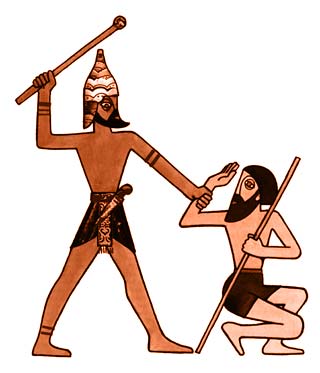
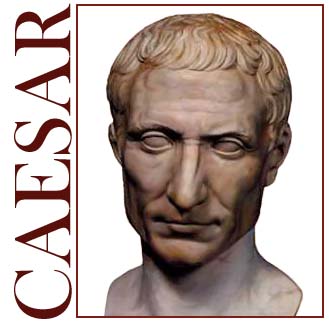
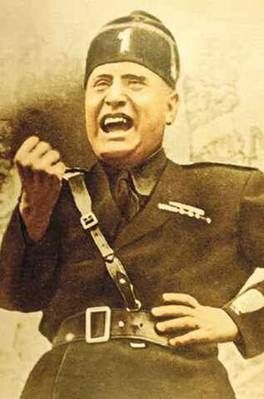
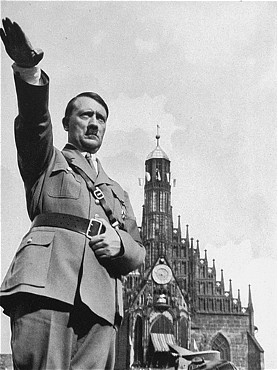

You'll recognize one of those archists above as Adolph Hitler.
Hitler did not kill six million Jews.
Name one Jew whom you can prove Hitler killed.
Six million Jews were killed by
six million Germans
who chose to wear a silly uniform, walk a silly goose-step, and follow the orders of a beyond-silly, pathologically evil man.These Germans were archists. They were "ordinary people." Just like you.
|
If you don't take immediate steps to become an anarchist, then by default you'll be an archist. Plus, you'll be unable to resist the temptations, the bribes, the pressure and the threats by archists to become an archist. You'll become an archist just like those rows and rows of "good" Germans above. They are just like you. You are just like them. "Sensible." "Rational." "Practical." |
What did Tertullian mean by setting "Athens" and "Jerusalem" in antithesis?
| Athens is often viewed as the womb of "Western" non-Christian philosophy, beginning with Protagoras, an early Greek philosopher, who claimed that "Man is the measure of all things." This is the essence of the Religion of Secular Humanism. But Athens was not wholly "secular." Athenians believed in a host of false "gods." Socrates was executed as an "atheist" for advancing a wholly secular outlook. His student, Plato, re-affirmed a more conventional belief, when he said, "In our eyes God will be “the measure of all things” in the highest degree—a degree much higher than is any “man” they talk of." But this "God-talk" was just a formality. Plato was not talking about the God of the Bible, the God who made His earthly home (temple) in Jerusalem on Mt. Zion. "Athens" is the repudiation of the God of Jerusalem. The Apostle Paul made this clear when he spoke to the philosophers in Athens (Acts 17). |
What did Tertullian mean by "the Academy?"
| Socrates and his student Plato, who founded his own school of philosophy there in c. 387 BC, calling it, ”The Academy.” Plato's student Aristotle also formed his own school. "The School of Athens," painted by Raphael on a wall in the Vatican in 1511, depicts the struggle between Plato and Aristotle. In the painting, they are walking through the Academy, Plato on the left, pointing up with one finger, while Aristotle, on the right, is pointing down with fingers outspread. They are disagreeing on the fundamental reality of the universe, and the fundamental reality of government and human society. Plato claiming that reality is “up there” in its Ideal Form (Platonism), while Aristotle said ultimate reality is “down here” in the particulars of life (Aristotelianism). This is also described as the conflict between the "one" and the "many," or unity vs. individuality. See the painting, "The School of Athens" by Raffaello Sanzio da Urbino |
Plato's "Republic" was a tyranny of the one ("the government," elite philosopher-kings, political unity) over the "many" (individuals, slaves). Platonism leads to the destruction of the freedom of the individual. But without form or unity, Aristotle's particulars cannot be brought together as the object of science. They are atomistically unrelateable. In either case, knowledge (scientia) collapses; society collapses. Secular philosophers still debate these ideas. Endlessly.
In Christianity, the Oneness of God is equally ultimate with the "many" of the individual members of the Trinity. Neither is subordinate to the other. God's Law (revealed in the Bible) is a blueprint for human life and dominion over nature (science, Genesis 1:26-28) that avoids completely the tension between unity and diversity, form and matter. Philosophers at secular universities never debate this solution. Ever.What happens if we put the Old Testament scriptures on a par with New Testament scriptures? It will dramatically change our interpretation of the New Testament scriptures. (The New Testament scriptures were written while the Old Covenant was still in effect; the Old Covenant did not come to a complete end until AD70, when the canon was closed.)
Our sponsor:
Supporting: love, joy, peace, patience, gentleness, goodness, faith, meekness, sobriety
Opposing: Secularism, Humanism, Anti-Family Sex, Hedonism, Autonomy, Totalitarianism, and Mass
Death
| The name "Vine & Fig Tree" comes from the fourth chapter of the prophet Micah, and is set forth here. You've probably heard Micah's words before -- we beat our "swords into
plowshares" and everyone dwells safely under their own "Vine & Fig Tree."
America's Founding Fathers were familiar with this vision: "Vine & Fig Tree" is the worldview that made America "the greatest nation on God's green earth." It could be called "The Original American Dream." |
|
Two centuries ago, the “Vine & Fig Tree” vision transformed America into the most prosperous and admired nation in human history. Tragically, we then experienced The Paradox of Deuteronomy 8: God blessed us, but we forgot God and said, "My power and the might of mine hand hath gotten me this wealth” (Deuteronomy 8:17), and then God judged our pride by turning our prosperity into bankruptcy and admiration into ridicule and hate. The United States is now despised around the world as a self-centered post-Christian bully.
George Washington's Diaries are available online at the Library of Congress. At one time, the LOC.GOV website introduced Washington's writings with these words:
No theme appears more frequently in the writings of Washington than his love for his land. The diaries are a monument to that concern. In his letters he referred often, as an expression of this devotion and its resulting contentment, to an Old
Testament passage. After the Revolution, when he had returned to Mount Vernon, he wrote the Marquis de Lafayette on Feb. 1, 1784:
This phrase occurs at least 11 times in Washington's letters.
|
|
Page Smith was a historian, winner of the Bancroft Prize, earning his M.A. degree in 1948, and Ph.D. degree in 1951 from Harvard. In his book Religious Origins of the American Revolution (Scholars Press, 1976), Smith writes about graduates from the older Harvard, like Samuel Adams (class of 1740), John Hancock (class of 1754), and John Adams (class of 1755). He says the passage in the book of Micah about “every man…under his vine and under his fig tree” was
the most potent expression of the colonist’s determination to be independent whatever the cost,…having substantial control over his own affairs. No theme was more constantly reiterated by writers and speakers in the era of the Revolution.
Here's a few examples, including some post-Revolution writers looking back.
In 1892, the Supreme Court of the United States proudly boasted that America was legally, technically, officially, Constitutionally, and organically a "Christian nation." Looking at the "organic utterances" the Court referred to, we see that America was not just generically Christian, but a Protestant nation. Smith says,
The American Revolution might thus be said to have started, in a sense, when Martin Luther nailed his 95 theses to the church door at Wittenberg. It received a substantial part of its theological and philosophical underpinnings from John Calvin’s Institutes Of The Christian Religion and much of its social history from the Puritan Revolution of 1640-1660, and, perhaps, less obviously, from the Glorious Revolution of 1689.
Indeed, Smith adds, in early America, the Reformation
left its mark on every aspect of the personal and social life of the faithful. In the family, in education, in business activity, in work, in community and, ultimately, in politics, the consequences of the Reformation were determinative for American history.
Put another way, the American Revolution is inconceivable in the absence of that context of ideas which have constituted radical Christianity. The leaders of the Revolution in every colony were imbued with the precepts of the Reformed faith.
By "radical" Christianity, Smith refers to the Bible. "Radical" comes from the Latin word for "root," and the Bible was the root and foundation of protestant Christianity in colonial America. "Sola Scriptura!"
By "Reformed
faith," Smith draws a distinction between Calvinism and Lutheranism. America was not just a Protestant nation, but a Calvinist nation.
The Westminster Standards are the highest expression of "the Reformed Faith."
A truly well-rounded American education would include study of Luther's 95 Theses, Calvin's Institutes, and the Westminster Standards. And of course the Bible itself. Can you name one college in America that requires study of these texts by all students?
Christian Philosopher Cornelius Van Til said "There is no alternative but that of theonomy and autonomy." The Law of God and the law of man. When society is governed by the Law of God in the Bible, it is free from the tyrannical rule of Autonomous Man. As remote or repugnant as Puritanism may be to some, Smith says “it is essential that we understand that the Reformation in its full power was one of the great emancipations of history.”
It is unfortunate that Calvin and his progeny were not consistent Christian Theocrats. As we will see, they tried to combine "Jerusalem and Athens." Instead of a pure "Theocracy," which literally means "God governs," they wanted clergymen -- or clergy-approved men -- to govern. This is not pure "Theocracy." Rule by clergy is "Ecclesiocracy."
Warning!
You Are About to be Offended
by the following audacious claim:
You were trained by your government-approved teachers to be offended and appalled at that claim. Yesterday's secular clergymen stripped public schools of Calvinism and the Bible. Today's clergymen are the CEO's of the Military-Industrial Complex and Wall St., who oscillate between corporate boardrooms and "smoke-filled rooms" in Washington D.C. A secular ecclesiocracy is just an "oligarchy." The United States -- the woke/neo-conservative regime in Washington D.C. -- is an oligarchy. It is still a "theocracy," with every man his own god, and the State as the apotheosis of Autonomous Man. "The Government," as Hegel put it, is "god walking on the earth."
"Theocracy" is an inescapable concept. Even "democracy" is a theocracy: "vox populi, vox dei" -- “The voice of the people is the voice of god.”
Pity the nation whose gods are Joe Biden and Donald Trump.
As we noted above, Calvinism made America the most prosperous and admired nation in history. Removing Calvinism transformed America's prosperity into bankruptcy and admiration into ridicule and hate.

I'm working to create an online "university" which can be put on a hand-held electronic device for billions of Muslims and billions of "Christians" around the world. It will give the student the Bible-based education that America's Founding Fathers received when they were children.
At Vine & Fig Tree University we're trying to duplicate the now-extinct Harvard University -- a Bible-based Christian university founded by the New England Puritans to promote the Christianity of the Protestant Reformation in the New World -- which is now an atheistic university at war with the original goals of Harvard.
The Founders of Harvard University (the church-state of Massachusetts) also created the first public school system. It was based on the Bible, and created Bible-literate students qualified to enter Harvard University.
Graduates of today's government-run "public" schools have been brainwashed into believing that Harvard's original Christian worldview is not as good as today's atheistic worldview. Nobody wants an education approved by the Protestant Reformers and the New England Puritans. Nobody is searching in Google to find a university that teaches what Harvard's Founders wanted students to learn in 1636 -- and nobody knows as much about the Bible and social virtues as Harvard expected high school applicants to know before their first college class.
But at Vine & Fig Tree University we believe that Harvard's Founders were not perfectly consistent with the teachings of the Bible. So we seek to reform the reformers. We want to be more pure than the Puritans. But our reforms are viewed as heretical, and we only incur additional wrath from those who already oppose the original Founders of Harvard.
Vine & Fig Tree University takes its name from the Bible verse which historians claim was the most popular Bible verse in America from 1600 to the American Revolution. (That's saying something significant, because America's public school system was designed primarily to teach everyone the Bible. If you were to ask today's Americans who their favorite opera singer is, they would draw a blank, because they can't name a single opera singer. Likewise if you asked today's Americans what their favorite Bible verse is. Some may have heard of "John 3:16," but otherwise know as much about the Bible as they do about opera singers. This was not the case in early America.)
Here is the foundational text for Vine & Fig Tree University:
| Micah 4:1-7
1 But it shall come to pass, |
This is the foundational Bible passage for America, a land of “Liberty Under God.” “Vine & Fig Tree” is the original “American Dream.” Nobody educated in the colonial American one-room schoolhouse believed in "the rapture," and all of them could have told you that a government is an "abomination" which forces people to "recognize" or "celebrate" the "marriage" of two homosexuals. Micah's prophecy does not fit into the popular "prophecy charts" of most churches.
But Americans from 1600-1800 only scratched the surface of this passage. And from 1800 to today, this passage has been flushed down the Orwellian "Memory Hole." Out of 300,000 churches in America, the number of churches that take this passage seriously (and agree with the perspective advanced here) can be counted on your right hand.
| The first three semesters of Vine & Fig Tree University is the Curriculum of the colonial American one-room schoolhouse 2.0 It will give students a vision for a Christianized world. We are all created in the Image of God, and hard-wired to aspire to the vision described by the Old Testament Prophet Micah 4:1-7: |
| Micah's Prophecy |
Archetype |
Controversy |
| And it will come about in the last
days That the mountain of the House of the LORD Will be established as the chief of the mountains And it will be raised above the hills |
“Predestination” “Preterism” Audio |
|
| And the peoples will stream to it. And many nations will come and say, "Come, let us go up to the mountain of the LORD And to the House of the God of Jacob, |
“Optimillennialism” Audio |
|
| That He may teach us about His ways And that we may walk in His paths." For from Zion will go forth the Law Even the Word of the LORD from Jerusalem. |
“Theonomy” Audio |
|
| And He will judge between many peoples And render decisions for mighty, distant nations. Then they will hammer their swords into plowshares And their spears into pruning hooks; Nation will not lift up sword against nation And never again will they train for war. |
“Pacifism” Audio |
|
| And each of them will sit under his | “Patriarchy” Audio |
|
| Vine and under his
fig tree, With no one to make them afraid. For the LORD of hosts has spoken. |
“Anarchism” Audio |
|
| Though all the peoples walk Each in the name of his god, As for us, we will walk In the Name of the LORD our God forever and ever. In that day, saith the LORD, will I assemble her that halteth, and I will gather her that is driven out, and her that I have afflicted; And I will make her that halted a remnant, and her that was cast far off a strong nation: and the LORD shall reign over them in mount Zion from henceforth, even for ever. |
“Theocracy” Audio |
|
|
You won't agree with everything in my curriculum, but you will be a better person for having wrestled with these ideas: Just as iron sharpens iron, friends sharpen the minds of each other. |
Audio | |
Let's get a bird's-eye view of Micah 4:1-7. Then we'll look at the passage with increasing attention to the details.
Micah says
| 1 it shall come to pass, |
Q.: How does Micah know what will come to pass?
A.: God told him. This is seen in verse 4:
| 4 for the mouth of the LORD of hosts hath spoken it. |
Q.: How does God know what will come to pass?
A.: God is in control.
| the mountain of the house of the LORD shall be established |
Q.: When will this come to pass?
A.:
| in the last days |
Perhaps Micah meant "in the distant future." But the writers of the New Testament consistently affirmed that they were living in "the last days," and the best interpretation of this phrase is that they were living in the last days of the Old Covenant.
| that the mountain |
The original "mountain" was the Garden of Eden, from which flowed four rivers (downhill). The temple on Mt. Zion was a model of the Garden.
| the house of the LORD |
The temple of the LORD: Where is it today? It was destroyed in A.D. 70 by the Romans. The New Testament writers say that the new temple is made up of God's People.
| shall be established |
This "establishment" has already happened. The new temple (God's People) was being built even before the old temple had been destroyed. The virgin-born Jesus of Nazareth was seated in His new temple as the Messiah of Israel (Acts 2:36). Messiah = King. Kingdom established in the past, not waiting for a second coming of the King.
| in the top of the mountains, and it shall be exalted above the hills; |
The nations around Israel built their own "high places" in an attempt to imitate God's Garden. The neo-conservative woke regime in Washington D.C., as well as the UK, UN, NWO, WEF, the "former" USSR, etc. are all rival "mountains." Christ has a superior jurisdiction over them all.
| and people shall flow unto it. 2 And many nations shall come, and say, |
This began happening in Acts 2, and has continued since, with ups and downs through history.
| Come, and let us go up to the mountain of the LORD, and to the house of the God of Jacob; and He will teach us of His ways, and we will walk in His paths: for the Law shall go forth of Zion, and the Word of the LORD from Jerusalem. |
Notice the words of exhortation and education. Too many Christians today think there is a conflict between "Law" and "Gospel." Micah didn't think so.
| 3 And He shall judge among many people, and rebuke strong nations afar off; |
| and they shall beat their swords into plowshares, and their spears into pruninghooks: nation shall not lift up a sword against nation, neither shall they learn war any more. |
Peace is a major theme in the Bible. Jesus is "The Prince of Peace." Many (if not most) Christians today claim that wars must increase until the "Second Coming" of Christ, sometime in our future. This is based on an erroneous interpretation of Matthew 24:6. There are fewer wars today than there were in Micah's day. Christians have enough financial and electoral power to end all the wars currently taking place in the world today.
Q.: What would happen if Christians never voted for any politician who promised "Peace through Strength," that is, "peace" through killing millions of innocent people?
Q.: What would happen if Christians never voted for any politician who promised to use
the power of the sword (the State) to engage in extortion ("taxation") to fund mass murder by the military?
Q.: What would happen if "the Law shall go forth" out of the New Temple of God's People, and they never voted for any politician who promised to
violate the commands against murder and theft?
A.: All of today's politicians would have to resign from "the public sector" and get jobs in "the private sector."
The "Public Sector" ("the sword") would be abolished.
"Public Schools" exist to brainwash you into
believing that would be a terrible thing.
| 4 But they shall sit every man under his vine and under his fig tree; and none shall make them afraid: |
This was the original "American Dream."
| 2 for the Law shall go forth of Zion, and the Word of the LORD from Jerusalem. 5 Although all people will walk |
The early church father Tertullian (c. 155 AD – c. 220 AD) asked:
|
What indeed has Athens to do with Jerusalem? What concord is there between the Academy and the Church?... Our instructions come from “the porch of Solomon”.... Away with all attempts to produce a mottled Christianity of Stoic, Platonic, and
dialectic composition! We want no curious disputation after possessing Christ Jesus...! |
Perhaps in his day Christians were being told to "Listen to the Academy!" just as Christians in our day are told "Listen to the Science!" But Micah says the temple of the living God will not be corrupted by the temple of man the would-be god.
Augustine wrote about the conflict between "The City of God" and the city of man. Where is your "citizenship?"
| 6 In that day, saith the LORD, will I assemble her that halteth, and I will gather her that is driven out, and her that I have afflicted; 7 And I will make her that halted a remnant, and her that was cast far off a strong nation: |
God rebukes unbelieving nations, but then restores them and gives them faithful obedience.
God's People are part of that process, by extending mercy to those God has rebuked (Matthew 25:31-46).
| and the LORD shall reign over them in mount Zion from henceforth, even for ever. |
The Kingdom that Christ inaugurated in "the last days" of the Old Covenant lasts forever.
Of the increase of His government and peace
There will be no end
Isaiah 9:6-7
Here are some controversial themes that can be found in Micah's prophecy. We have found 23 "core values" in the passage, and each one can set off a firestorm of controversy. But when fully understood, each one is a source of great comfort, optimism, and "good news" ("gospel").
Micah 4:1-7 |
Key Controversies |
| 4 for the mouth of the LORD of hosts hath spoken it. | 0. Bibliolatry: God speaks, we worship the Word |
| 1 it shall come to pass, | 1: Calvinism/predestination: "It shall come to pass" |
| in the last days | 2: Preterism: "in the last days" of the Old Covenant |
| that the mountain | 3: Creationism: The "mountain" = Eden |
| the house of the LORD | The temple of the LORD: Where is it today? "Mount Zion." Is the "institutional church" a part of the Kingdom of God? |
| shall be established | This has already happened (Acts 2:36) |
| in the top of the mountains, and it shall be exalted above the hills; |
USA/USSR/UK/NWO/WEF etc. are all rival "mountains" |
| and people shall flow unto it. 2 And many nations shall come, and say, |
4. Optimillennialism: "Peoples will stream; nations will come" This is currently happening. |
| Come, and let us go up to the mountain of the LORD, and to the house of the God of Jacob; and He will teach us of His ways, and we will walk in His paths: for the Law shall go forth of Zion, and the Word of the LORD from Jerusalem. |
5: Theonomy: "the Law of God"
6. Education: Theonomic/Jerusalem/Family/business: 7: Character: spontaneous obedience to God's Law. |
| 3 And He shall judge among many people, and rebuke strong nations afar off; |
8: Theocracy / Christocracy: "He shall judge" |
| and they shall beat their swords into plowshares, and their spears into pruninghooks: nation shall not lift up a sword against nation, neither shall they learn war any more. |
9: Pacifism: "swords into plowshares"
10: Archistlessness: no "sword" = no "Government" or "State" |
4 But they shall sit every man under
his vine and under his fig tree;
and none shall make them afraid:
Vine & Fig Tree
Daily Life
| Family Education | Family Business |
| 11: Patriarchy: "His Vine"
6: Education: Family does the teaching of God's Law 7: Character: VFTU teaches God's Law because |
12: Dominion/work/service - figs and grapes must be picked, and prepared to serve consumers
13: Agrarianism: Vine & Fig Tree 17: Property/Communism: Sharing is Christian, but compulsory "sharing" is theft. 18. "Socialism" - The home as community center, home for the homeless/afflicted. |
| 4 But they shall sit every man under his vine and under his fig tree; and none shall make them afraid: |
Who are those who would "make afraid?" Archists:
14: Fall of Man; sin: the desire to "be as gods" (Genesis 3:5) 15: Salvation: "None shall make them afraid" "dwell safely" || verses |
| 5 Although all people will walk every one in the name of his god, we will walk in the name of the LORD our God for ever and ever. |
16. Jerusalem vs. Athens 7: Character vs. "Mass Formation Psychosis" standing alone against public lawlessness and unbelief 17: WE will walk; communism vs. individualism/property |
| 6 In that day, saith the LORD, will I assemble her that halteth, and I will gather her that is driven out, and her that I have afflicted; 7 And I will make her that halted a remnant, and her that was cast far off a strong nation: |
18. Socialism: Many people believe that "socialists" care about the poor, but "capitalists" only care about themselves. Socialists would never accept Micah's claim that the Lord "afflicts" people for their bad choices, and socialists ignore the fact that "capitalists" manufacture things that the poor want to buy. But socialists are sometimes correct when they point out a capitalist who "afflicts" the powerless. The Bible says the way we treat the "afflicted" is the way we treat Jesus Himself. |
| and the LORD shall reign over them in mount Zion from henceforth, even for ever. |
Lord Shall Reign
19: Gospel: A proclamation of a rival kingdom 20: Justification: choosing citizenship in Jerusalem over Athens Mount Zion 21. Church (House of the Lord on Mount Zion) - false temple, false "we" For ever and ever22: Eternity: |
The Puritan Church-State of Massachusetts created Harvard in 1636, and in 1647 created "public schools." The purpose of both was to promote widespread understanding of the Bible. Bible-educated citizens would then help create and maintain a Christian Theocracy. The Founders of Harvard believed that it was necessary to create a "civil government" to promote religion and civic order. They did not understand how religion and social order could be promoted by a Market Freed from threats of government force. Vine & Fig Tree University exists to promote this "paradigm shift." It will not take thick textbooks and long classroom lectures to do this. It simply requires taking the most basic precepts of the Bible seriously and consistently. This is not complicated or "tricky." It doesn't require high levels of intelligence. It takes high levels of ethics. Just be a consistently moral person, and ignore the "experts" who say the Bible is outdated or "utopian."
Let's think about these simple propositions like Bereans (Acts 17:11). You'll see why no pastor wants a Vine & Fig Tree University graduate anywhere near his church.
Micah 4:1-7 (left column) is a representative of many “Vine & Fig Tree” verses in the Bible. We can add some observations on how this passage is expressed in the VFTU curriculum (right column).
Micah 4:1-7 |
|
Vine & Fig Tree University |
| And it will come about in the
last days That the mountain of the House of the LORD Will be established as the chief of the mountains And it will be raised above the hills |
We are not in "the last days" of the Old Covenant. We are in the first days of the New Covenant.
The "mountain" of the "house of the Lord" was Jerusalem, but before that it was the Garden of Eden, an elevated plateau from which flowed four rivers. Adam and Eve were called to transform the Garden of Eden into "The New Jerusalem," or as Augustine called it, "The City of God." The establishment of this "mountain" took place when Jesus the Christ/Messiah came, 2000 years ago. Daniel 2 predicts that this Mountain-City will spread over the entire world. |
|
| And the peoples will stream to
it. And many nations will come and say, "Come, let us go up to the mountain of the LORD And to the House of the God of Jacob, |
Today, in stark contrast to the days in which Micah delivered this prophecy, a majority of human beings on planet earth claim to worship the God of Abraham.
Galatians 3:8 The concept of "blessing" is seen in Deuteronomy 28:1-14 and Leviticus 26:3-13. Micah would be astonished to see that in 2024, billions of human beings enjoy the "blessings" that are described in those passages. Micah could not have imagined that billions -- thousands of millions -- of human beings could live on this planet at the same time without mass starvation and total war. |
|
| That He may teach us about His ways And that we may walk in His paths." For from Zion will go forth the Law Even the Word of the LORD from Jerusalem. |
Jeremiah 31:33 predicts that the Torah will be written on the hearts of New Covenant believers. | |
| And He will judge between many peoples And render decisions for mighty, distant nations. Then they will hammer their swords into plowshares And their spears into pruning hooks; Nation will not lift up sword against nation And never again will they train for war. |
The Protestant Reformers and the Founders of Harvard missed this point. They rejected the "pacifism" which was advocated by the "Radical Reformation" a.k.a. the "Anabaptists." | |
| And each of them will sit under his | What is a family? What about private property? |
|
| Vine and under his fig
tree, With no one to make them afraid. For the LORD of hosts has spoken. |
What about technology? What about the military? What is it that really brings "security?" | |
| Though all the peoples walk Each in the name of his god, As for us, we will walk In the Name of the LORD our God forever and ever. |
What if all the politicians, university professors, college accreditation agencies, TV commentators, bloggers, newspaper editors, rock stars, scientists, CEO's, celebrities, athletes, authors, and think-tanks repudiate the Vine & Fig Tree vision and tell you not to believe it? | |
| In that day, saith the LORD, will I assemble her that halteth, and I will gather her that is driven out, and her that I have afflicted; And I will make her that halted a remnant, and her that was cast far off a strong nation: and the LORD shall reign over them in mount Zion from henceforth, even for ever. |
Should we strive to be on top, or to help those on the bottom? Is God on the side of those who have accomplished much by their own power and initiative, or is He on the side of those who are willing to be used by God to accomplish much to His Glory? |
We've pulled out 23 Themes from this text:
Theme 0. Bibliolatry: God speaks, we worship the Word
Theme 1. Calvinism/Predestination: "It shall come to pass"
Theme 2. Preterism: "in the last days"
Theme
3. Creationism: The "mountain" = Eden
Theme 4. Optimillennialism: "Peoples will stream; nations will come"
Theme 5. Theonomy: "the Law of God"
Theme 6.
Education: Theonomic/Jerusalem/Family/business
Theme 7. Character: although all people Athens, we will Jerusalem
Theme 8. Theocracy: He shall judge
Theme 9. Pacifism:
"swords into plowshares"
Theme 10. Anarchism; Anarcho-Capitalism: no violence = no state || Jesus is the One True Archist
Theme 11: Patriarchy: "His Vine"
Theme 12: Dominion/work/service
Theme
13: Agrarianism: Vine & Fig Tree
who are those who would "make afraid?" Archists:
Theme 14: Fall of man; Sin How did some become "Archists?"
Theme
15: Salvation: None shall make them afraid
Micah says the law will go forth from Jerusalem
Theme 16: Jerusalem versus Athens
Theme 17: Communism vs. property: "WE will walk"
Theme
18: Socialism and the poor: caring for the ones "God has afflicted"
| The Lord Shall Reign:
| | Theme 19: Gospel: A proclamation of a rival kingdom
| | Theme 20: Justification:
choosing Jerusalem over Athens
| From Mount Zion
| | Theme 21. Church (House of the Lord on Mount Zion)
Theme 22: Eternity
Let's combine these themes from Micah's prophecy with the chapters of the Westminster Standards.
After 1647, students wishing to enroll in Harvard were required to give their assent to the Westminster Standards in order to be admitted as a student. Probably nobody who will be starting as a Freshman at Harvard this Fall has studied the Westminster Standards, much less agrees with them. Applicants to Harvard in the early 1600's had a much higher level of academic attainment than graduates of atheistic public schools -- victims of educational malpractice -- in the early 2000's. And high school students in the 1600's already had a Biblical worldview before their first day of college.
 The Westminster Confession of Faith and the Larger and Shorter Catechisms were written in the 1640's.
They reflect the growth of Protestant theology that began in 1517 with Luther's "95 Theses" and continued under men like John Calvin.
The Westminster Confession of Faith and the Larger and Shorter Catechisms were written in the 1640's.
They reflect the growth of Protestant theology that began in 1517 with Luther's "95 Theses" and continued under men like John Calvin.
John Frame says
The assembly’s Confession of Faith, completed in December, 1646, is the last of the classic Reformed confessions and by far the most influential in the English-speaking world. Though it governed the Church of England only briefly, it has been widely adopted (sometimes with amendments) by British and American Presbyterian bodies as well as by many Congregational and Baptist churches.
B.B. Warfield, professor at Princeton in the late 1800's, wrote of the Westminster Standards,
[T]hey are the final crystallization of the elements of evangelical religion, after the conflicts of sixteen hundred years. . . . [T]hey are the richest and most precise and best guarded statement ever penned of all that enters into evangelical religion . . . .
Richard Gardiner, in his impressive collection of "Primary Source Documents Pertaining to Early American History," lists many sources which introduce the average Secular Humanist to the now-unknown religious foundations of American Revolution and Government. Among these sources are the Westminster Standards. Gardiner says of them:
 The Westminster Confession of Faith (1646) In addition to being the
decree of Parliament as the standard for Christian doctrine in the British Kingdom, it was adopted as the official statement of belief for the colonies of Massachusetts and Connecticut. Although slightly altered and called by different names, it was the creed of
Congregationalist, Baptist, and Presbyterian Churches throughout the English speaking world. Assent to the Westminster Confession was officially required at Harvard, Yale, and Princeton. Princeton scholar, Benjamin Warfield wrote: "It was impossible for any body of
Christians in the [English] Kingdoms to avoid attending to it."The Westminster
Catechism (1646) Second only to the Bible, the "Shorter Catechism" of the Westminster Confession was the most widely published piece of literature in the pre-revolutionary era in America. It is estimated that
some five million copies were available in the colonies. With a total population of only four million people in America at the time of the Revolution, the number is staggering. The Westminster Catechism was not only a central part of the colonial educational curriculum,
learning it was required by law. Each town employed an officer whose duty was to visit homes to hear the children recite the Catechism. The primary schoolbook for children, the New England Primer, included the Catechism. Daily recitations of it were required at
these schools. Their curriculum included memorization of the Westminster Confession and the Westminster Larger Catechism. There was not a person at Independence Hall in 1776 who had not been
exposed to it, and most of them had it spoon fed to them before they could walk. The Westminster Confession of Faith (1646) In addition to being the
decree of Parliament as the standard for Christian doctrine in the British Kingdom, it was adopted as the official statement of belief for the colonies of Massachusetts and Connecticut. Although slightly altered and called by different names, it was the creed of
Congregationalist, Baptist, and Presbyterian Churches throughout the English speaking world. Assent to the Westminster Confession was officially required at Harvard, Yale, and Princeton. Princeton scholar, Benjamin Warfield wrote: "It was impossible for any body of
Christians in the [English] Kingdoms to avoid attending to it."The Westminster
Catechism (1646) Second only to the Bible, the "Shorter Catechism" of the Westminster Confession was the most widely published piece of literature in the pre-revolutionary era in America. It is estimated that
some five million copies were available in the colonies. With a total population of only four million people in America at the time of the Revolution, the number is staggering. The Westminster Catechism was not only a central part of the colonial educational curriculum,
learning it was required by law. Each town employed an officer whose duty was to visit homes to hear the children recite the Catechism. The primary schoolbook for children, the New England Primer, included the Catechism. Daily recitations of it were required at
these schools. Their curriculum included memorization of the Westminster Confession and the Westminster Larger Catechism. There was not a person at Independence Hall in 1776 who had not been
exposed to it, and most of them had it spoon fed to them before they could walk. |
The Shorter Catechism begins with this notice:
| Agreed upon by the Assembly of Divines at Westminster, with the Assistance of Commissioners from the Church of Scotland, as a Part of the Covenanted Uniformity in Religion Betwixt the Churches of Christ in the Kingdoms of Scotland, England, and Ireland.
and Approved Anno 1648, by the General Assembly of the Church of Scotland, to Be a Directory for Catechising Such as Are of Weaker Capacity, |
"Weaker capacity." Like 5-year olds.
The "Larger Catechism" is described as "a Directory for catechising such as have made some proficiency in the knowledge of the grounds of religion." Like 12-year olds. A Protestant Bar-Mitzvah.
90% of the "Pastors" of today's churches do not know as much about theology as the average 8th-grade American in 1776.
Many people are rightly disturbed by the idea of a government official entering a home and dictating what children should learn when it comes to religion.
But they are also offended by the idea of God Himself entering a home and dictating what children should learn when it
comes to religion . . . or any other subject.
The word "Theocracy" is a frightening boogeyman in our day. Harvard University and the Westminster Standards were both designed to promote a Christian Theocracy. Neither one embraced the modern concept of "separation of church and state," which more accurately means "separation of God (religion, Christianity) and Government." Harvard/Westminster stood for the proposition that both Church and State must be "under God." Vine & Fig Tree University questions whether "the State" -- which is a Monopoly of Violence -- can ever truly be "under God," that is, obedient to God's Commandments. Similarly concerning the institution called "the church." The Westminster Assembly, predominantly Presbyterian, was strongly opposed to Roman Catholicism, yet in many ways is still very similar to Roman Catholicism in structure and power-dynamics. John Milton said "New Presbyter is but Old Priest writ large."
The Bible says all believers are priests and kings:
Revelation 1:6
Jesus Christ has made us kings and priests to His God and Father, to Him be glory and dominion forever and ever. Amen.Revelation 5:9-10
And have redeemed us to God by Your blood And have made us kings and priests to our God; And we shall reign on the earth.
Roman Catholics claimed to have priests; Harvard and Westminster denied this.
Harvard's most notable graduates in its first 200 years -- Samuel Adams, John Hancock, John Adams, etc. -- denied the claim of "the
divine right of kings."
Vine & Fig Tree University contends that we are all priests and kings, and nobody is a priest or a king.
Vine & Fig Tree University
denies the modern concept of "separation of church and state." We believe in "the abolition of church and state," that is, abolition of monopoly priesthoods and political oligarchy. We believe in an orderly self-governing society,
and a truly religious (James 1:27) society, without the institutions of "church" and "state."
Both Harvard and Westminster believed in the institutions of "church" and "state" because "the church fathers" did. Not everything "the church fathers" believed came from the Bible. "The church fathers" believed many things because Aristotle and Greco-Roman humanism taught them to believe these things. One of the primary purposes of Vine & Fig Tree University is to strip away Greco-Roman humanism and go back to the Scriptures. At many points the Protestant Reformers and the New England Puritans wanted to "reform" and "purify" in this way, but they were products of their time.
Vine & Fig Tree University and "The Great Commission" is not about promoting any particular church or denomination, nor any particular nation. The only legitimate "church" is the Body of Christ, and the only legitimate nation is "the holy nation" spoken of in 1 Peter 2:9.
Here are the chapters of the Westminster Confession, with links to the section below where we compare the Westminster Standards with the core values of Vine & Fig Tree University:
Westminster Confession of Faith |
Vine & Fig Tree University |
| Chapter 1 — Of the Holy Scripture | Substantial agreement. |
| Chapter 2 — Of God, and of the Holy Trinity | Substantial agreement. |
| Chapter 3 — Of God’s Eternal Decree | Substantial agreement. |
| Chapter 4 — Of Creation | Substantial agreement. |
| Chapter 5 — Of Providence | Substantial agreement. |
| Chapter 6 — Of the Fall of Man, of Sin, and of the Punishment Thereof | Substantial agreement. |
| Chapter 7 — Of God’s Covenant with Man | Substantial agreement. |
| Chapter 8 — Of Christ the Mediator | Substantial agreement. |
| Chapter 9 — Of Free Will | Substantial agreement. |
| Chapter 10 — Of Effectual Calling | Substantial agreement. |
| Chapter 11 — Of Justification | Chapters 10-18 are referred to as "The Ordo Salutis," or "the Order of Salvation." Without
disagreeing with anything in these chapters, we find two deficiencies.
We avoid these deficiencies by promoting a more Theonomic doctrine of "Justification" which we call "Justification by Allegiance" (as opposed to "Justification by Faith," where "faith" means "mere belief" or presumption). |
| Chapter 12 — Of Adoption | Substantial agreement. |
| Chapter 13 — Of Sanctification | Substantial agreement. |
| Chapter 14 — Of Saving Faith | Substantial agreement. |
| Chapter 15 — Of Repentance unto Life | Substantial agreement. |
| Chapter 16 — Of Good Works | Substantial agreement. |
| Chapter 17 — Of the Perseverance of the Saints | Substantial agreement. |
| Chapter 18 — Of the Assurance of Grace and Salvation | Substantial agreement. |
| Chapter 19 — Of the Law of God | This chapter is confused. It tries to embrace both Biblical Law and "natural law." |
| Chapter 20 — Of Christian Liberty, and Liberty of Conscience | Substantial agreement. |
| Chapter 21 — Of Religious Worship, and the Sabbath Day || work six days | This chapter is confused. The "sabbath," or seventh day of rest, is not the same thing as the commemoration of the resurrection of Christ on the first day of the week. |
| Chapter 22 — Of Lawful Oaths and Vows | Substantial agreement. |
| Chapter 23 — Of the Civil Magistrate | Substantial disagreement. No human being on planet earth in 2024 can credibly claim that God gives him permission to call himself "the civil magistrate" and hurt people and take their stuff, or attempt to impose his own will on others by force or threats of violence. |
| Chapter 24 — Of Marriage and Divorce | General agreement. |
| Chapter 25 — Of the Church | "The Church" is an imitation of the State. |
| Chapter 26 — Of the Communion of Saints | General agreement. |
| Chapter 27 — Of the Sacraments | In general, Vine & Fig Tree University rejects the claims of "the Institutional Church." The claims of the "church" are not always the claims of the Bible. |
| Chapter 28 — Of Baptism | |
| Chapter 29 — Of the Lord’s Supper | |
| Chapter 30 — Of Church Censures | |
| Chapter 31 — Of Synods and Councils | |
| Chapter 32 — Of the State of Men after Death, and of the Resurrection of the Dead | In general, Vine & Fig Tree University rejects the claims of "futurists" and agrees with the claims of "preterists." The Westminster Standards reject preterism at many points, without agreeing with "premillennialism." |
| Chapter 33 — Of the Last Judgment |
Q.1: What is the chief end of man?
A.1: Man's chief end is to glorify God, and to enjoy Him forever.
I say "famously" because 300 years ago, 90% of the English-speaking world could have answered that question from memory. (In 1700, it is estimated that approximately 10% of English-speaking people identified as Catholic, while around 90% identified as Protestant.)
Rick Warren began his multi-million best-selling book The Purpose Driven Life with the four words "It’s Not About You." Those are good words, and yet the book really was all about the reader. And the reader's church.
John M. Frame writes,
The lordship of Christ is not only ultimate and unquestionable, not only above and beyond all other authorities, but also over all areas of human life. In 1 Corinthians 10:31 we read, "Whether you eat or drink or whatever you do, do it all for the glory of God" (cf. Rom. 14:23; 2 Cor. 10:5; Col 3:17, 23; 2 Tim. 3:16-17). Our Lord's demand upon us is comprehensive. In all that we do, we must seek to please him. No area of human life is neutral. [note: This was the insight of the great Dutch thinker Abraham Kuyper. He saw that the lordship of Christ requires radically different Christian forms of culture. Christians should be producing distinctively Christian
• art,
• science,
• philosophy,
• psychology,
• historical and
• biblical scholarship, and
• political and
• economic systems.
And Christians should educate their children in distinctively Christian ways (note the God-saturated education urged in Deut. 6:6ff. after the challenge to love God exclusively). For many of us, such considerations mandate home schooling or Christian schools for our children, for how can we otherwise compete with up to seven hours a day of public-school secularism mandated by law? In any case, Christians may not take the easy road, uncritically following the thinking of the unbelieving world. Consider Kuyper's remark: Of all the territory in the creation, Jesus says, "It is mine."
John M. Frame, Apologetics to the Glory of God, p. 7 text+n.11
Does God have an ego problem, that He always needs His creatures to praise Him and glorify Him?
Or do we have an ego problem, that we fail to be grateful to our Creator for life and for the blueprint we have in God's Law that shows us how to create an enjoyable life?
As we work our way through Micah's prophecy, the "Dominion Mandate," and the Bible from The Garden of Eden to the New Jerusalem, we'll see that man's chief end (goal or purpose) is to build the City of God, that is, the Vine & Fig Tree society.
| Micah 1:1 The Word of the Lord that came to Micah of Moresheth in the days of Jotham, Ahaz, and Hezekiah, kings of Judah, which he saw concerning Samaria and Jerusalem. Micah 4:4 Micah 4:6 |
I have numbered this theme "0" (zero) because it undergirds all the other themes.
The Westminster Confession of Faith begins with a chapter on the Bible. And rightly so. Everything taught at Vine & Fig Tree University is grounded in the Bible because the Bible is the Word of God.
Some people call this view "bibliolatry." Like we make the Bible into an idol. But an "idol" is a false god. The Bible is the Word of the True God.
"Bibliolatry" is closely related to "predestination," which we look at next. If you believe in "free will," or that God cannot "violate" man's "free will," then you cannot logically believe that the Bible is the Word of God.
The words in the Bible were written by the hands of human beings, but I believe the Bible is the Word of God. God speaks through those human words. This says something
• about the words,
• something about the human authors of the
words,
• as well as something about the God of the Bible.
The Words:
In Galatians 3:16, the Apostle Paul makes a theological argument based on whether the word in a quotation from Genesis is plural or singular. The words matter.
The human authors:
God wrote the Bible using "human pens." God made their hands move the way He wanted them to move. In the Bible, the will of God is sovereign over the will of man. 1 Peter 1:21 says
For no prophecy was ever produced by the will of man, but men spoke from God as they were carried along by the Holy Spirit.
Of course, it was the "will" of Moses and Isaiah and Paul and other authors to write down words. Moses wrote what God told him to write, but perhaps Moses would say he wrote those words "of my own free will." Nobody pointed a gun at Moses' head and forced him to write. But what Peter says is controversial. Even though Moses and other Biblical authors freely wrote the words they intended to write, God was doing something through them and the words they wrote. They did not write those words solely by their own "free will." Their hands moved the way God willed them to move.
It's true, we can tell the differences between the words Moses wrote, the words Luke wrote, the words John wrote, and the words Paul wrote. They all had their own individual personalities and writing styles. But the men who wrote the words of Scripture had their lives — their parents, training, and life experiences — all orchestrated by God so that — guided by the Holy Spirit — they would write the exact words that God wanted to be written so that God could communicate exactly what He wanted to communicate to the human race. Their words are God's words. God's will trumps their will. Paul told Timothy that God "breathed out" His words through these human authors (2 Timothy 3:16, [theópneustos (Strong's #2315, from 2316 /theós, "God" and 4154 /pnéō, "breathe out"]).
The God of the Words:
To say that the Bible is the Word of God is to say that God's will is sovereign over the will of man. Some people find this deeply offensive. God made the mouths of Moses, David, and Isaiah speak the words God wanted spoken. God made the hands of Matthew, Paul, and John write the words God wanted written. If God did not overrule the "free" and fallible will of man, how did their will to speak and write beget the infallible Word of God?
I don't use the term "free will," because secular philosophers use that term to suggest that if there is a god, such a god doesn't know what's going on, and is constantly being surprised at what the will of man does. So I would never say that I have "free will" and can do something that will catch God off-guard. God knows what I think and what I feel and what I will do because He predestined it all. But I am not a rock, or an insect, or an animal, or a robot. I am a human being created in the Image of God. Amazing.Some will say that since God predestines even sin, and then punishes sinners for the sin God predestined them to commit, it would be better if sinners had never been born. They had no "free will." They had no choice. "That's not fair." And if it's not "fair," it can't be true. This claim is logical. If a man has no free will, and gets punished for what God predestined him to do, it would be better for him if he had never been born. But Mark 14:21 says exactly that: God predestined Jesus to be sinfully put to death:
"The Son of Man indeed goes just as it is written of Him, but woe to that man by whom the Son of Man is betrayed! It would have been good for that man if he had never been born.”
That's pretty scary. Judas had no choice in whether he would be born. God created Judas without asking Judas for permission, and predestined Judas to commit a terrible sin (John 19:11).
But Judas was created in the Image of God. All sinners are created in the Image of God. And in the end, every knee will bow and every sinner will admit that God's Judgment is fair (Isaiah 45:23; Romans 14:11; Philippians 2:10-11). All sinners will say "I admit. I sinned." All sinners will admit that God is just. Even though He predestined them to sin (Romans 9; Isaiah 10).
Christians who oppose the Sovereignty of God and uphold the "free will" of man claim that predestination "makes man a puppet." But as I said, man is clearly not a puppet; man is created in the Image of God, and we all know this. But the Bible agrees that God's sovereignty makes man a "puppet" of God's decree. The Bible describes man not as a "puppet," however, but as a bucket of water.
Well, not a bucket, but a river of water.
Proverbs 21:1
The king’s heart is in the hand of the Lord,
Like the rivers of water;
He turns it wherever He wishes.
How is this not like being "a puppet?"
Is a meandering river created in the Image of God?
How is the opponent of God's Sovereignty not making an accusation against God?
I believe the Bible is the Word of God.
Jesus is the Word of God incarnate; the Bible is the Word of God inscriptured.
Some people call this "Bibliolatry." I worship
the Bible. That alarms nearly every church I know.
The Bible claims to be the Word of God. It claims that God speaks to human beings. It claims that God used human beings the way I am using a keyboard as I write this.
Let's consider first the claim that God speaks, and the Bible is God speaking to us.
Imagine that a UFO lands on the White House lawn, and an extraterrestrial being hands the President a Peace Treaty. The ET says, "Read this Treaty. It tells you how to cure cancer, end war, obtain free energy, eliminate the threat of global warming, and extend lifespans by hundreds of years. If you agree to abide by its terms, our race will help your race. If you do not agree, you will be destroyed. We will wait right here for your answer."
Network television will have their cameras at the White House 24/7. Commentators will be speculating endlessly about what the extraterrestrial Treaty says, and whether or not the President will accept their terms. People will cancel vacations and having children, breathlessly waiting for the decision, knowing their entire future hangs in the balance.
If there are any ET's in the universe, they were created by the God of the Bible. His Word is more important than the word of any ET. But we spend more time watching CNN or FoxNews than we spend listening to the Bible, even though the news channels aren't covering anything as interesting as a UFO on the White House lawn. For some, "news" doesn't get our attention as much as sports, soaps, or celebrities.
All the while, we have a book from the Creator of the universe sitting un-read on a shelf next to the Flat Screen TV.
What the heck is wrong with us?
| Westminster Standards |
| Chapter 1 - the Holy Scripture |
The Bible is a Peace Treaty -- a Covenant -- that God is willing to enter into with those who have been in rebellion against Him. The Treaty calls for unconditional surrender on our part. The Treaty promises blessing -- "salvation" -- on God's part.
The ethical and moral significance of a covenant of unconditional surrender is sometimes masked by theologians who focus on "covenant theology" as a theological buzzword.
| Westminster Standards |
| Chapter 7 God’s Covenant with Man |
Here is perhaps the #1 reason no church wants to be infiltrated by someone who believes the Bible was actually written by God.
|
The Bereans are commended for questioning the church. They heard a message from the Apostles and checked what they heard with the Scriptures. There is no entity on planet earth who wants their members questioning what the church has taught and comparing church doctrine with the Bible.
Especially regarding the "heretical" ideas I'll be raising below.
Even though Protestant churches champion "sola Scriptura" and the "priesthood of all believers." They don't really mean it. They don't like Bereans.
The Bereans appeared to be like modern libertarians, with their bumper-sticker that says "QUESTION AUTHORITY." The Apostles gave them the Gospel of Jesus Christ, but the Bereans didn't just take the Apostles' word for it, but checked what they were told against a higher authority, the Scripture. The Bereans are more dogmatic authoritarians than those who mindlessly accept the word of clergy or creeds.
Additionally, the Bereans studied the Bible "daily." The verses on that link show that daily engagement with the Bible is an imperative.
I am a "Bible-believing" Christian. Feel free to accuse me of engaging in bibliolatry, fundamentalism, extremism, creationism, Calvinism, Theonomy, etc. Guilty as charged.
This attitude makes one a better Christian, as seen in our second text.
Just as iron sharpens iron,
friends sharpen the minds of each other.
Proverbs 27:17
My goal in this article is to be your "friend." I hope you'll be my friend as well, and challenge my thinking in a loving way. I hope you'll learn the skill of benefitting from opinions which are contrary to your own.
Vine & Fig Tree University goes against the grain of "church history" and the "experts." I am not against "authorities" or "experts." I rely on them and quote them. I believe the data and premises of the "experts" leads to my conclusion. An "expert" can be your friend and sharpen you, but you might have to pay the expert ("mentor," "professor" "seminary"). This article is free. May you be sharpened. May we be friends.
Third text:
Proverbs 18:17
"The first to state his case seems right until another comes forward and examines him."
What you learned in church seems right to you. Wait until you compare it with what the Bible says.
I love the Lord with all my heart, mind, soul, and strength. Not just part-way. That makes me an "extremist." People tell me I take the Bible to an extreme. I think I just take it consistently. At least I try.
If you disagree with this -- if you want to avoid "extremes" -- then you want to be at point "M" on the chart below:
| Extreme | Middle of the Road | Extreme |
| A B C D E F G H I J K L | M | N O P Q R S T U V W X Y Z |
| Capitalism | Apathy | Tyranny |
| Theocracy | Lukewarm | Atheism |
| Love | Indifference | Hate |
Do you want to be a Grade "A" Christian? Then you had better avoid being a Grade "Z" Christian with all your heart, mind, soul and strength.
|
If you are not an extremist in defense of the Bible, what is the guiding principle that prevents you from being a defender of tyranny, atheism and hate? Is "moderation" the Grand Principle that you believe will keep America from collapsing into chaos and lawlessness? When Jesus said "Love your neighbor," was He really just telling us not to hate our neighbor, to avoid extremes, and have an attitude of "moderation" toward our neighbor? Can Lukewarm Indifference ever be Christlike?
Even if my goal were no more than "moderation," if you are at point "Z," I must be an "extremist" in the opposite direction, and advocate "A" in order to get you to point "M," because if I only advocate "Moderation," "Z + M" only brings you to point "T." Life is a tug-of-war. If you don't pull the rope with every ounce of strength you have, you're in the mud. Jesus said the struggle to overcome the world is "agonizing."
I advocate "A" on the scale above. I'm trying to get you to adopt "A" as your position as well. If you're a Moderate and I move you toward "A" to any degree, I've succeeded. For now.
If you follow some of what the Bible says, you are not following anything the Bible says. If you pick and choose, you are your own god.
Even if you choose to follow Jesus 99% of the time (using your "free will"), it is still YOU who are choosing, you who approve of 99% of Jesus' commands, you who put yourself in the place of God and judge some of what Christ said to be wrong, you who are acting as lord of your life. You view religion as a Smörgåsbord. You pick and choose depending on what YOU like, but do not view the Word of God as an absolutely binding package deal. Everybody agrees with something Jesus said, even some real sickos. A Christian is someone who believes everything Jesus said. Nothing less than full submission counts for anything.
That's a place to transition to the second of my propositions. I believe that if you believe in "free will," you do not believe that the Bible is the Word of God.I say that not on the grounds that the Bible teaches something other than "free will," but because if God cannot "violate" man's "free will," there cannot be a Bible at all.
So let's consider what the Bible says about God's Sovereignty.
| Micah's Prophecy
"It shall come to pass" |
How does Micah know what will "come to pass?"
Answer: God told him (see "Bibliolatry" above).
How does God know what will "come to pass?"
Answer: He predestined it.
God is omniscient, and knows the end from the beginning (Isaiah 46:10; Acts 15:18), because the future has already been created.
In his work The Praise of Folly, first printed in 1511, Renaissance humanist Erasmus asks, "For what else is the life of man but a kind of play in which men in various costumes perform until the director motions them off the stage." In his The Merchant of Venice, written about 85 years later, Shakespeare had one of his main characters, Antonio, compare the world to a stage:
I hold the world but as the world, Gratiano;
A stage where every man must play a part,
And mine a sad one.
A few years later, in his comedy As You Like It, one of his characters says,
All the world's a stage,
And all the men and women merely Players;
They have their exits and their entrances,
This can reflect a cynical outlook. But it can also reflect the Bible, and be much more optimistic.
Is life a play, with God as the Screenwriter and Director, who creates actors to play the parts in His drama, all for His Glory?
Some would say a "yes" answer "violates" man's "free will." But the Bible says that when God calls an actor off the stage, the actor will confess that God was a great screenwriter, and was not unfair in creating the actor to play his part, which was written for him before he was born.
Some say that predestination "makes man a robot." But you and I both know that we are not robots. We were created in the Image of God. We have the capacity for reason, to plan for the future, to compose and appreciate symphonies. We understand God's Commandments, and we have a moral obligation to obey them. We know that as we get in the car and drive to the prostitute's house, that we should turn the car around. We know that God is just to hold us responsible for our actions. In the end of God's Play, "every knee will bow and every tongue will confess" that we made the choice to sin and God is just and fair to hold us accountable (Isaiah 45:23; Romans 14:11; Philippians 2:10-11). These things cannot be said about the other animals. They can't appreciate God's Play the way His image-bearers do.
Omnipotence is the basis for omniscience. God knew what every atom in the universe would do before He created them, because He created everything that way. There was no other god or being co-existing with God to force God to create the world in a way God did not want it to be. God knew what He was doing. He created everything the way He wanted.
All the inhabitants of the earth are reputed as nothing;
He does according to His will in the army of heaven
And among the inhabitants of the earth.
No one can restrain His hand
Or say to Him, “What have You done?”
Daniel 4:35
Evolution is an impersonal "struggle for survival."
God is Sovereign, but God is also Love.
This has tremendous implications for our actions in history.
Calvinism: "Liberty Under God"
Futurists say that "prophecy" reveals a grim future. War, Great Tribulation, the Antichrist, and Armageddon are all predestined (though not all futurists would use that word -- but what's the difference between "prophesied" and "predestined?").
Micah does not say that tribulation and annihilation has been predestined, but a Vine & Fig Tree world has.
I believe in God. There are a lot of people in churches on Sunday morning who say "I believe in God," but what evidence is there of this on Monday through Saturday?
I believe God is the creator. The Bible says God created everything there is, probably no more than 10,000 years ago. (Yikes! A "creationist!" A "fundamentalist!")
There is an unbridgeable gap between the Creator and the creature (Romans 1:25).
The Westminster Confession and Catechisms set forth a "Calvinist" doctrine of God. Many people hate that term. I believe in "the Five Points of Calvinism." Calvin would not have let me in his church. Calvin would have put me to death.
If I were to describe what I think God is like, most people would say they don't believe in that kind of God. And they're even more offended that I try to impress this "Calvinist" theology into every area of my life, even "secular" areas, including Monday through Saturday.
Predestination
Before the Creator created all that is, the Creator knew the end from the beginning (Isaiah 46:10; Revelation 1:8; Revelation 21:6, 13). God knows the future because God created it. The future has already been created. This is called "predestination," meaning the destination of the creation was designed and set in motion before ("pre") it was even created. The path of every molecule and sub-atomic particle in the universe was set in motion, and is carefully and lovingly conducted by God through history to its predestined end. The thoughts I think and the feelings I feel are wave-particles of energy and chemicals that travel across the synapses of my brain and through my heart and "reins." All predestined by God. Some say my belief makes man a "robot." But God did not create man as a robot. You and I both know that we are not "robots." God created man in His Image. That means when I think and plan, when I paint a picture or compose a symphony, when I build a log cabin or a skyscraper that can house 25,000 people, I am engaged in the wonder-filled task of exercising dominion over the earth (Genesis 1:26-28), something animals do not do.
No matter how glorious I think man is, by virtue of his being created in the Image of God, there are those who feel that my conception of God "violates" human "free will."
"Arminians" call me a "Calvinist." They don't want me in their churches.Jesus Wrote the Bible Using Human Penmen
This question is often asked.
If God predestined Judas Iscariot to sin by betraying Christ, and also predestined Pilate to commit a lesser sin (John 19:11) of ordering Jesus to be murdered (Acts 2:23; 4:28; 1 Peter 2:8), doesn't this mean God is the "author of sin?"
There is a fundamental ambiguity in this question.
"Sin" is the violation of God's Law (1 John 3:4). God cannot violate His own Law. Sin is rebellion against the authority of God. God cannot rebel against Himself.
So when we consider the sins of Judas, Pilate, and the rest of humanity, and when we consider that the Bible says their sins were predestined by God, the question "Is God the Author of Sin" needs to be clarified.
The question is, "Is God the Author of THEIR sin?"
The answer is no, because they are created in the Image of God. It's their sin against God, not God's.
The Westminster Confession's answer to this question is not as clear:
WCF 3.1 God from all eternity did, by the most wise and holy counsel of his own will, freely and unchangeably ordain whatsoever comes to pass (Rom 9:15, 18; 11:33; Eph 1:11; Heb 6:17); yet so as thereby neither is God the author of sin (James 1:13, 17; 1 John 1:5), nor is violence offered to the will of the creatures, nor is the liberty or contingency of second causes taken away, but rather established (Prov 16:33; Mat 17:12; John 19:11; Acts 2:23; 4:27-28).
WCF 5.2 Although in relation to the foreknowledge and decree of God, the first cause, all things come to pass immutably and infallibly (Acts 2:23), yet by the same providence he ordereth them to fall out, according to the nature of second causes, either necessarily, freely, or contingently (Gen 8:22; Exod 21:13 with Deut 19:5; 1 Kings 22:28, 34; Isa 10:6-7; Jer 31:35).
Every knee will bow and every tongue will confess ((Isaiah 45:23; Romans 14:11; Philippians 2:10-11)) that God is not the author of sin, because every tongue and knee -- every human sinner -- was created in the Image of God.
Predestination is an inescapable concept.
But there is a predestination of love, and another predestination of meaninglessness.
Modern Darwinists are increasingly agreed that "free will" is a myth. We do what our DNA tells us to do, evolutionists say. The illusion of free will is exercised in a meaningless universe, where everything happens randomly with no purpose.
"Calvinism" teaches that human beings are created in the Image of God, a God who is Love (1 John 4:8), and the entire universe is moving toward a loving goal. God has predestined all this.
The Bible says we have a moral obligation to choose between these two rival systems of predestination.
Joshua 24:15
And if it is evil in your eyes to serve the Lord, choose this day whom you will serve, whether the gods your fathers served in the region beyond the River, or the gods of the Amorites in whose land you dwell. But as for me and my house, we will serve the LORD.”1 Kings 18:21
And Elijah came unto all the people, and said, How long halt ye between two opinions? if the LORD be God, follow him: but if Baal, then follow him. And the people answered him not a word.Deuteronomy 30:19
I call heaven and earth as witnesses today against you, that I have set before you life and death, blessing and cursing; therefore choose life, that both you and your descendants may live;
As we will see below, the Bible says man was created to build the City of God. For the Darwinist, man's only objective is "the survival of the fittest." "The fittest" is defined as "the one who survives." If your own survival depends on killing others or stealing from them, then you have a "moral" duty kill and steal. The only moral is survival.
| Westminster Standards |
| Chapter 3 - God’s Eternal Decree |
| Chapter 2 - God, and of the Holy Trinity |
| Chapter 9 Free Will |
| Micah's Prophecy |
| "in the last days"
And it will come about in the last days |
The word "eschatology" comes from the Greek word for "last." It is the study of "last things" or final things.
The Westminster Confession relegates eschatology to the last two chapters of the Confession. But in the last 200 years it has become a much more important subject than it was 400 years ago, when the Westminster Standards were written.
If you've never studied "eschatology," you'll need to become familiar with a few theological terms:
"Millennium"
This refers to a period of great blessing. A "Golden Age." Usually thought of as the time when Jesus reigns as the Christ (Messiah).
Theologians ask how this "millennium" relates to "the Second Coming" of Christ. Which comes first: the Second Coming or the Millennium?
Premillennialists and Amillennialists generally believe that before the Second Coming, things get worse and worse. Premils believe that at the Second Coming, Jesus begins to reign as the Messiah on earth. Amils believe that at the Second Coming, human history on earth ends and
the eternal state begins.
Postmillennialists believe that Christ is reigning now, making the world conformed to His Law, and that at the Second Coming human history on earth ends and the eternal state begins. So Gary North has coined two new terms:
The subject is extremely important in our day, because the subject is plagued by errors, and these errors are popularly believed and have a global impact. Millions of copies of books speculating about "the last days" have been sold in this generation. These erroneous beliefs have a powerful influence on U.S. foreign policy in the Middle East. Millions of people have been killed because of "pessimillennial" beliefs. Millions more -- maybe billions -- will be killed in the future if premillennialism continues to guide U.S. foreign policy. It's a "self-fulfilling prophecy."
Everything about Micah's “Vine & Fig Tree” prophecy is undermined by today's erroneous eschatologies. They all deny that it is even possible -- much less mandatory -- for us to beat our "swords into plowshares" and pursue the fulfillment of Micah's “Vine & Fig Tree” prophecy. Eschatology is critical. (We wouldn't necessarily place the subject at the very top of the list, but it occurs right off the bat in Micah's prophecy, so here it is. But it deserves higher placement than the last two chapters of the Confession.)
Micah says his prophecy will begin to be fulfilled in "the last days." What does this mean? Commentators suggest two meanings:
I believe "the last days" of the Old Covenant are now in our past. We are not now living in "the last days" of the Old Covenant. The Old Covenant came to a definitive end in AD 70 when the temple in Jerusalem was destroyed. As a result, Jesus is reigning as the Christ today.
The Latin word for "past" is praeter. The word "preterism" comes from the Latin word for past, which is brought into English words like "the preterit tense" and a school of eschatology called "preterism." Saying a prophecy was fulfilled in the past is called "Preterism."
In the early decades of the 21st century, this word has become very controversial.
According to Peter in Acts 2, and elsewhere in the New Testament, the Apostles were living in "the Last Days" of the Old Covenant. This is when Jesus was made the Christ: in the past.
Interpreting the Bible is not hard. It doesn't take a high I.Q. (Intelligence Quotient). It takes a high M.Q. (Morality Quotient). Interpreting the U.S. Constitution is similar. The Constitution was designed to thwart tyranny. But some people want tyranny. The tyrant wants power, and "We the Sheeple" want freedom from responsibility, and we believe the promises of the tyrant to bring "equality" and "fairness." If you cherish immorality, you will deliberately misinterpret and distort the Bible.
How do we correctly interpret Micah's “Vine & Fig Tree” prophecy, as well as others which speak of the Messiah? Sometimes the form of prophecy can confuse us. Often it is poetic, rather than "scientific" or "historical" or reminiscent of journalistic "neutrality." It is designed to encourage us today. That is, to encourage us to obey God's Commandments.
Churches split over obscure doctrines, but they are united in their silence in the face of disobedience to the plain commandments of God. Murder, destruction, perversion: "Let's not get into politics; let's stick to doctrine."
Jesus said, "If anyone wills to do His will, he shall know concerning the doctrine, whether it is from God or whether I speak on My own authority." (John 7:17 NKJV) If you want God's will to be done on earth as it is in heaven (Matthew 6:10), and if you are willing to do God's will yourself, your obedient spirit will open your eyes to understand the harder parts of the Bible.
The Bible teaching ministry I founded is called “Vine & Fig Tree.” The name comes from the 4th chapter of Micah. It talks about a day we beat "swords into plowshares." I believe that's not just a prediction about Micah's future, but a command for us today. I believe the Bible -- from cover to cover -- commands pacifism. War -- "the sword" -- is an evil.
You are welcome to try to "sharpen" me on this issue. Others have certainly tried. I am willing to admit that ISIS-inspired psychos kill innocent people around the world, and sometimes it's hard to believe that the Babe born in Bethlehem and laid in a manger on that "Silent Night" was really the Messiah, the Prince of Peace. But despite ISIS, I believe Micah would agree that Jesus is now reigning as Messiah and Prince of Peace.
In Micah's day, seven hundred years before the coming of the Messiah, half of all human beings died as a result of archist violence.
There
was no such thing as "liberty" in Isaiah's day. Today we enjoy liberty because the Messiah came two thousand years ago.
Today, the vast majority of human beings die of "natural causes" rather than violence. The exceptions to that blanket statement are easily
remedied by professing Christians in America. It's a matter of ethics, not fate or eschatology. We are commanded to bring about the continued and expanded fulfillment of these prophecies. Jesus gave us enough to consider them "fulfilled," and everything beyond that
is just frosting on the cake.
Sanctified Imagination
If Micah could travel through time 2,700 years to our day, he would fall on his knees in praise and faithful gratitude to God for fulfilling his prophecies. We are not so grateful. We should be.
But we can start where we are and imagine even greater fulfillment of the "messianic" prophecies. We should take upon ourselves the exercise of faith and imagine how the earth will look 2,700 years into our future, and work and plan for that day.
Micah and Isaiah would say that their prophecies have been gloriously fulfilled. Those of us living today are the beneficiaries of centuries of theological sanctification from Isaiah's day, and can imagine even greater ways in which those prophecies can be further fulfilled.
But most Christians do not believe that Christ is fulfilling those prophecies and reigning as Messiah today.
The premillennialists are wrong for a number of reasons.
A. The Messianic Kingdom is Everlasting.
Not just 10 centuries, as millennialists hold
Isaiah 9:6-7
6 For unto us a Child is born,
Unto us a Son is given;
And the government will be upon His shoulder.
And His name will be called
Wonderful, Counselor, Mighty God,
Everlasting Father, Prince of Peace.
7 Of the increase of His government and peace
There will be no end,
Upon the throne of David and over His kingdom,
To order it and establish it with judgment and justice
From that time forward, even forever.
The zeal of the LORD of hosts will perform this.Micah 4:5
Micah 4:7
As for us, we will walk
In the Name of the LORD our God
forever and ever.
and the LORD shall reign over them in mount Zion
from henceforth, even for ever.
The Messianic Age Never Ends -- "world without end." Of the baby Jesus it was foretold:
Luke 1
32 He shall be great, and shall be called the Son of the Highest: and the Lord God shall give unto him the throne of his father David:
33 And he shall reign over the house of Jacob for ever; and of his kingdom there shall be no end.
This reign began 2,000 years ago. And it has only just begun.
The idea that tens of thousands of human beings can live in one apartment building is provocative. There are seven billion human beings on earth today. The entire population of the earth can be "squeezed" into one-third of the state of Texas, each one enjoying a home with the population density of the home in which I grew up, with one-third of the state given to business and industry meeting all human needs, and one-third of the state given to parks and recreation. That leaves the other 49 states empty. The entire African continent would be uninhabited by human beings. Asia and India, with their billions of people, could live much more comfortably in Dubai-style apartments in one-third of the state of Texas. And thousands of years from now, when mankind has fulfilled God's command to "be fruitful and multiply; fill the earth and subdue it" (Genesis 1:26-28; 9:1) and there are 700 billion, or a 1,000 billion (trillion) human beings on earth, the vast majority will be Christians. David Chilton writes:
6while it is fashionable for modern Christian intellectuals to speak of our civilization as "post-Christian," we should turn that around and make it Biblically accurate: Our culture is not post-Christian - our culture is still largely pre-Christian!
and
The actual number of the saved, far from being limited to mere tens of thousands, is in reality a multitude that no one could count, so vast that it cannot be comprehended. For the fact is that Christ came to save the world. Traditionally -- although Calvinists have been technically correct in declaring that the full benefits of the atonement were intended only for the elect - both Calvinists and Arminians have tended to miss the point of John 3:16. That point has been beautifully summarized by Benjamin Warfield:
You must not fancy, then, that God sits helplessly by while the world, which He has created for Himself, hurtles hopelessly to destruction, and He is able only to snatch with difficulty here and there a brand from the universal burning. The world does not govern Him in a single one of its acts: He governs it and leads it steadily onward to the end which, from the beginning, or ever a beam of it had been laid, He had determined for it. ... Through all the years one increasing purpose runs, one increasing purpose: the kingdoms of the earth become ever more and more the Kingdom of our God and His Christ. The process may be slow; the progress may appear to our impatient eyes to lag. But it is God who is building: and under His hands the structure rises as steadily as it does slowly, and in due time the capstone shall be set into its place, and to our astonished eyes shall be revealed nothing less than a saved world."
Benjamin B. Warfield, from a sermon on John 3:16 entitled "God's Immeasurable Love," in Biblical and Theological Studies (Philadelphia: Presbyterian and Reformed Publishing Co., 1968), pp. 518f.
[New York City contains not just residences, but businesses (e.g., "Wall Street") and parks (e.g., "Central Park"). The "Texas" link we provided above does not make this distinction.]
Then there are other planets.
People who want Jesus to return and set up a 1,000 year kingdom (when He's already/only been reigning for twice that long) and then end the whole "earth" business are quitters with no vision. That's probably most church-going Christians.
Daniel 2
In the days of the Roman Empire, the Rock is born, and His Kingdom begins to take over the world.
The transformation is not instantaneous.
The Messianic Kingdom is not handed to us
fully-developed on a silver platter
after we passively wait for it.
The statue in Daniel 2 represents the archist paradigm of the pre-Christian world. In Luke 4, Jesus was tempted by Satan:
5 The devil, taking Him up on a high mountain, showed Him all the kingdoms of the world in a moment of time. 6 And the devil said to Him, “All this authority I will give You, and their glory; for this has been delivered to me, and I give it to whomever I wish. 7 Therefore, if You will worship before me, all will be Yours.”
Jesus destroyed the entire demonic imperial paradigm. The Last Adam restored the seed of the First Adam to our original purpose of building the City of God. But the weeds of the City of Man still need to be cut down as a part of tending The Garden. Replacing the City of Man with the City of God is a process called "sanctification." It applies socially as well as individually.
Isaiah 9:6-7 also shows us this idea of perpetual growth. The NRSV renders verse 7:
His authority shall grow continually
The Vine & Fig Tree prophecy of Micah (4:1-7) also shows numerous evidences of continual growth:
"We have duties." "Let us go." These are significant statements. They relate to themes we will look at below: Theonomy, Theocracy, Capitalism. They relate to the issue of predestination and free will, which we looked at above.
Some people don't believe that Jesus of Nazareth is the Messiah predicted by the Old Testament prophets. Let's look at a Jewish website and an article called "Why Jews Don't Believe In Jesus." It says,
Jews do not accept Jesus as the messiah because . . . Jesus Did Not Fulfill the Messianic Prophecies.
What is the Messiah supposed to accomplish? One of the central themes of biblical prophecy is the promise of a future age of perfection characterized by universal peace and recognition of God. (Isaiah 2:1-4, 32:15-18, 60:15-18; Zephaniah 3:9; Hosea 2:20-22; Amos 9:13-15; Micah 4:1-4; Zechariah 8:23, 14:9; Jeremiah 31:33-34)
We will look at the word "perfection" in a minute. But first let's look at the phrase "universal peace and recognition of God." Jesus did not fulfill those "Messianic Prophecies" in the way many Jews thought the Messiah would do it. For example, they expected the Messiah to be a Warrior-King who would destroy the Roman Army that was occupying Israel under a military dictatorship, and then restore "national sovereignty" to Israel.
I would like to suggest that Jesus is in fact fulfilling those Messianic Prophecies, and understanding why this is true can revolutionize your faith. (For a detailed response to that article from the Jewish website, click here.)
Most people who call themselves "Christians" today believe that Micah's prophecy (and the others cited) will not begin to see fulfillment until Jesus returns to earth a second time. This second coming will be "pre-millennial." So even though Jesus did not fulfill these Messianic Prophecies at His first coming, Jesus is still the Messiah, because He will fulfill these prophecies at His second comin. The Jewish website understands this rationalization:
Because no one has ever fulfilled the Bible's description of this future King, Jews still await the coming of the Messiah. All past Messianic claimants, including Jesus of Nazareth, Bar Cochba and Shabbtai Tzvi have been rejected.
Christians counter that Jesus will fulfill these in the Second Coming. Jewish sources show that the Messiah will fulfill the prophecies outright; in the Bible no concept of a second coming exists.
The Rabbi is correct: "in the Bible no concept of a second coming exists." But the Rabbi is mistaken to claim that these prophecies will be fulfilled "outright." But millions of Christians agree with him. That word "outright" is a very important word. Maybe it's the most important word in history! Another way of saying "outright" is "instantly." "All at once."
Those two points are important, and we will be returning to them and emphasizing them over and over again.
If Micah could travel through time from his day seven centuries before the birth of Christ to our day 20 centuries later, he would think that these Messianic prophecies had been fulfilled "outright." The world today is dramatically different from the world of Micah's day. The Bible teaches that Jesus was born during "the last days" of the Old Covenant, and He put into effect a New Covenant, and as a result of this New Covenant, billions of human beings have been streaming to "the mountain of the Lord" (Micah 4:2), and the world is more obedient to God's Commandments today than it was before Jesus was born. The world is more peaceful. The world is more civilized. The Pentagon, the Mainstream Media and secular academia do not want you to understand this.
Nor do most clergymen. The more perceptive clergy will say that our belief that Micah's prophecy is already being fulfilled (along with all the other Messianic prophecies), and that we should continue beating swords into plowshares, is "dangerous" and "heretical."
We should obey Micah's prophecy outright. All at once. Immediately.
We will discuss this further when we discuss "pacifism" below. Or see this essay: Why Postmillennialists Must Be Pacifists.
But the dramatic contrast between Micah's day and our day was not accomplished "outright," but "By Little and By Little." By many people taking personal responsibility and exercising dominion.
The desire for Christ's Kingdom to see perfection "outright" is the same desire that promotes "rights" and "entitlements" rather than duties. Premillennialism destroyed postmillennial America.
Luke 17:20-22
20 Now when He was asked by the Pharisees when the kingdom of God would come, He answered them and said, “The kingdom of God does not come with observation; 21 nor will they say, ‘See here!’ or ‘See there!’ For indeed, the kingdom of God is within you.”Luke 10:9
“heal the sick there, and say to them, ‘The kingdom of God has come near to you.’”
The Messianic Kingdom grows. Of its increase "there will be no end" (Isaiah 9:6-7). That means it will never be "perfect." It's always growing towards something better. Even in "the New Heavens and New Earth" -- which many think of as an eternal state of perfection -- there is sin and death. But it is so much better than life in Isaiah's day, that it could only be communicated using wild, poetic language that has led many to believe it would be sinlessly perfect.
In the eyes of most Christians, God Himself -- the Second Person of the Trinity -- comes to earth twice, and is still unable to persuade or empower human beings to exercise dominion in a loving, honest, and faithful manner. The first Christmas was full of promise, but ends in failure. So Christ comes a second time, thousands of years later, bringing an army of resurrected saints with Him, takes a seat on a throne in Jerusalem, rules with a rod of iron in a believers-vs.-unbelievers police state, and still, it all ends in failure. Toward the end of the 10th century of Christ's Messianic reign, Satan reigns for "a little season" (Revelation 20:3), encouraging masses of people to rebel against the personal, visible reign of Jesus Christ Himself. Seeing that He is going to lose the game, Jesus takes His football and goes home.
The very popular Christian writer Dave Hunt has written:
In fact, dominion – taking dominion and setting up the kingdom of Christ – is an impossibility, even for God. The millennial reign of Christ, far from being the kingdom, is actually the final proof of the incorrigible nature of the human heart, because Christ Himself can’t do it.[1]
"Impossible even for God." The Creator's idea of creating man in His Own Image and telling man to exercise dominion over the earth, converting the earth to God's Temple, building the City of God, was a mistake. Progress is not possible. Only regress. Earth is a failure. Jesus' prayer ("Thy will be done on earth as it is in heaven") is just tilting at Satanic windmills. As Hal Lindsey put it, "Satan is Alive and Well on Planet Earth." Poor God.
Didn't God know when He created human beings that it would all turn out in failure? Why did He bother?
Jesus is the Messiah today, forever; not to be waited for in the future, to reign for a few short years, and to then lose a war when Satan is released "for a little season." But to be obeyed today.
Too many Christians expect a perfect millennium to be given to passive Christians at the second coming, but denounce those who actively try to be perfect in this present age. Join THE PERFECT CLUB.
Prophecy as Law
When God promises a blessing (or when He threatens a curse) we know what God thinks is good or bad. If we respect God, we feel a moral obligation to pursue the good and eschew the bad.
| Westminster Standards |
| Chapter 32 - the State of Men after Death, and of the Resurrection of the Dead
Chapter 33 - the Last Judgment |
| Micah's Prophecy |
| That the mountain of the House of the LORD Will be established as the chief of the mountains And it will be raised above the hills |
Under the discussion of God's sovereignty (above), we discussed the concept of being created by impersonal forces of "nature" vs. being created by a personal and loving God.
But many Christians say God "used" evolution to create man.
The Bible says four rivers flowed out of (downhill from) Eden, indicating that Eden was on a "mountain" or elevated plateau. Ever since then, and throughout the Bible, the mountain has been a reminder of Eden. The Garden of Eden is a major theme in the Bible.
Was there actually a Garden of Eden in history? Are the first few chapters of Genesis a chronicle of history, or a "religious" poem of some kind? How would Jesus answer that question?
Jesus treated Genesis as actual history. See Matthew 19 for an example. For centuries, Christians believed in creation four thousand years before the birth of Jesus. If you can believe that Jesus rose from the dead, in violation of "scientific law," why can't you believe God created all things a few thousand years ago?
Under this label of "Creationism" we have four intersecting themes:
Politicians who feel threatened by the Bible, seeing it as an "anarchist manifesto" want you to believe the Bible is "pre-scientific" and cannot be trusted. Karl Marx said his "scientific socialism" was grounded in history. Jesus grounded His teachings in the history in Genesis. Marxists and Christians have very different views of history.
One of the biggest tests of Biblical character is the ability to stand against "the science" of evolution. "Listen to the science" we are constantly told. Is your faith informed and able to stand against the crowd?
Evolutionism is not science; it is a religion; it is the religion of archism. Like covid hysteria and tyranny, it is one example of a "Mass Formation Psychosis." ("Archism" is the belief that members of a ruling class have the right to impose their will on others by force or threats of violence. Jesus said His followers are not to be archists "like the kings of the gentiles" (Mark 10:42-45).
The New Jerusalem is a New Creation.
Micah 4:1-2 says Jerusalem (Mt. Zion, the mountain of the House [temple] of the Lord) will be "established." This is actually the creation of a New Jerusalem. This is the restoration of the conditions that originally existed in the Garden of Eden.
Evolutionary premillennialism sees a vast past and no future. It's all going to end in our day.
Creationist preterism sees creation in a recent past, re-creation in Christ "the Last Adam," and a vast future building of the Kingdom of God (the New Jerusalem) ahead
of us.
Planet earth is a miracle, not an accident. Supernatural design, supernatural creation, supernatural administration. There is no such thing as "nature."
Creating/Building the New Jerusalem will be a
supernatural act, but we (you, I, and all God's Image-Bearers who make up His Temple) still have moral obligations to expend energy on behalf of this work of edification. We cannot be passive. But in the end, Christ gets all
the credit and glory.
| Westminster Standards |
| Chapter 4 Creation |
| Micah's Prophecy |
| And the peoples will stream to it. And many nations will come and say, "Come, let us go up to the mountain of the LORD And to the House of the God of Jacob |
Micah predicts that the world will be Christianized. | "All nations, all peoples"
This is a major theme in the Scriptures (the Old Testament)
The Universal Spread of Christ's Kingdom
This offends pessimillennialists, who believe we must wait for Christ to give passive Christians their millennium at the second coming. And it offends those who believe that "all religions are equal; we're all headed up to the top of the same mountain, just climbing along different paths." They say we're "arrogant" "bigots" for speaking of the global conversion to Christianity.
But in the last few decades, it has become obvious that one religion is not like the others. This forces us to examine the claim held by Christians in the past, that one religion is superior to the others. In recent years, our attention has been caught by the religion of Jihadism. This religion is not going up the same mountain as those who say all religions are equal. The religion of Jihadism wants to blow-up the entire mountain with everyone on it; even if this kills the suicide bombers themselves. They don't believe in converting others to their religion by persuasion/reason, but by force. If you believe all religions are basically equal, that religion destroys your claim. There are many other religions that will do that.
All religions are not "basically the same."
There are many false religions and there is only one true religion.
"Diversity" vs. CivilizationStatist "Globalism" -- The world will not be Christianized by government coercion.
Optimillennialism is optimism about the future progress of the Kingdom of God on earth. It defies entropy, and is not evolutionary. Therefore Optimillennialism depends on Creationism.
There has been a dramatic shift: the most dramatic shift in human history. Those who worshiped the God of Abraham were a tiny minority before Christ; today a majority of the human race claims to worship the God of Abraham. We'll revisit that claim below. Micah says false religions will be replaced by the True Religion. We're in the infancy of "church history." The Body of Christ is just beginning to learn how to walk.
| Westminster Standards |
| The Westminster Catechisms contain more on this them than the Confession:
Day 150: The Lord's Prayer, part 3 - "Thy Kingdom Come" Day 151: The Lord's Prayer, part 4 - "Thy Will Be Done"Many scholars have argued that the Westminster Standards embody an optimistic eschatology called "post-millennialism, but there isn't a separate section in the Westminster Standards on "Post-Millennialism," or as we call it, "Optimillennialism." |
| Micah's Prophecy |
| That He may teach us about His ways And that we may walk in His paths." For from Zion will go forth the Law Even the Word of the LORD from Jerusalem. And He will judge between many peoples And render decisions for mighty, distant nations. |
The word "Theonomy" comes from two Greek words meaning "God's Law."
It stands for the proposition that the entire Bible is the Word of God and we are to be governed by it.
This is controversial because many Christians do not believe they have to obey
any of God's Laws if they are recorded in the pages of what New Testament writers called "The Scriptures" and what we today call "the Old Testament."
"Theonomy" stands for the proposition that the
Bible is a blueprint for the creation of Global Christian Civilization.
It stands for the proposition that God is our ultimate Authority, and He has the right to command us.
This is controversial because many Christians in our day do not believe they are obligated to obey
God's commands during the work-week, in businesses or the "public square," but only on Sunday mornings in a "church" or in their "spiritual life."
When Americans learned the Bible in public schools (and public schools were Bible schools), America was the most prosperous, most admired nation on earth. America sent missionaries around the globe. Now the U.S. exports weapons and pornography. Americans are increasingly lawless.
• The God who gave you life deserves your respect
• Every Word this God speaks deserves your attention/obedience
• Bible is not just for "private"
religion, "down in your heart"
• Also for public policy
• Textbook for every area
Being "judgmental" vs. Hitler
"Those who will not be governed by God condemn themselves to be governed by tyrants" -- William Penn
Our moral obligation to obey God's Commandment counters those who complain that our advocacy of predestination leaves man without "free will." You are morally obligated to choose to obey God's Law. I don't know whether you have been predestined to be obedient or not. But you know what you must do, and you will eventually admit that you chose to do what you wanted to do. Every knee will bow and every tongue will confess that our Sovereign God is perfectly fair (Isaiah 45:23; Romans 14:11; Philippians 2:10-11).
The Westminster Catechism contains an exposition of the Law of God under the category of the Ten Commandments. This exposition is, on the whole, wonderful. If we take these three commands seriously:
the implications are astounding.
Nobody disagrees with these views in the abstract, but if I make them too practical, or apply them to the wrong people, then these views become heretical and offensive. Together these views lead me to a conclusion that everyone rejects. Passionately rejects. I used to reject it myself when I was younger. We'll consider it below.
"Swords into plowshares" is highlighted by Micah as essential element of "optimillennialism" (global conversion and "Christian Reconstruction") and Theonomy (God's blueprint). But no Christian Reconstructionist advocates "swords into plowshare" for fear of being accused of being a "pacifist" (covered below)
God's Law plainly says "Thou shalt not steal/Thou shalt not kill" and this rules out the "monopoly of violence" known as "civil government," but "Reconstructionists" are not "abolitionists," because they fear being labeled as "anarchists!"
Opposition to "civil government" is based on the superiority of self-government. That is, each individual obeying God's Law.
Here are the next 5 themes:Theme 6.. Education: Theonomic/Jerusalem/Family/business
Theme 7: Character: although all people Athens, we will Jerusalem
Theme 8. Theocracy: He shall judge
Theme 9. Pacifism:
"swords into plowshares"
Theme 10. Anarchism; anarcho-Capitalism: no violence = no state || Jesus is the One True Archist
Micah says the law of God must be taught, and people will stream to learn God's Law. Therefore Theonomy leads to Education (#6 below).
When children are taught God's Law at home, they become habitually obedient. They instinctively stand up against evil. We call this "character," #7 below.
When we obey God's Law, God Governs us.
The word "Theocracy" = God Governs
Theonomy therefore leads to Theocracy, Theme #8 below.
Some deny this. Theologians divide God's Word into two or three groups. The first group is called "The Moral Law." Laws against murder and theft are in this category. The second group is called "the ceremonial law." Laws about priests and shedding blood for atonement are under this category.
Everyone says they agree that "the ceremonial laws" have their fulfillment in Christ, rather than in a levitical priesthood and temple sacrifices. But some have divided "The Moral Law" by breaking off laws which have a social (rather than strictly individual) character. They call these social laws "judicial laws" or "civil laws." Those who say these laws are not part of "the moral law" usually say these laws are no longer binding, and governments today are not morally obligated to obey them.
Upon analysis, this division doesn't make sense. Is "Thou shalt not kill" part of the "moral law?" Most would say yes, along with "Thou shalt not steal." But if all my friends "vote" for me and "elect" me to be a "civil magistrate," am I still prohibited from stealing (levying a "tax") and killing ("capital punishment")? If the answer is yes, our next two themes are correct: pacifism and anarchism, which we hope to prove below.
Consider the commandment, "Thou shalt not kill." (Exodus 20:13, quoted by Jesus, Mark 10:19) That link contains the exposition of the 6th Commandment in the Westminster Larger Catechism. It is "a pacifist manifesto." If pacifism is true, and if "thou shalt not steal" is true, anarchism follows logically. Nothing in "the judicial law" or "the civil law" retracts the force of the 6th commandment and exempts those who call themselves "civil government."
Here are the next 5 themes:
Theme 6.. Education: Theonomic/Jerusalem/Family/business
Theme 7: Character: "Although all people Athens, we will Jerusalem"
Theme 8. Theocracy: "He shall judge"
Theme
9. Pacifism: "Thou shalt not kill," therefore "swords into plowshares"
Theme 10. Anarchism; anarcho-Capitalism: no violence = no "state" or "civil government" || Jesus is the One True Archist
| Micah's Prophecy |
| Micah 4:2
"Come, let us go up to the mountain of the LORD That He may teach us about His ways neither shall they learn war any more. |
The text says "HE may teach"
How does Jesus teach 8 billion people from a throne in Jerusalem?
If He can teach the world to obey God's Law from Jerusalem, why can He not teach the world from the right hand of the Father in heaven?
Jesus uses His Body -- believers -- to teach the nations everything He commanded (Matthew 28:18-20).
Teaching God's Law is central to the establishment of a Vine & Fig Tree society.
Deuteronomy 4:9f.; 6:7f., 20f.; 11:18-21, etc.
The Family teaches the Law
http://bit.ly/teach-your-children
Education must be Theonomic/Theocratic: the central command is
to teach God's Law.
Teaching God's Law-Word must dominate our daily thinking. The texts in Deuteronomy say our whole day should be centered on God's Law. This would certainly apply to "schools and the means of education."
But today's schools ban the Bible. The Bible cannot be endorsed or promoted in "public" schools. Children are therefore taught that the Bible can safely be ignored. Children are taught that the Bible is an ancient relic that has no relevance to their daily lives, or to the daily life of the Government.
There is no "neutrality."
Teaching God's Law (the Scriptures) determines your greatness in Christ's Kingdom:
"The Great Commission" -- make all humanity students of God's Law -- makes us all educators under Christ the Superintendent.Matthew 5:17-19
17 “Do not think that I came to destroy the Law or the Prophets. I did not come to destroy but to fulfill. 19 Whoever therefore breaks one of the least of these commandments, and teaches men so, shall be called least in the kingdom of heaven; but whoever does and teaches them, he shall be called great in the kingdom of heaven.
Education is something all of us must do.
Law - teaching all the nations through hospitality and open borders.
Different from evangelism - Converting the existing generation vs. teaching the next generation
"Education" includes "character" by way of "apologetics" and service.
Lifelong learners / lifelong teachers
Aristotle said, "Give me a child until he is 7, and I will show you the man. The Jesuits are said to have adapted this: "Give us a child till he’s 7 and we’ll have him for life." Proverbs 22:6 says, "Train up a child in the way he should go, And when he is old he will not depart from it." Schools are remedial: they make up for what parents neglected to teach children during those formative, "pre-school" years. What schools fail to teach, businesses must make up for.
This is the title of A three-volume history of Russian imprisonment by Aleksandr Solzhenitsyn.
The word "gulag" is a Russian Acronym: Glavnoye Upravleniye Ispravitelno-Trudovykh Lagerey -- “Chief Administration of Corrective Labour Camps”
An "archipelago" is a chain or cluster of islands in a larger sea. Indonesia is an archipelago. Off the coast of Finland is an archipelago of some 40,000 small islands.
In the larger sea of Russia, there were thousands of labor camps. They were businesses in a communist system.
In America, public schools are a gulag archipelago -- thousands of camps, not for forced labor, but for compulsory atheistic indoctrination. Businesses are considered by some to places of slavery: "wage slavery." Walmart -- a chain of businesses -- would be considered by some like a gulag archipelago.
Forced labor is intended not only to produce goods and services for the enslavers, but also to indoctrinate, educate, and train the prisoners.
Businesses educate more people than churches.
Much more could be done by businesses.
A great example is the "mataburro" that educated the "tabaqueros."
A "tabaquero" is someone who works with tobacco, often rolling cigars in a "tabaqueria" (cigar factory). In many Tabaquerias en Cuba and in New York City, there was a left-wing, revolutionary, or socialist bias. The tabaqueros, working in rows of desks that looked much like a schoolroom, were indoctrinated by "readers" who would read socialist writings to the workers. Any worker who expressed capitalist sympathies would be answered by the "mataburro," literally "donkey killer," who would read socialist doctrine that would slay the "misinformation" of that "capitalist ass."
Businesses today inculcate workers with a "woke" agenda.
Biblical businesses will employ Theonomic mataburros, creating a chain of islands of education.
More: The Gulag Archipelago (vineandfigtree.org)
| Micah's Prophecy |
| Though all the peoples walk Each in the name of his god, As for us, we will walk In the Name of the LORD our God forever and ever. |
"Character" is the ability to stand against the crowd, in faith, in obedience to God.
• What you do when nobody is watching; when you think you can get away with it.
• What you do when everybody is watching (and mocking). Do you abandon God's Law to look "cool."
Micah highlights the importance of teaching God's Law.
Ethics is more important than genius.
An ethical society with average IQ has a higher standard of living than a pervasively unethical society with many Einsteins and "geniuses." Egg-heads can spend their time slicing and dicing arcane questions in science
and philosophy -- which may be "true" in some sense -- but miss "the weightier matters" of God's Law -- Justice, Mercy, and Faith (Matthew 23:23).
True education enables a Christian to stand against unbelief.
The ability to stand against the crowd, in faith, in obedience to God.
Ethics is more important to civilization than intelligence.
Character and pacifism - forgiveness, nurture vs. rule
Character and Kingdom-building/optimillennialism | leadership
John Adams compared the American Revolution with the French Revolution, and concluded that the difference was character.
While our Country remains untainted with the Principles and manners, which are now producing desolation in so many Parts of the World: while she continues Sincere and incapable of insidious and impious Policy: We shall have the Strongest Reason to rejoice in the local destination assigned Us by Providence. But should the People of America, once become capable of that deep simulation towards one another and towards foreign nations, which assumes the Language of Justice and moderation while it is practicing Iniquity and Extravagance; and displays in the most captivating manner the charming Pictures of Candour frankness & sincerity while it is rioting in rapine and Insolence: this Country will be the most miserable Habitation in the World. Because We have no Government armed with Power capable of contending with human Passions unbridled by morality and Religion. Avarice, Ambition Revenge or Galantry, would break the strongest Cords of our Constitution as a Whale goes through a Net. Our Constitution was made only for a moral and religious People. It is wholly inadequate to the government of any other
In the same way, a Free Market is made only for people with Godly character.
"Anarcho-Capitalism" only works in a Christian nation.
Step 1: Murder Your Old Man!
Most theologians oppose "perfectionism," but where is perfection denounced by Scripture?
I studied law and passed the California Bar Exam. I was completely qualified to become an attorney, but the Supreme Court of the United States has ruled that Christians -- whose allegiance to God trumps their allegiance to the government (Acts 5:29) -- cannot be permitted to take the oath required of all attorneys. Details.
An oath is an act of religious worship, not a secular formality.
Vows are an important tool in developing character according to God's Law. Understanding Vows
| Chapter 22 Lawful Oaths and Vows |
"Though everyone Athens, we will Jerusalem." See "Jerusalem vs. Athens," below.
Galantry, gallantry, as used by John Adams in this context, is defined by Websters Dictionary, 1828 edition as:
GAL'LANTRY, noun
1. Splendor of appearance; show; magnificence; ostentatious finery. [Obsolete or obsolescent.]
. . .
5. Vicious love or pretensions to love; civilities paid to females for the purpose of winning favors; hence, lewdness; debauchery.
| Micah's Prophecy |
| Focus text: "He shall judge"
He will teach us of His ways, |
The "He" in this passage is Jesus the Messiah.
"Theonomy" = "Theocracy"
He will teach us of His ways,
and we will walk in His paths:
3 And He shall judge among many people,
and rebuke strong nations afar off;
The Law-Giver is our Judge and King (Isaiah 33:22). If you don't believe in Theonomy, then you don't believe Jesus is a Christ-King. He's just a homeless story-teller. He has nothing to say to "strong nations" -- Pharaoh, Caesar, Hitler, Stalin, Trump, or Biden. Jesus cannot command them to repent if there is no Theonomy.
Micah is prophesying a global Theocracy.
This is an important question. Also, Why Does Jesus Have To Rebuke Nations?
Under the premillennial scheme, are there false kings and false kingdoms in the Millennium, after Christ's Second Coming and enthronement in Jerusalem? If there are, how does the premillennial vision of the "millennium" differ from "the church age" in which we now live?
The postmillennialist and preterist contend that Jesus is the Messiah today, right now, and is rebuking nations. But how does He do that if He is not seated on a throne in Jerusalem? The premillennialist needs to explain how Jesus is able to rebuke and govern the people of Brazil and Canada when He is sitting in Jerusalem, but cannot rebuke nations if He is sitting at the right hand of God in heaven.
The word "Theocracy" comes from two Greek words meaning "God Governs."
God "governs" us when He issues commandments and holds His subjects personally responsible to obey them. Those who believe the Bible obey His commandments and are blessed. Those who reject His reign violate His commandments and experience God's rebuke and curse. See Deuteronomy 28 and Leviticus 26. Blessing and cursing are both examples of God governing.
Daniel 2 is a prophecy of global Christocracy. In the days of the Roman Empire, Daniel predicted, Christ would be born. He would crush the ancient Demonic Imperial Paradigm and begin spreading His own Kingdom over the earth. Historians have documented the on-going fulfillment of this prophecy, which continues today (though not without local and temporary ups-and-downs, and not without failure to distinguish the "civilization" of Athens and that of Jerusalem):
The entire world of human action can be governed by Jesus the Christ without Pharaohs, Caesars, Führers, SWAT Teams and Political Technocrats. This government is called "Providence."
But just as Jesus is our Christ -- our anointed King and High Priest -- so believers -- all believers -- are priests and kings. We are the Body of Christ, and Christ executes His reign through us. True Christians are Theocrats in our families, businesses, communities, and every area of human action. Not archist Theocrats, as we saw above; Christlike Theocrats. Just as Adam was placed into the Garden to build it up into the New Jerusalem, so we are called to administer a global Christocracy.
In the centuries after the fall of Rome, merchants set commercial standards and resolved disputes without politicians. This was the world of the Lex Mercatoria. Lex Mercatoria is a legal phrase which has come to signify the power of a stateless society to prevent most disputes and in a peaceful, harmonious and orderly way resolve those disputes that arise -- without dependence upon tax-funded political institutions such as monarch, crown, parliament or congress.
The prophet Micah speaks of the universal reign of God's Law over the earth.
Here again is John Adams, inviting us to think about a world where human law-makers are put out of business, and God's Theonomy replaces man's law-books and creates God's Theocracy. R. J. Rushdoony wrote the following:
This is what John Adams, later second President of the U.S., wrote in his diary on February 22, 1756:
Like others of his day, Adams was a theonomist! |
In principle, Adams is advocating "Theocracy." Adams is saying we should be governed by God and His Law Book, the Bible. "God governs" is the literal meaning of "Theocracy." Rushdoony says "Theocracy" is anarcho-capitalism.
America was originally a Theocracy. That is, America originally acknowledged that God was in charge and we had a moral obligation to obey Him.
James Madison, "the Father of the Constitution," is reported to have said,
We have staked the whole future of American civilization, not upon the power of government, far from it. We have staked the future of all of our political institutions upon the capacity of each and all of us to govern ourselves ... according to the Ten Commandments of God.
America was originally a Christocracy.
Benjamin Rush signed the Declaration of Independence and served in the Presidential administrations of John Adams, Thomas Jefferson, and James Madison -- each of whom came from a different political party. And of what party was Rush?
I have been alternately called an aristocrat and a democrat. I am now neither. I am a Christocrat. I believe all power . . . will always fail of producing order and happiness in the hands of man. He alone Who created and redeemed man is qualified to govern him. [An Eulogium Upon Benjamin Rush, M.D. - Google Books ]
Only our Creator and Redeemer should be our Ruler (Romans 1:25).
America was originally a Trinitarian Christocracy.
On March 6, 1799, President John Adams proclaimed a national day of prayer in which Americans would
Everyone lives in a theocracy. Either the God of the Bible governs us, or some other god, or everyone gets to be his own god. Usually, the State is seen as the apotheosis of Autonomous Man, and "God walking on the earth," as Hegel put it.
Postmillennialism/Preterism claims that Jesus became the Christ/King in the past, and now IS the Christ.
But to say "Jesus is the Christ" is to say that Jesus alone is the Christ/King.
The "kings of the gentiles" (Mark 10:42-45) bitterly resent this claim. They say that John Adams, in principle, is advocating "Theocracy" or "anarchy."
No, Adams wasn't advocating "anarchy" directly. Adams' purpose was just to praise the Bible.
But nobody in government today would ever say what Adams said: We should take the Bible for our only law book.
That's too "radical." It's extremist. It's "homophobic." Or something. Only a "domestic terrorist" would say something like this.
Taking Jesus as our Messiah and the Bible as our only lawbook puts "the kings of the gentiles" out of business. We should listen to John Adams, and pray "that through the grace of His Holy Spirit we may be disposed and enabled to yield a more suitable obedience to His righteous requisitions" in every area of our lives.
The Holy Spirit holds Theocracy together.
The Holy Spirit holds Theocracy together through the preaching and teaching of the Word:
| The Westminster Confession has a chapter on God and the Trinity, on Christ as Mediator, but no chapter on the Holy Spirit. |
Jesus can rule the nations because the Word of God is the Sword of the Lord, and is more powerful than the military sword of man:
Matthew 26:52
Then said Jesus unto him, Put up again thy sword into his place: for all they that take the sword shall perish with the sword.
Micah 4:3
and they shall beat their swords into plowshares,
and their spears into pruninghooks:
nation shall not lift up a sword against nation,
neither shall they learn war any more.
Hebrews 4:12
12 For the word of God is living and powerful, and sharper than any two-edged sword, piercing even to the division of soul and spirit, and of joints and marrow, and is a discerner of the thoughts and intents of the heart.
2 Corinthians 10:3-5
3 For though we walk in the flesh, we do not war according to the flesh. 4 For the weapons of our warfare are not carnal but mighty in God for pulling down strongholds, 5 casting down arguments and every high thing that exalts itself against the knowledge of God, bringing every thought into captivity to the obedience of Christ,
Ephesians 6:17
17 And take the helmet of salvation, and the sword of the Spirit, which is the word of God;
Isaiah 11:4
4 But with righteousness He shall judge the poor,
And decide with equity for the meek of the earth;
He shall strike the earth with the rod of His mouth,
And with the breath of His lips He shall slay the wicked.
Isaiah 49:2
2 And He has made My mouth like a sharp sword;
In the shadow of His hand He has hidden Me,
And made Me a polished shaft;
In His quiver He has hidden Me.”
Hosea 6:5
5 Therefore I have hewn them by the prophets,
I have slain them by the words of My mouth;
And your judgments are like light that goes forth.
2 Thessalonians 2:8
8 And then the lawless one will be revealed, whom the Lord will consume with the breath of His mouth and destroy with the brightness of His coming.
Revelation 1:16
16 He had in His right hand seven stars, out of His mouth went a sharp two-edged sword, and His countenance was like the sun shining in its strength.
Revelation 2:16
16 Repent, or else I will come to you quickly and will fight against them with the sword of My mouth.
Revelation 19:15
15 Now out of His mouth goes a sharp sword, that with it He should strike the nations. And He Himself will rule them with a rod of iron. He Himself treads the winepress of the fierceness and wrath of Almighty God.
Revelation 19:21
21 And the rest were killed with the sword which proceeded from the mouth of Him who sat on the horse. And all the birds were filled with their flesh.
A global Christocracy is possible because God uses His Sword-Word to change hearts and bring world peace through global obedience.
So then faith cometh by hearing, and hearing by the word of God. (Romans 10:14-17)
This is why we are commanded to read, study, and meditate on God's Word daily. My case for the “Vine & Fig Tree” worldview will only be persuasive if you read the verses of Scripture and let them change your mind. Theocracy happens when we proclaim and obey God's Sword-Word (Matthew 5:19).
Christ is the ruler in a Christocracy. But Christ rules through His Body. "The Body of Christ" is sometimes called "the Church," but that makes some people think we're talking about church buildings and the College of Cardinals. But the Body of Christ is every believer.
Connection to other core doctrines:10. Archistlessness
Your local church probably does not believe that. The phrase sounds unobjectionable, but only because nobody thinks very deeply about it.
Jews have thought about it. They deny that the virgin-born Jew from Nazareth is Israel's Christ (a Greek word which is equivalent to the Hebrew word "Messiah"). Jesus is not their King.
But surprisingly, most people who call themselves "Christians" don't really believe these four words. They don't believe Jesus is -- in our day, right now -- fulfilling all the "Messianic Prophecies" of the Bible, prophecies which are relegated to a time often called "The Millennium."
The two most controversial words in that statement are the words "IS" and "THE."
Most church-going Christians believe that Jesus will become the Messiah at a future Christmas, a future advent, a future "Second Coming." But the word "IS" -- present tense -- is the wrong word to use about Jesus being the Messiah. To say that Jesus "is" the Messiah is to say that He already became the Messiah and began ruling in the past. Theologians use the word "preterism" to describe an event that happened in the past. Nearly all churches believe "preterism" is a heresy. |
The word "Christ" has many meanings. The basic meaning is "anointed," as in "king" (Matthew 21:5 ), e.g., "King of Israel" (John 1:49). Jesus is also called a "Ruler" (Micah 5:2), a "Potentate" (1 Timothy 6:15 ), a "Governor" (Matthew 2:6 ), a "Captain" (Hebrews 2:10 ), a "Prince" (Isaiah 9:6 ), and many other words (some of which we aren't familiar with in our day, like "Horn" [Luke 1:69 ]) which are political in nature. Many political terms can be inferred: |
|||
Our point is that Jesus is the -- THE -- the ONLY -- legitimate "king," "prince," "ruler," "president," "prime minister," "governor," "legislator," "judge," and "potentate." If we simply practice what we preach -- by obeying His commandments -- we will have a peaceful, orderly, and prosperous society. All other earthly kings, princes, rulers, presidents, prime ministers, governors, legislators, judges, and potentates are illegitimate usurpers and anti-Christ. The desire for a creature to be our king "like all the nations" (or "gentiles") (1 Samuel 8:5,20) is the rejection of the Creator as King (1 Samuel 8:7; Isaiah 33:22; Romans 1:25). Jesus said His followers are not to be like these gentiles and their false rulers (Mark 10:42-45). The word "ruler" is the Greek word from which we derive the English word "anarchist." We are not to have any "archist" but Christ. I know what you're thinking. "What are you, some kind of ANARCHIST?" That suspicion is the kind of thing we were all taught in schools run by earthly kings, princes, rulers, presidents, prime ministers, governors, legislators, judges, and potentates. We are never taught what Jesus taught. Jesus said the kings of the gentiles love to impose their will on other people by political and military force, but Christ's followers are not to do these things (Mark 10:42-45). Mark uses the Greek word from which we get our English word "anarchist." He says the kings of the Gentiles love to be "archists." But Christians are NOT to be "archists." So some folks will say all this talk about Jesus being THE Ruler -- the only legitimate Ruler -- will lead to "anarchy." Obeying Jesus as the Christ will certainly lead to the elimination of bloodthirsty empires and their Caesars, Pharaohs, and Führers. But it will certainly not lead to chaos and lawlessness (which is what most people have been trained to think of when they hear the word "anarchism" or contemplate the absence of "archists" in the swordless Kingdom of Christ). Taken together, the two words "IS" and "THE" are branded as the heresy of "anarcho-preterism." Most people who call themselves "Christians" today believe that Micah's prophecy will not begin to see fulfillment until Jesus returns to earth a second time. But the Bible teaches that Jesus was born during "the last days" of the Old Covenant, and He put into effect a New Covenant, and as a result of this New Covenant, billions of human beings have been streaming to "the mountain of the Lord," and the world is more obedient to God's Commandments today than it was before Jesus was born. The world is more peaceful. The mainstream media and secular academia of the "Boomers" do not want you to understand this. Nor do most clergymen. The more perceptive clergy will say that our belief that Jesus has already begun reigning as the Christ/Messiah of Israel, that Micah's prophecy is already being fulfilled, and that we should continue beating swords into plowshares, is "dangerous." They will warn you that we are promoting the ancient heresy of "anarcho-preterism." They are correct (we are indeed promoting "anarcho-preterism") except for two things:
|
Jesus is the Christ.
In 2024, almost nobody believes that statement to be true.When you first hear it, you might think that the juxtaposition of "Jesus" and "Christ" is obvious and not at all controversial. But when you dig deeper, it appears that this is the most controversial proposition on planet earth.
And -- most surprisingly -- the vast, overwhelming majority of professing, church-going (or non-churching) Christians do not believe that Jesus is the Christ today.
This website defends the proposition that Jesus is the Messiah right now, and has fulfilled or is fulfilling all the "messianic prophecies" -- even those prophecies most Christians reserve for "the millennium."
Jesus is the Christ. Today.
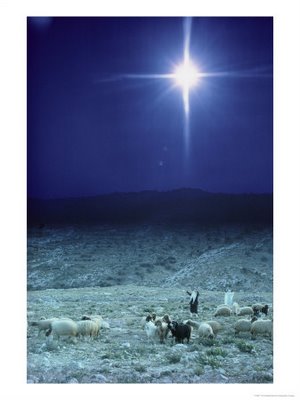 This means we can have peace on earth. Today.*
The angels told the shepherds on the first Christmas that the birth of a Jewish boy in Bethlehem meant "Peace on Earth."
And this is the sign unto you: Ye shall find a Babe wrapped in swaddling clothes, and lying in a manger.
And suddenly there was with the angel a multitude of the heavenly host praising God, and saying,
Glory to God in the highest,
And
peace on earth
among men in whom He is well pleased.
A favorite Christmas carol mentions this announcement:
| It came upon the midnight clear, That glorious song of old, From angels bending near the earth To touch their harps of gold: "Peace on the earth, good will to men, From heaven's all-gracious King." The world in solemn stillness lay To hear the angels sing. |
Another Christmas carol notes that Christian churches pay lip-service to this announcement::
| I heard the bells on Christmas Day Their old, familiar carols play, and wild and sweet The words repeat Of peace on earth, good-will to men! |
But the poem, written during the Civil War, expresses some doubt:
| Then from each black, accursed mouth The cannon thundered in the South, And with the sound The carols drowned Of peace on earth, good-will to men! |
The poet today might write about "The War on Terrorism."
| And in despair I bowed my head; "There is no peace on earth," I said; "For hate is strong, And mocks the song Of peace on earth, good-will to men! |
But the poet had something many of today's Christians lack: Optimism:
| Then pealed the bells more loud and deep: "God is not dead, nor doth He sleep; The Wrong shall fail, The Right prevail, With peace on earth, good-will to men." |
Probably a majority of self-described Christians today believe the future belongs not to "The Prince of Peace," but to "the antichrist," "great tribulation," "Armageddon," and global war and suffering.
Sure, things will be much better after The Second Coming of Christ. Then we will have "peace on earth." But not before.
Apparently, the angels were mistaken. They thought the first advent of Christ meant "peace on earth."
Apparently the only meaning of Christmas is
"You can go to heaven when you die, and leave all the war and suffering on earth."
This website challenges the prevailing pessimism.
Many people complain that the Bible is filled with war, slavery, and violence. "How can that be the Word of God?" they ask.
But the world before Christ really was filled with war, slavery, and violence. Many historians note that most human beings died violent deaths, or died prematurely from the violence of slavery, conquest, captivity, and all forms of human violence.
If they could travel through time from their day to ours, every prophet who spoke of the coming Messiah would fall on his knees in gratitude to God for the fact that most people on earth today die peacefully, not violently. They would be utterly speechless walking down the aisles of your local WalMart. The character of human life was changed dramatically by the babe born in Bethlehem. And further change is possible:
| For lo!, the days are hastening on, By prophet bards foretold, When with the ever-circling years Comes round the age of gold When peace shall over all the earth Its ancient splendors fling, And the whole world give back the song Which now the angels sing. |
Christ has already eliminated 99% of all the violence that existed in the world before the first Christmas.
With the poet who "heard the bells on Christmas day" we should note that with the birth of Jesus,
This website claims that Christians could end 99% of the remaining violence in the world in 2024.
But we have to believe in the real meaning of Christmas:
| Micah's Prophecy |
| Then they will hammer their swords into plowshares And their spears into pruning hooks; Nation will not lift up sword against nation And never again will they train for war. |
I believe that God says "Thou shalt not kill." "Everybody knows" that Jesus commanded His disciples to be "pacifists," but most churches say we can't take that to an "extreme." Most churches defend some killing. If someone personally insults you, you might be a "pacifist." It's OK to be "super spiritual" in your "private" life. But if some foreigner publicly insults your secular government, you'll "support the troops" as they drop bombs and kill children. "Spiritual" in the private sector, "responsible" and "practical" and "realistic" in the public sector.
Not only does Jesus command us not to kill, but even to love our enemies (Matthew 5:44). This is challenging, but do-able. Failure to shoot for this target ends up justifying mass murder.
During the 20th century, hundreds of millions of human beings were murdered by atheists, many of whom attended churches regularly. During my lifetime, "Christians" who worked for "my" government killed, crippled, or made homeless tens of millions of innocent non-combatant civilians around the world. I think the United States is the enemy of God and humanity. I guess other Christians think it's OK to inflict mass suffering and terror in order to keep gas prices down. "U.S.A.! U.S.A.! U.S.A.!" "I Pledge Allegiance...."
The Bible says we should beat our "swords into plowshares" (Micah 4). Most churches disagree. They cheer their members when they don the uniform of a soldier for a "New World Order."
Jesus commands us to
I was born in the year of "Sputnik," the Russian satellite that inaugurated "the Space Race" which was a part of "the Cold War." I wasn't yet in high school when the Vietnam War raged, and when the nation was divided by anti-war protesters. I was
raised to believe that socialism was evil and capitalism was good. I believed that the anti-war protesters were a bunch of anti-American commies. (They may well have been incited by Communists and used by Communists as tools or pawns in Moscow's attempt to bring down the
American/capitalist system. But they were on the right side of an immoral war.*)
During my lifetime, "my" government has killed, crippled, or made homeless TENS OF MILLIONS of
innocent, non-combatant, non-white civilians. The United States drops a bomb somewhere in the world every 12 minutes, on average. Barack Obama,
who won the Nobel Prize for Peace, maintained U.S. military bases in nearly 100 nations around the world, and dropped
thousands of bombs on homes, schools, hospitals, factories, and weddings around the world.
I always believed the U.S. military was a force for good.
It was only when I became a fundamentalist Bible-believing Christian that I began to question all this.
The message of this sermon is that a person is not a real Christian if that person is not a pacifist. You may not agree with the conclusion, but following the argument will stimulate thought. You will be glad you gave the argument some attention.
Most people would agree that a person who says we should hammer our "swords into plowshares" and "never again train for war" (Micah 4:3) is a "pacifist." Is this a "fringe" belief or is it central to the Christian faith?
Consider James 1:27
Pure religion and undefiled before God and the Father is this, To visit the fatherless and widows in their affliction, and to keep himself unspotted from the world.
|
If it's wrong to fail to "visit" or "watch over" widows, it is certainly wrong to create widows by killing their husbands.
The United States is the greatest Widow-Maker on earth. This makes the United States the enemy of pure religion.
But I had been raised to believe that all good Christians were to "support the troops."
In the last section of Matthew 25, Jesus says the way you treat widows and orphans and the sick and homeless and illegal aliens and those in prison is a measure of how Christian you are. People who traumatize widows and orphans and cause them to cry themselves to sleep at night are probably "goats," not "sheep."
Take an American child who has not yet entered government-run schooling and show the American child a photo of a child in Yemen or Iraq who has had her arms blown off by a U.S. bomb. That American child will know that something is wrong. Show that same photo to that same child after the child has graduated from Harvard University and has a prestigious job in the U.S. State Department. Watch the five-dollar words start flying: "Collateral Damage." "Realpolitik." "U.S. Partners and Allies." "National Security Interests."
Some might say that we are not commanded to take care of women and children if their husbands and fathers are our "enemies." That is, if those poor men have been conscripted at gunpoint by a tyrannical dictatorship and forced to fight against "U.S. armed forces" invading their homeland. After all, they are our "enemies." "Kill the commies." "Support our troops."
But Jesus commands His followers to love their enemies.
| “You have heard that it was said, ‘You shall love your neighbor and hate your enemy.’ But I say to you, love your enemies, bless those who curse you, do good to those who hate you, and pray for those who spitefully use you and persecute you,” Matthew 5:43-44 |
Jesus sacrificed Himself to save His enemies.
| Christ died for the ungodly God demonstrates His own love toward us, in that while we were still sinners, Christ died for us. For if while we were enemies we were reconciled to God by the death of His Son, much more, now that we are reconciled, shall we be saved by His life. Romans 5:6,8,10 |
The heartfelt desire of every true Christian is the
Regeneration,
Repentance,
Restitution,
Reconciliation, and
Redemption
of "the enemy."
Not the destruction of the enemy.
In short: "Love your enemy." (Matthew 5:43)
"Thou
shalt not kill." (Exodus 20:13).
You cannot love your enemy after you kill him.
It is better to be killed than to kill. Jesus chose to be killed rather than to kill.
1 Peter 2:21 commands us to follow "in His steps" at precisely the point where physical violence is unrighteously threatened against us. Whether by a home invader or a nation
invader.
All of this is obvious to a child, but we adults don't buy this nonsense.
The word "pacifism" comes from the Latin word for "peace." It does not come from the English word "passive." Supporters of the Vine & Fig Tree worldview are active in beating swords into plowshares.
The dictionaries usually give two definitions for "pacifist." First, an opponent of war. Second, an opponent of self-defense. That second definition is inaccurate. I know of no pacifist who would say that if you have a shield and someone comes after you with a sword, you cannot defend yourself against aggression with your shield.
The real issue is lethal "self-defense." If your sword-bearing attacker gets tired of whacking his sword against your shield, and lies down to take a nap, the pacifist would say you should defend yourself against further attacks by running away, not by cracking your attacker's skull open with your shield.
Our definition of "pacifist" is "one who keeps the commandments of Christ."
Here's what "swords into plowshares" pacifism means:
Jesus said ("Thou shalt not kill." Mark 10:19, quoting Exodus 20:13). John Calvin recognized that
"The sum of this Commandment is, that we should not unjustly do violence to any one. Under the word 'kill' is included by synecdoche all violence, smiting, and aggression."[1]
Jesus also said "Thou shalt not steal," (Matthew 19:18; Exodus 20:13-16; Deuteronomy 5:17-20), meaning, Thou shalt not confiscate someone else's property.
So can we all agree that basic Christian morality includes this:
But Jesus goes further.
He says we are not to hurt our enemy. Even if our enemy hurts us first.
We are not allowed to confiscate the stuff belonging to our enemy, even if he's our enemy because he did not join us in voting for the winning candidate. So how does the world
get to the “Vine & Fig Tree” world? According to the Bible, just follow basic Christian morality:
Then if someone else decides to hurt you or take your stuff.
That means that if someone hurts you or takes your stuff, and you seek reconciliation, but you're rebuffed, then you cannot hire a Mafia "hit-man" to take vengeance against your unrepentant enemy.
Most Christians will agree with that.
But here's the kicker:
If someone hurts you or takes your stuff, and you seek reconciliation, but you're rebuffed, then you cannot "vote" for a "representative" to tax your neighbor and build a "military-industrial complex" to take vengeance against your unrepentant enemy. You will vote such politicians out of office. If you vote all non-pacifists out of office, you will no longer have a "government."
All pacifists are anarchists.
Myth:
Fact:
Peace through Peace, not through "Strength." | "Swords into Plowshares"
Pacifism leads to Anarcho-Theocracy
Peace is possiblePeace is the opposite of Violence. The State is a monopoly of violence. Therefore pacifism produces anarchism or archistlessness.
Walmart does not threaten to drop a bomb on your home if you cross "the red line" and shop at another store. That's what "the government" does. Capitalists use persuasion rather than violence.
Jesus commands us to love our enemies, but also to try to win them back to faithfulness. But sometimes persuasion does not bring instant success. We mentioned Matthew 18 above. Jesus lays out steps to follow to win back an erring brother. But if these steps fail, the church must "excommunicate" the sinner. This should be the basis for a capitalist economy.
A free market economy depends on Godly character. This in turn requires Godly education. We saw above what John Adams said in this regard:
We have no Government armed with Power capable of contending with human Passions unbridled by morality and Religion. Avarice, Ambition Revenge or Galantry, would break the strongest Cords of our Constitution as a Whale goes through a Net. Our Constitution was made only for a moral and religious People. It is wholly inadequate to the government of any other
Substitute "free market" for "Constitution."
Nobody can read the Bible and avoid the conclusion that the institution we call "the State" is institutionalized vengeance.
If someone does something you don't like, you are prohibited from taking vengeance, from confiscating his property, or depriving him of his life.
You are also prohibited from hiring a "contract killer" to kill him. Wouldn't you agree? You personally didn't do the killing -- the "hit-man" you hired actually did the killing -- but you share in the guilt.
You are also prohibited from "voting" for someone to be your "representative" and kill people you don't like.
Every political science professor in every university on planet earth will agree that the essential nature of "the State" is violence. It claims a "monopoly on violence."
So
• if you oppose violence,
• if you oppose theft, and
• if you oppose vengeance,
every political science professor in every university on planet earth, and every seminary professor, and every
pastor of every entity calling itself a "church" is going to say you are an "anarchist."
| Westminster Standards |
|
| Micah's Prophecy |
| Micah 4:3
And He will judge between many peoples |
In the "North Garden" of the United Nations in New York is a statue of a man beating a sword into a plowshare. Inscribed on the pedestal are the words "We shall beat our swords into plowshares," although the U.N. website says the title of the statue is "Let us beat swords into plowshares." Isaiah is quoted, in the prophecy which directly parallels the passage in Micah. The statue was a gift to the United Nations in 1959 from the compulsory sword-enforced "Union of Soviet Socialist Republics." The U.N. says the statue "symbolizes man’s desire to put an end to war and transform tools of destruction into tools to benefit mankind."
Does "man" really have such a desire? See Theme 14 below.
What would it take to "put an end to war?" If this desire were to be put into force, what other effects would it have?
Micah says nations will not "train for war." If there were sufficient political will to abolish West Point, what else would be abolished?
If there were sufficient voter mandate to abolish West Point and not go to war, you would wonder if voters wouldn't also abolish the rest of the U.S. government.
If you are a pacifist (Theme 9 above) you are also an "anarchist." If there is no justification for war, there is no justification for "the State."
I think every Professor of Political Science would agree with that claim. If you reject the idea of "National Defense" (all wars are "defensive"), you won't form "the State."
The word comes from two Greek words meaning "not" an "archist."
An "archist" is a "ruler." We here at Vine & Fig Tree invented the word "archist," deriving it from a Greek word found in Mark 10:42-45, from which the English word "anarchist" is derived.
An "archist" believes he has the right to impose his own will on others by force or threats of violence.
We have been brainwashed in "public" schools (run by archists) to believe that an "anarchist" is:
Anyone can be called an "anarchist" by someone who wants to vilify an opponent, but most of those who call themselves "anarchist" have reached their position by their opposition to violence. I am a pacifist, therefore I am opposed to any institution of systematic violence and coercion (e.g., "the Mafia," "the State," etc.).
By etymological definition, the opposite of an "anarchist" is an "archist." By being trained to believe that "anarchists" are bad, we've been subtly inculcated with the belief that those who protect us against "anarchists" (logically, "archists") are good.
But the Bible says archists are bad, and explicitly prohibits us from being archists.
And as we will see below, Jesus prohibits His followers from aspiring to rule over others. Jesus said a Christian must not be an "archist."
An "archist" is a "ruler." We here at Vine & Fig Tree invented the word "archist," deriving it from a Greek word found in Mark 10:42-45, from which the English word "anarchist" is derived. In the Gospel of Mark, chapter 10, Jesus discovers His disciples arguing about who is going to be the "greatest" in the Kingdom of God. Their concept of the Messiah was someone who would use force and violence to vanquish the Roman occupation army that held Israel under tribute. They looked forward to the coming of a Messiah who would enlist them into a Messianic Israeli Army which would "stick it to" the Romans. But just as Micah said we should beat "swords into plowshares," Jesus said His disciples should "love your enemies," and if their soldiers conscript you to carry their provisions for one mile, you should go with the occupation forces two. (This form of pacifism completely refutes the legitimacy of "national defense.") The disciples didn't understand that Jesus' Messianic Kingdom was quite unlike the kingdoms of the world.
But Jesus called them to Himself and said to them, "You know that those who are considered rulers over the Gentiles lord it over them, and their great ones exercise authority over them. {43} Yet it shall not be so among you; but whoever desires to become great among you shall be your servant. {44} And whoever of you desires to be first shall be slave of all. {45} "For even the Son of Man did not come to be served, but to serve, and to give His life a ransom for many." |
The word translated "rulers" comes from the Greek word from which we derive our English word "anarchist" ("a + archist" -- the first "a" is the Greek letter "alpha," known as the "alpha privative," meaning "not" -- a[n]archist -- the letter "n" bridges the "alpha privative" and the word "archist").
"Lords," "rulers" and "great ones" are "archists."
An "archist" believes he has the right to impose his will on other people by force. He need not rely solely on persuasion. He need not give others anything of value in exchange for what he wants from others. He can threaten violence, and carry out those threats if he doesn't get what he wants. It would be sinful for others to engage in such violent extortion or vengeance, but the "archist" claims a "legal" and moral right to do what others must not do.
Jesus clearly says His followers are not to be "archists." They are to be "servants."
A Christian society is an archist-free society.
Jesus says His followers are not to be archists. Connect the dots. Christians must be "an-archists."
www.HowToBecomeAChristianAnarchist.com
If you oppose violence, you cannot be an "archist."
A logically consistent Christian pacifist is also an anarchist, for two reasons:
• First, a pacifist is against violence, and "the State" is institutionalized, systematic violence;
• Second, Jesus prohibits His followers from being "archists"
An "archist" is one who believes he has a
right to impose his own will on others by force or threats of violence. Chiefly, the "archist" imposes his will on others through the machinery of "the State," whose tactics include
• fines,
• prisons,
• torture,
• executions,
• armed invasions, and
• terrorism.
The Christian, on the contrary, believes it is always sinful to impose your own will on others by initiating force or threatening
violence. (We are to be servants, not "archists." Mark 10:42-45.) I know, that sounds "weird." "Anarchism?" Aren't "anarchists" bad people?
As I read the Bible, the bad guys are the "archists." Chapter after chapter in the Bible says "archists" are false gods.
Only Jesus is a legitimate Archist.
By etymological definition, the opposite of an "anarchist" is an "archist." By being trained to believe that "anarchists" are bad, we've been subtly inculcated with the belief that those who protect us against "anarchists" (logically, "archists") are good.
To put it favorably:
To put it unfavorably:
People who want some socialism, some fascism, some communism -- but especially people who want full communism or total socialism -- see pure capitalism as "anarchy." One economist, Murray Rothbard, coined the term "anarcho-capitalism" to describe a society with 0% socialism, 0% fascism 0% communism, 0% corporatism, 0% crony capitalism, 0% keynesianism, 0% democratic socialism, and a 100% pure Free Market.
But without any socialist bureaucracies whatever, and without any armed KGB agents whatever, and with no military parades with tanks and missiles led by Generalissimo So-and-So, people who favor some socialism or a little bit of communism see "anarcho-capitalism" as just plain "anarchy."
Even more offensive to modern Christians than the belief that Jesus is the Christ today (and we shouldn't be waiting around for a second advent of Jesus) is the claim that Jesus is THE Christ today; that in our day there is no other legitimate Christ, no other legitimate king.
Nobody believes in "kings" anymore. So let's update our language.
As we will see below, Isaiah 33:22 confirms this:
For the Lord is our Judge,
The Lord is our Lawgiver,
The Lord is our King;
He will save us
As we will see below, it was a mistake for Israel to want an earthly king to replace God (1 Samuel 8).
Mark 10:42-45 (and other passages we're going to be considering in a moment) teaches that
When the people become more moral, and reject violence and coercion, they reject socialism, fascism, and what we call "civil government." And those who get a paycheck from "the government" will denounce the absence of coercion as "anarchy!" So the Marketing Dept. says we should call it "Archistlessness."
The word "anarchist" comes from two Greek words meaning "not an archist."
Q.: What is an archist?
A.: A bad person. A person who
lacks Godly character. Seeks to be god, impose vengeance, regulation by threats of violence.
Beating "swords into plowshares" implies a theory of government, as well as a theory of eschatology.
Even more offensive to modern Christians than the belief that Jesus IS the Christ (today) (and we shouldn't be waiting around for a second advent of Jesus) is the claim that Jesus is THE Christ today; that in our day there is no other legitimate Christ, no other legitimate king.
Nobody believes in "kings" anymore. So let's update our language.
Isaiah 33:22 confirms this:
For the Lord is our Judge,
The Lord is our Lawgiver,
The Lord is our King;
He will save us
Some conservatives, like David Barton, have seen this verse as a justification for three "branches" of government. But these functions are interchangeable. "Judges" in the Bible "ruled" as kings do. Jesus is a "unitary" Savior who discharges all the responsibilities which human "government" wants to monopolize.
As we will see below, it was a mistake for Israel to want an earthly king to replace God (1 Samuel 8).
And as we will see below, Jesus prohibits His followers from aspiring to rule over others. Jesus said a Christian must not be an "archist."
Nor can a Christian "vote" for archists.
If God prohibits you from stealing, you cannot "vote" for someone to steal for you.
If God says you cannot hurt other people, you cannot "vote" for someone to hurt
other people for you.
Mark 10:42-45 (and other passages we're going to be considering in a moment) teaches that
People who don't see earthly "archists" as bad guys are themselves guilty of idolatry.
The Bible is an "Anarchist Manifesto." From cover to cover, the Bible condemns archists -- violent people, like Cain, Lamech, violent men that provoked the flood in Noah's day, Nimrod, and so on. These evil, violent people are the ones who created "civil governments."
The Origin of "the State" ("Civil Government") - Political Philosophy 101 According to the BibleChristians who strongly oppose "anarchism" (I used to be one of them) believe the Bible prescribes (not just describes) civil governments. They believe God's Law contains laws for "governments."
Every political science professor in every university on planet earth will agree that the essential nature of "the State" is violence. It claims a "monopoly on violence." Wikipedia || Encyclopedia Britannica || Oxford || More: The State as Monopoly of Violence
Using the Greek word from which we derived the English word "anarchist," Jesus plainly says His followers are not to be "archists." Mark 10:42-45. We are to be servants, not "archists." "Not" + "archist" = "anarchist"
Only Jesus is a legitimate Archist.
People who don't see earthly "archists" as bad guys are themselves guilty of idolatry.
God says "Thou shalt not steal."
You would never go up to your next-door neighbor, put a gun to his head, and say "give me some of your money."
But you vote for people who promise
to do this on your behalf, and give the money to you or people you approve of.
There is no ethical difference between "taxes" and "extortion."
Here's an example of me butting-in on someone's blog and promoting my views: Godwords.
"What about Romans 13?" I'm always asked this question when I say I'm an "anarcho-pacifist."
Romans 12 and 13 are a unit on not resisting evil. "Bless those who persecute you" (Romans 12:14) does not mean that persecutors have God's ethical approval. They need to repent. We are not to resist evil (Romans 12:19), but to overcome evil with good gifts (Romans 12:21), even (turn the page) the most evil entity on the planet: The State (Romans 13:1ff). Paul refers to the Empire as "the Powers." Everywhere that Greek word is used in the New Testament, it means "demonic." Even the Romans believed that demons (daimones, daimoneV) guided the Empire.
The message of Romans 13 is "be subject to evil." The message of Romans 13 is not "evil is good."
Yes, "all things work together for good" (Romans 13:4; 8:28), even evil things, like "principalities and powers" (Romans 8:38) and their sword (Romans 8:35).
But evil people have a moral obligation to repent of things that pacifists have a moral obligation to submit to.
We support 100% pure laissez-faire capitalism. We almost had this back in America's “Vine & Fig Tree” days. Jacob Hornberger describes those days:
Our ancestors brought into existence a society in which there was no income tax or IRS, one where people could keep everything they earned and decide for themselves what to do with it. There was no Social Security, Medicare, Medicaid, farm subsidies, education grants, food stamps, public housing, or FDIC. Indeed, there was no welfare state or mandatory, coercive charity. There were no drug laws. There were very few economic regulations, especially at the federal level. No minimum-wage laws. No occupational-licensure laws. No Federal Reserve. No fiat money: the official U.S. money consisted of coins made out of precious metals. No immigration controls. No public (i.e., government) schooling. No national-security state. America had a relatively small army that was nothing like the enormous military establishment and military-industrial complex that exist today. No foreign military bases. No regime-change operations, coups, foreign interventions, foreign aid, or alliances with foreign regimes. No CIA. No NSA. No official programs for mass surveillance, torture, and assassination.
That is the most remarkable political and economic achievement in history. Never in history has there existed such a society. It was the closest that people have ever come to what libertarians envision as a genuinely free society. Notwithstanding the exceptions (e.g., slavery and tariffs), the result was the freest and most prosperous nation in history and certainly among the most peaceful and harmonious for most of the time (the Civil War, the Mexican War, slavery, and the war against American Indians being notable exceptions).
Today the exceptions have become the rule.
A 100% pure laissez-faire capitalist society depends on people being committed to obeying God's Law, particularly laws that require families to take care of their own, and neighbors to take care of families that cannot. Getting rid of tyrannical government requires a great moral elevation in society. It requires extreme Biblicism among "We, the People."
So what is the result of extreme Biblicism? Where will that lead?
I call it the “Vine & Fig Tree” worldview. I created a non-profit organization to promote this worldview.
People tell me that my extremism is "unrealistic," "impractical," and "utopian."
In his diary on February 22, 1756, John Adams, later second President of the United States, wrote this:
Suppose a nation in some distant region should take the Bible for their only law book, and every member should regulate his conduct by the precepts there exhibited! Every member would be obliged in conscience,
• to temperance, frugality, and industry,
• to justice, kindness, and charity towards his fellow men; and
• to piety, love and reverence towards Almighty God.
What a Utopia, what a Paradise would this region be.
I believe the only law book we need is the Bible. I'll say more about this in just a minute. The Bible is a textbook for every subject, not just religion. In our day, that's one of the most offensive things anyone can say.
I know my way around a law library. I've spent hundreds of hours in law libraries studying the law books of civil government. I passed the California Bar Exam, but was denied a license to practice law because America -- once a Christian nation -- is now a secular nation, and Christians cannot become attorneys, according to the Supreme Court of the United States, because their allegiance to God's Law Book trumps their allegiance to Washington D.C.'s law books. Details.
Not everyone is going to take the Bible as their only law book, and behave like Jesus commands all men to behave. What should we do about these people? Jesus gave us a step-by-step blueprint to follow in Matthew 18. Here's how that could work out. The Bible never commanded human beings to form "governments" to deal with criminals by taking vengeance against them. In fact, it is a sin to create a government. Creating a government is a rejection of God (1 Samuel 8). The cost to society of a government is greater than the cost to society of criminals under anarcho-pacifism. We'll return to this below.
Most people who call themselves "Christians" today believe that Micah's prophecy will not begin to see fulfillment until Jesus returns to earth a second time. But the Bible teaches that Jesus was born during "the last days" of the Old Covenant, and He put into effect a New Covenant, and as a result of this New Covenant, billions of human beings have been streaming to "the mountain of the Lord," and the world is more obedient to God's Commandments today than it was before Jesus was born. The world is more peaceful. The mainstream media and secular academia do not want you to understand this.Nor do most clergymen. The more perceptive clergy will say that our belief that Micah's prophecy is already being fulfilled, and that we should continue beating swords into plowshares, is "dangerous." They will warn you that we are promoting the ancient heresy of "anarcho-preterism." They are correct (we are indeed promoting "anarcho-preterism") except for two things:
Distilled into a single proposition, Vine & Fig Tree stands for this:
Jesus is the Christ Today
To say that Jesus is the Messiah today is to say that Jesus became the Messiah in the past, rather than saying He must come again (in the future) before He can begin His Messianic Reign.
It's easy enough to prove that Jesus was made the Christ in the past. Peter explains it in Acts chapter 2. After the Apostles spoke to a large audience of people "from every nation under heaven" (Acts 2:5) in all their various foreign languages, Peter explained that this was a fulfillment of an Old Testament prophecy. He further explains how Jesus had already fulfilled the Davidic prophecies about the enthroning of the Messiah:
| Acts 2 14 But Peter, standing up with the eleven, raised his voice and said to them... “This is what
was spoken by the prophet Joel:
17 ‘And it shall come to pass in the last days, says God,
And signs in the earth beneath: Blood and fire and vapor of smoke. 20 The sun shall be turned into darkness, And the moon into blood, Before the coming of the great and awesome day of the Lord. 21 And it shall come to pass That whoever calls on the name of the Lord Shall be saved.’ 22 “Men of Israel, hear these words: Jesus of Nazareth, a Man attested by God to you by miracles, wonders, and signs which God did through Him in your midst, as you yourselves also know— 23 Him, being delivered by the determined purpose and foreknowledge of God, you have taken by lawless hands, have crucified, and put to death; 24 whom God raised up, having loosed the pains of death, because it was not possible that He should be held by it. 25 For David says [Psalm 16:8–11] concerning Him: ‘I foresaw the Lord always before my face, 29 “Men and brethren, let me speak freely to you of the patriarch David, that he is both dead and buried, and his tomb is with us to this day. 30 Therefore, being a prophet, and knowing that God had sworn with an oath to him that of the fruit of his body, according to the flesh, He would raise up the Christ to sit on his throne, 31 he, foreseeing this, spoke concerning the resurrection of the Christ, that His soul was not left in Hades, nor did His flesh see corruption. 32 This Jesus God has raised up, of which we are all witnesses. 33 Therefore being exalted to the right hand of God, and having received from the Father the promise of the Holy Spirit, He poured out this which you now see and hear. 34 “For David did not ascend into the heavens, but he says [Psalm 110:1] himself: ‘The Lord said to my Lord, 36 “Therefore let all the house of Israel know assuredly that God has made this Jesus, whom you crucified, both Lord and Christ.” 37 Now when they heard this, they were cut to the heart, and said to Peter and the rest of the apostles, “Men and brethren, what shall we do?” 38 Then Peter said to them, “Repent, and let every one of you be baptized in the name of Jesus Christ for the remission of sins; and you shall receive the gift of the Holy Spirit. 39 For the promise is to you and to your children, and to all who are afar off, as many as the Lord our God will call.” 40 And with many other words he testified and exhorted them, saying, “Be saved from this perverse generation.” |
God made Jesus of Nazareth the Christ -- 2000 years ago -- fulfilling the Old Testament prophecies concerning the throne of David. Peter and other devout Jews came to believe this; Christians should believe this; today's Jews do not. What was happening in Peter's "present" happened in our "past."
Even more offensive to modern Christians than the belief that Jesus is the Christ today (and we shouldn't be waiting around for a second advent of Jesus) is the claim that Jesus is THE Christ today; that in our day there is no other legitimate Christ, no other legitimate king.
Nobody believes in "kings" anymore. So let's update our language.
As we will see below, Isaiah 33:22 confirms this:
For the Lord is our Judge,
The Lord is our Lawgiver,
The Lord is our King;
He will save us
As we will see below, it was a mistake for Israel to want an earthly king to replace God (1 Samuel 8).
This means that a Christian economy is 100% "capitalist" and 0% "socialist."
Many people today grossly misunderstand those terms. They think "capitalism" means politicians support big corporations. They think "socialism" means politicians have "compassion for the poor." What causes confusion is the term common to both ideas: "politicians."
From a Biblical perspective, politicians are wanna-be christs.
All governments are oligarchies: monarchs have their "advisors" and enforcers; republics have their "deep state."
A society that is Biblical is archist-free. These three texts show this.
Our first text is Isaiah 33:22
For the Lord is our Judge,
The Lord is our Lawgiver,
The Lord is our King;
He will save us
Some have said that all three "branches" of government are seen here. Probably not the way the Hebrews thought, but the point is that God is our Governor. God provides Government.
God governs from heaven through Providence, not visible physical enthronement in Jerusalem. This is the major error of the "pre-millennialists." See the discussion of the "invisible hand" above. Micah's Vine & Fig Tree prophecy (Micah 4:1-7) says
And He will judge between many peoples
And render decisions for mighty, distant nations.
While it's true that Jesus is the Word, the Word does not judge by sitting on a visible, physical throne in Jerusalem. "The Word" that judges nations is God's Law:
For from Zion will go forth the Law
Even the Word of the LORD from Jerusalem.
As we saw above, man's chief purpose on earth is to build the City of God. The New Jerusalem is not handed to man on a silver platter fully-built. It is built by the "invisible Hand" of "Divine Providence," but God uses obedient and responsible human agents. An "invisible" Hand requires visible human servants, who are hands, feet, eyes, and other "members" of the Body of Christ.
Israel rejected this concept.
Israel wanted visible physical archists like the Gentiles had. Emperors, Pharaohs, Molochs, and
Caesars.
This brings us to our second text: 1 Samuel 8
Read the passage. Read the commentary in that link. The Bible says Israel, in desiring a king like the Gentiles had, was rejecting God. This is an awe-ful and profound indictment. Israel, "the chosen people," rejected the God who chose them, preferring the central-planning archist gods of the pagans. The Israelites were idolators.
Of course, Israel's rejection of God didn't stop God from governing. We hear much from premillennialists that Jesus offered Himself to Israel as Messiah, but Israel rejected Him as King, so He could only be "savior." This is nuts. Jesus was King whether the Jewish establishment wanted Him or not, and He destroyed apostate Israel in a day of fiery vengeance.
Luke 21:20
“But when you see Jerusalem surrounded by armies, then know that its desolation is near. 22 For these are the days of vengeance, that all things which are written may be fulfilled.”Luke 19:14,27
14 But his citizens hated him, and sent a delegation after him, saying, ‘We will not have this man to reign over us.’
27 But bring here those enemies of mine, who did not want me to reign over them, and slay them before me.’”Matthew 22:1-14
But when the king heard about it, he was furious. And he sent out his armies, destroyed those murderers, and burned up their city. (cf. 2 Thessalonians 1:3-10)
We see the error of 1 Samuel 8 in Christ's apostles before they were filled with the Spirit. They not only wanted Jesus to be a visible physical archist to overthrow the Roman occupation army, they too wanted archist powers to take vengeance on their oppressors. None of this has a place in Christ's Kingdom. This is seen in our third text, Mark 10:42-45, where the Greek word underlying the English word "anarchist" is found. (We looked at this passage above.)
1 Samuel 8 teaches that the desire for a visible, physical archist is a rejection of God.
Jesus prohibits "archism"In the ancient world, all empires and politicians were religious. The emperor/pharaoh/caesar was a deity. Politicians were gods and mediators/priests.
Today the politician -- and the Polis -- is said to be "secular," but this is only
evidence of the religion of Secular Humanism.
In the Old Testament, archists were called "gods" (Ps 82, etc.).
The desire for a physical, visible archist = idolatry
Human archists
= false gods = idols
There is no such thing as a "good" archist.
By definition, "the government" is an institution which claims the right to steal,
kidnap, and murder. If it doesn't make that claim, and does not accomplish its goals through violence (which would otherwise be universally acknowledged as sinful in "the
private sector"), it's not a "government" and is not made up of archists. It's just a Rotary Club or some other voluntary
association. (Which would be a good thing. Voluntary non-violent non-coercive associations provide all the governance any human society needs:
• homeschools educate,
• businesses
discipline, and
• competitive free market Dispute Resolution Organizations resolve disputes.
This is "governance"
without "the government.")
"The State" is a criminal enterprise. It is prohibited by God's Law, even if God Himself "ordains" it (brings it into existence), like God created Assyria (Isaiah 10) or Rome (Luke 21:20-22) to judge (rape, pillage, burn, destroy) Israel.
Followers of Christ are prohibited from being archists.
| Westminster Standards |
| Chapter 23 the Civil Magistrate |
| Micah's Prophecy |
| Focus text: "His Vine"
And each of them will sit under his |
The monogamous heterosexual family is the root of civilization. "Patriarchy" is a hated word. It doesn't mean what you think it means.
We use the word "patriarchy" to describe a society where the Family is the central unit. A "patriarch" is not a wife-beater; but the beginning of the "family tree.". Patria is the Greek word for "Family," and arche is the Greek word for "beginning" (see John 1:1 - Ἐν ἀρχῇ ἦν ὁ λόγος, En archē ēn o logos, "In the beginning was the Word").
Modern feminists say we must "Smash the Patriarchy!" "The Patriarchy" refers to social institutions like church and state which are dominated by men. Conservatives say only men should be priests and kings; women should not be "ordained." Feminists want women to be priests and kings as well as men. The Biblical view is for nobody to be "ordained." No human being should be a priest or a king. Only Jesus is our Priest and King. The Biblical way to "Smash the Patriarchy" -- "The Establishment" -- The Military-Industrial-Civil-Financial-Pharmaceutical-Academic-Religious-Entertainment Complex -- is not to expand it to include women, but to abolish it altogether.
This verse from Micah assumes "family values" taught elsewhere in the Bible in more detail. It also assumes the family history -- that is, the history of patriarchy -- discussed above.
Pierre Joseph Proudhon: Patriarchy and Agrarian Jurisprudence
The modern concept of "separation of church and state" -- which really means the "separation of God and the Public Square" -- denies the concept of Biblical Theocracy. This website not only denies "the separation of church and state," but promotes "the abolition of church and state."
The Bible uses “Vine & Fig Tree” imagery to describe a time when we beat our "swords into plowshares" and everyone dwells peacefully under his own “Vine & Fig Tree.” The New Testament describes Christians as "sons of Abraham" the Patriarch. Abraham and Sarah were not under the rule of any State or Empire. The desire to have a creaturely king is a rejection of God the Creator as King (1 Samuel 8; Romans 1:25). The real meaning of Easter is that Jesus is now -- in 2022 -- the only legitimate King. Every king on planet earth should immediately abdicate and get a real job in "the Private Sector." This is one reason why every government in the last 2000 years has eventually banned the Bible. Even the United States, where The Supreme Court has ruled that public school teachers cannot tell students that Jesus the King says "Thou shalt not steal" (Matthew 19:18; Exodus 20:13-16; Deuteronomy 5:17-20). Creaturely kings are "false gods" in the Bible, and they correctly view the Bible as a threat to their idolatrous reign: to them, The Bible is an "Anarchist Manifesto." According to the Bible, creaturely government is "The Most Dangerous Idolatry." It will take me a while to convince you that the Real Meaning of Easter is “Vine & Fig Tree.” I'll have to persuade you to read a lot of Bible verses through new eyes.
Abraham and Sarah did not "go to church." Their priest was Melchizedek, as is ours.
Family = "undemocratic" says progressives
When families are functional, the State is unnecessary;John Adams: importance of mothers
The Family is God's central unit of society. The family is commanded to teach God's Law. Therefore next installment: Education
| Westminster Standards |
| Chapter 24 Marriage and Divorce |
| Micah's Prophecy |
| And each of them will sit under his Vine and under his fig tree,] |
Vineyards and orchards require tending. The fruit (produce) requires packaging and transport if being sold to others.
Our text here is "the Dominion Mandate," Genesis 1:26-28. Also, Genesis 2:15,19
Here we read the purpose for which God created Man.
Human beings were created to "exercise dominion" over the earth as stewards of God's property.
This means growing
and building the Kingdom of God, for the glory of God.
This means transforming a wilderness into a Garden, and the Garden into the City of God, the New Jerusalem, a city of unlimited growth and wealth.
I have benefited from a book entitled, Images of the Spirit by Meredith G. Kline. Genesis 1:2 is a "theophany" -- an appearance or manifestation of God on earth. Kline suggests that the physical theophanic Glory of the Holy Spirit, who hovered over the original earth creation in Genesis 1:2, served as the "divine model" for man's creation. In expounding these themes, Kline develops a system of typology where the Garden of Eden, the tabernacle, temple, priest and prophet are all modeled after the archetypal form of the Glory-Spirit, which is a model of heaven itself. Jesus taught us to pray that God's will would be done "on earth as it is in heaven" (Matthew 6:10). Comparing the first chapters of Genesis and the last chapters of Revelation suggests that man's original purpose is nothing less than building the City of God, the New Jerusalem. Edenic motifs are clearly seen in Revelation 21. The "newness" of the "New" Jerusalem is the absence of the ceremonial temple, and the liturgical or restorative patterns of reconciling God and sinners found in the Old Covenant. Just as man was to "dress and keep" the Garden, so he was/is to dress the entire world into the City of God.
Some people object to our belief in predestination. They say this destroys man's responsibility for action. But they also deny that man has a responsibility to take the actions necessary to bring heaven to earth and build the City of God. The the “Vine & Fig Tree” worldview places more responsibility on man than those who deny God's predestination.
Many people object to the idea that man builds the Kingdom of God. They say this is "humanistic," and that the Polis of God must be created wholly by God with no participation by man, and then handed to man on a silver platter. Correct thinking on this issue requires a "paradigm shift." Hal Lindsey represents the old paradigm:
There used to be a group called "postmillennialists." They believed that the Christians would root out all the evil in the world, abolish godless rulers, and convert the world through ever-increasing evangelism until they brought about the Kingdom of God through their own efforts. Then after 1000 years of the institutional church reigning on earth with peace, equality and righteousness, Christ would return and time would end. These people rejected much of the Scripture as being literal and believed in the inherent goodness of man. World War I greatly disheartened this group and World War II virtually wiped out this viewpoint. No self-respecting scholar who looks at the world conditions and the accelerating decline of Christian influence today is a "postmillennialist."
Hal Lindsey, The Late, Great Planet Earth, 1970, p. 176
The idea that Christians would bring about the Kingdom of God "through their own efforts" is a real red-flag for these kind of Christians. They say it reeks of "secular humanism."
Obviously, "anarcho-preterists" do not believe that The City of God is designed by a joint act of Congress. The New Jerusalem is not the vision of an ecclesiastical council or synod, or ecumenical one-world religion. But even as the leaders of church and state conspired together to kill Jesus, even today they are unwittingly orchestrated by the "Invisible Hand of Divine Providence" to enlarge the City of God.
The New Jerusalem is the Bride of Christ, and she must adorn herself for her Husband with righteous acts (Revelation 21:2; 19:7-8; Psalm 45:9-14; Isaiah 54:5; 61:10; 62:4).
But God still gets all the credit.
Consider the "Division of Labor" (Romans 12; 1 Corinthians 12).
There is not a single person on planet earth who can build a pencil
from scratch. This is because all the labor and skills required to extract the raw materials from God's Creation and assemble them into a pencil are divided among many human beings, no one of them possessing all the skills and knowledge needed to plant and harvest
trees, extract and refine chemicals, and build the equipment which fabricates a pencil. While Faber-Castell might get credit for making pencils, many other companies had a hand in the task. Previous generations saw the
global human economy as being overseen by an "Invisible Hand." Also called "Providence," about which we'll see more below.
Ultimately, only God can get credit for building the New Jerusalem, but man is commanded to do the work.
Imagine the construction of a large apartment. I mean really large, like 432 Park Avenue, the tallest residential building in New York. Or five of the ten tallest buildings in the world, found in Dubai, United Arab Emirates. One of these buildings can house 25,000 human beings. Who gets "credit" for building one of these buildings? Maybe the architect -- except it was a team of architects. Maybe the CEO of the Construction firm, but he personally does not know how to build a cement mixer. Suppose your vocation is being a plumber, and you were hired to install a unique sink in one of the residences on the 32nd floor during the construction of one of these buildings. Do you get credit for building the building? Of course not. You knew very little about what kind of building was being constructed. You were just fulfilling your individual calling as a plumber. Should you say, "This is not my building, so I'm not going to contribute to its edification?" That would be disobedient.
Each human being has a calling to build part of the Kingdom of God. It is man's job to build the kingdom. God gets all the credit.
Man's divine purpose on earth is to create a flourishing anarchist society, overseen only by an Invisible Hand.
A Jewish scholar named Franz Oppenheimer divided people into two groups.
The first group he called "Economic Man." "Economic Man" engages in work, produces things of value (or provides valuable services) and gets paid, then trades that money for things other people produce.
The second group he called "Political Man." These people do not produce, they confiscate.
Because Christians are "pacifists," they believe in overcoming evil with good. In Romans 12, we respond to evil with food or drink, and in Romans 13 we respond to evil with gifts of money, hoping in these cases that God will grant repentance to those who do evil to us.
Taxation is extortion, a form of theft. There isn't a single verse in the Bible to which any human being alive today can point to and say, "This verse assures me that if I declare myself to be the king, I can threaten you with violence if you do not give me the money I demand, and God will not hold me guilty of sin."
If someone sins against you, and you do everything Jesus says to do in order to help that person repent and right his wrongs, Jesus says to "excommunicate" him (our modern terminology, not His), and treat him like someone who cannot possibly be a genuine Christian: "a tax collector" (Matthew 18:17).
If there is no theft, there is no "State." "Civil Governments" do not exist without "taxation," which is theft. "Civil government" is distinguished from businesses and charities by its claim to have a right to steal.
| “Public Sector” | “Private Sector” |
| “Government” Sector | Non-“Government” Sector |
| Monopoly Sector | Competitive Sector |
| Coercive Sector | Persuasive Sector |
| Violent Sector | Peaceful Sector |
| Parasite Sector | Productive Sector |
| "Political Man" | "Economic Man" |
Private Service Creates Public Order
"Public Service" Creates Disorder
There is a standard by which we judge our efforts at constructing the Kingdom of God. It is the Bible.
Specifically, God's Law. (All of Scripture is Law, because all of Scripture is breathed-out by God, who is our Lord, and every utterance of a Sovereign is to be respected and obeyed by His vassals.)
The Bible makes up the blueprints for the building of the New Jerusalem, the Kingdom of God. These Blueprints were drafted by the Master Architect. We are to follow the blueprints as servants and laborers, but God gets the glory. As Calvin put it:
As soon as we acknowledge God to be the supreme Architect, who has erected the beauteous fabric of the universe, our minds must necessarily be ravished with wonder at his infinite goodness, wisdom, and power.
Rushdoony has written that God's Law is God's Plan for Victory and Dominion. God's Law commands us to build the Kingdom of God, and tells us exactly how to do this. God's Law both commands and promises success in building the Kingdom of God.
Such Promises ("blessings") are found in texts like Leviticus 26 and Deuteronomy 28.
Obedience to God's commandments brings blessings, specifically, the blessing of peace.
Peace means freedom from the
initiation of force or threats of violence by others. Since archists are those who employ violence as a means to an end, "peace" means "freedom from archists." The Bible
distinguishes "workmen" from the "horns" of power (Zechariah 1:18-21), and if we work to build God's Kingdom and do not become archists,
God will keep those nasty archists away from us:
Proverbs 16:7
When a man’s ways please the LORD,
He makes even his enemies to be at peace with him.
The Blessing of Freedom from Archists
Obedience to God's Law is blessed by God with anarcho-capitalism.
Exercising dominion according to God's Law brings God's Blessings, which constitute "salvation."
By comparing the first two chapters of Genesis with the last two chapters of Revelation, it becomes clear that Man's purpose is to build the City of God, the New Jerusalem.
The Hebrew word for "glory" is related to the word for "weight." In the Bible, gold makes better money than paper. [Explore this theme] Man's purpose is to create real wealth.
In the third chapter of the Bible, Satan enters the scene and tempts Adam and Eve to build their own city instead of God's City. "Ye shall be as gods" Satan said, by drawing up your own blueprints, determining for yourself what constitutes "good" and "evil," and building the City of Man.
We see this in Genesis 11: The Tower of Babel. "Let us make us a name," Man said.
If you're not building a city for the glory of God, you're building a city for the glory of Man. The City of Man is inevitably The Society of Satan.
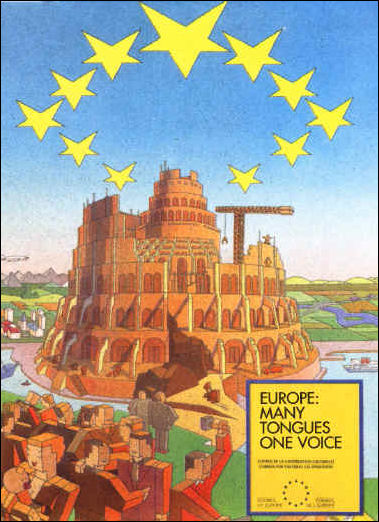
Augustine wrote a book called De Civitate Dei, "On the City of God" (Civitas Dei). The first words of the City of God are ‘gloriosissimam civitatem Dei,’ ‘the glorious city of God.’
The opposite of the City of God (Theonomy) is the City of Man (autonomy), although for Augustine, the opposite was civitas terrena, the "earthly city," which tends to confine the City of God to heaven. Augustine was not always correct. The conflict between these two cities is not geography (location), but authority (moral legitimacy). Jesus told us to work and pray that God's will would "be done on earth as it is in heaven." Peace is not just for heaven, as we see in Luke 2:
- 10 And the angel said unto them, “Fear not: for, behold, I bring you good tidings of great joy, which shall be to all people.
- 11 “For unto you is born this day in the city of David a Saviour, which is Christ the Lord.
- 13 And suddenly there was with the angel a multitude of the heavenly host praising God, and saying,
- 14 “Glory to God in the highest, and on earth peace, among those with whom He is pleased!”
If we follow God's Blueprints, we get peace, purpose, and life.
If we follow Man's blueprints, we get violence, meaninglessness, and escape into death.
The City of God is built with plowshares.
The City of Man is built with swords.
Jones has a blueprint.
Smith has a blueprint.
Whose blueprint will be followed?
The Sword will determine this.
The City of Man is tyranny. The City of God is Liberty.
But man soon tires of tyranny.
When Man attempts to escape God's blueprints, he tries anything and everything.
"Let us break their bands asunder, and cast away their cords from us."
Psalm 2:3
If God sees black and white, autonomous man will find "50 shades of [sadomasochistic] grey." He attempts to overthrow God's order by descending into chaos. Revolution is the religion of chaos. "Through revolution everything returns to chaos, and out of chaos comes “a new and regenerated world” (James Billington, former head of the Library of Congress).
The City of God is order. The City of Man defies God through chaos. But to say there is no meaning, no law, is usually just an excuse to impose one's own law on others.
|
And we're back to tyranny.
Some folks, seeing the violence (imposed, centralized) on the one hand, and the chaos (libertinism) on the other, seek to escape. They choose drugs, mind-numbing mantras, or suicide.
If Man reject's God's blueprints, and attempts to draft his own blueprints, we get:
These are the three forms of the City of Man.
God has called out a "church" to build the City of God. But Christ's "church" is not Jewish or Roman in its character. In the New Jerusalem, unlike the Old Jerusalem, there is
no temple in it, for the Lord God Almighty and the Lamb are its temple.
Revelation 21:22
Man's purpose is to build the City of God, the New Jerusalem.
If we think we might want to repent of building the City of Man, what does the City of God look like? What do God's Blueprints say?
God's Blueprints cover every area of life. The Bible will re-create everything and lay in place a new foundation:
| Christians are the sons of Abraham and heirs of the promises made to Abraham.
Of Abraham the Scripture says:
"Theonomy" is the Gospel:
"The blessings of liberty" -- "Good News" indeed -- come only through obedience to God's Law. |
If the Bible is not true, there really is no such thing as "Law" except the "positive law" of the State.
Every home school curriculum needs to teach children ""The
Laws of Nature and of Nature's God," that is, Biblical Law.
It was one of the most important features of early American public schools that they inculcated "religion and morality,"
a.k.a. "piety and virtue." America's Founders believed that religion and morality were "necessary for good government and the happiness of mankind,"
and this was the explicitly stated reason why schools were created.
One of the centerpieces of early American education was the Westminster Shorter Catechism. It was in virtually
every single classroom in America, and in nearly every home. One of the finest features of that work is an exposition of the Ten Commandments, including "the duties required" and "the sins forbidden" by each commandment. This is the foundation of the
Common Law and American Law. A school curriculum is not complete without a daily study of the Ten Commandments. Rushdoony's The
Institutes of Biblical Law would be an appropriate text for home-schooled high-schoolers. Here is an outline of a home-study program that I still haven't finished, as well as links to the Westminster Standards.
The Ten Commandments prohibit:
| 1. | Idolatry | more below |
| 2. | False Religion | more below |
| 3. | Swearing a false oath | more below |
| 4. | Refusal to work | more below |
| 5. | Disrespecting parents and other authorities | more below |
| 6. | Murder | more below |
| 7. | Cheating on your Wife | more below |
| 8. | Theft | more below |
| 9. | Slander | more below |
| 10. | Covetousness | more below |
For more than 300 years -- roughly 1600-1900 -- "the Laws of Nature and of Nature's God" -- that is, the Bible -- permeated America's schools and American culture. These laws are the foundation of civilization.
Ten Principles for a Free Society
The Ten Commandments in a Biblical Worldview
The Ten Commandments Moral Inventory and Meditation Program
Preface to the Ten Commandments
From Rushdoony's Institutes of Biblical Law:
| The First Commandment |
From Rushdoony's Institutes of Biblical Law:
| The Second Commandment |
From Rushdoony's Institutes of Biblical Law:
| The Third Commandment |
From Rushdoony's Institutes of Biblical Law:
| The Fourth Commandment |
From Rushdoony's Institutes of Biblical Law:
| The Fifth Commandment |
From Rushdoony's Institutes of Biblical Law:
| The Sixth Commandment |
From Rushdoony's Institutes of Biblical Law:
| The Seventh Commandment |
Family Values:
From Rushdoony's Institutes of Biblical Law:
| The Eighth Commandment |
From Rushdoony's Institutes of Biblical Law:
| The Ninth Commandment |
From Rushdoony's Institutes of Biblical Law:
| The Tenth Commandment |
From Rushdoony's Institutes of Biblical Law:
The Secular Messianic State will always allege that your exercise of religion is "political," because politics is a substitute for true religion:
James 1:27 says
Pure and undefiled religion before God and the Father is this:
to visit orphans and widows in their trouble,
and to keep oneself unspotted from the world.
This verse, according to some churches, says true religion is "social action," and the "church" must not be involved in "social action." Jesus says this will be the ultimate criterion of judgment on The Day of Judgment (Matthew 25:31-46). Not sacraments or church attendance.
Politicians are happy to put up a façade of social action, because they do so with other people's money. But social action which is not an extension of the reign of the Messiah, through His Body, is not real social action.
Critics of "Calvinism" allege that God's total, sovereign predestination of all things makes man a "puppet" or "robot." But we know that we are not "robots," and God does not treat us as mindless automatons. God treats us as beings created in His Image. God has given man dominion over the earth (Genesis 1:26-28). God's Law (Theonomy, Theme #5) is a comprehensive blueprint for building a new world. Theonomists build Civilization.
Those who deny God's Law and God's Predestination end up with a vision of man which is worse than a puppet. Man is ultimately meaningless. Without duty, there is no sin (1 John 3:4). There is no moral or ethical difference between a loving parent who daily, sacrificially, nurtures a child into adulthood, and a child molester. In the Bible, God's total sovereign predestination is paired with man's dominion and glorious duty to build the City of God. Denial of God's sovereignty is paired with a meaningless fleeting existence.
Man has more dignity as a creature of a sovereign predestinating God than he does as the random accident of an impersonal cosmos.
Some of those who oppose God's predestination cannot tolerate randomness and meaninglessness. They seek replace God's predestined order with Man's predestination. The City of Man is a city of tyranny, as oligarchs and philosopher-kings ("horns," Zechariah 1:18) seek to predestine the "craftsmen" (Zechariah 1:21) and create order without God (but see Luke 1:68-70). But political predestination, like Rome, always falls.
Calvinists build; autonomous man destroys.
‘We will not have this man to reign over us.’ (Luke 19:14)
‘Better to rule in hell than to serve in heaven.’ (Milton, Paradise Lost)
‘All they that hate Me love death.’ (Proverbs 8:36)
In other words, all who hate a predestinating God love disorder. They hate the City of God.
God's predestination does not conflict with man's duty to follow God's Law and build Christian Civilization. This is a glorious calling. Autonomous man's self-predestined calling is disorder and death.
It is the task of "the Church" (The Body of Christ) to "exercise dominion" (Genesis 1:26-28) and glorify the garden (Genesis 2:5,15); in short, to "build." We build the Body of Christ into the Lord's House. We build the earth into the Lord's Temple. We tear down the city of man and build the City of God. And when the New Jerusalem is complete, Christ the Master-Builder will get all the praise and credit.
The Empires of the world will say this interferes with their agenda. It violates "the separation of church and State."
The Empires are correct.
| Micah's Prophecy |
| Focus Text: Vine and
under his fig tree,
And each of them will sit under his |
The story of the Bible is "paradise lost" and Paradise Restored.
The story begins in a Garden and moves toward the goal of a Garden-City.
Man rebels against the City of God, and God saves rebellious man
from the City of Man, promising to restore man to the fellowship that existed in Eden. Salvation is Edenic restoration.
The blessings God promises in Deuteronomy 28 are (on the surface) appropriate for an agrarian society. Does that mean agrarianism is normative?
In an editorial comment in Calvin's Commentary on the Psalms, James Anderson adds to Calvin's comments on
- Psalm 15:5
- He that putteth not out his money to usury, nor taketh reward against the innocent. He that doeth these things shall never be moved.
The Jews were prohibited by the law from taking usury or interest on money lent to their brethren, but not on what was lent to strangers; that is, foreigners of other countries, (Deuteronomy 23:20.) The manifest design of this prohibition was, to promote humane and fraternal sentiments in the bosoms of the Israelites towards each other. A more remote end seems also to have been aimed at, viz., to check the formation of a commercial character among the Jews, and to confine them as much as possible to those agricultural and private pursuits, which would seclude them from intercourse with the surrounding nations, as it was not very likely that a practice of this nature would be extended much among foreigners which was prohibited at home." -- Walford's New Translation of the Book of Psalms.
God's Laws concerning "false weights and measures" prohibit the expansion of credit by the Federal Reserve or any central bank.
Gary North claims that if we follow Biblical Law, especially the law concerning sabbath rest, industrialization becomes impossible.
I dealt with these issues in my 1986 book, The Sinai Strategy: Economics and the Ten Commandments. I devoted Chapter 4 and Appendix A to the sabbath. I reprinted them in the 2012 edition: Authority and Dominion, Volume 2, Decalogue and Dominion, Chapter 24, and Volume 5, Appendix E: “The Economic Implications of The Sabbath.” If you are serious about exploring the theological and economic implications of the differences between the Sabbath law and the laws governing the Lord’s Day, I recommend that you read these chapters.
Chapter 44: Lord’s Day | Gary North
Some people dismiss the Bible as primitive and "agrarian" and therefore irrelevant to the modern world. But what has the "modern world" brought us?
* The Atomic Bomb * monosodium glutamate * smog * MTV * HMO's *
* "The Death of God" *
* "safe" abortions * "safe" sex * "assisted" death *
* The Death of Man *
"Salvation" in the Bible means the restoration of the conditions of the Garden of Eden (Genesis 1-2)
Studies in Mutualist Political Economy: Industrialism vs. Decentralism -- The Role of the State
Agrarian Man vs. Industrialist Man: Political vs. Economic Man
Pierre Joseph Proudhon: Agrarian Jurisprudence
Compare first three chapters in Genesis with last three chapters in Revelation: Edenic imagery - Garden of Eden / City of GodWilderness vs. Garden: Wilderness = disorder; Garden = Order
Living off land depends on owning the land. Therefore Agrarianism is related to Property.
Would you be willing to live for hundreds of years in the Garden of Eden with a community of sanctified people . . . but no cell phone?
The Bible does not speak of the "fall" of man. It was not a "fall," as in "Oops! I fell!"
It was a rebellion.
It was war against God. Man took the side of Satan against God.
Satan did not describe rebellion as a "fall," but as an evolution into godhead.
Genesis 3
4 And the serpent said unto the woman, Ye shall not surely die:
5 For God doth know that in the day ye eat thereof, then your eyes shall be opened, and ye shall be as gods, knowing good and evil.
"Knowing good and evil" in Genesis 3:5 carries the force of determining good and evil for yourselves. History shows that when man obeys God, life is heavenly; when man is his own god, as John Adams put it, “this world would be something not fit to be mentioned in public company — I mean hell.”
John Milton, in his work Paradise Lost, put these words in Satan's mouth:
To reign is worth ambition, though in Hell:
Better to reign in Hell than serve in Heaven.
"Ye shall be as gods" (Genesis 3:5).
"gods" in the Bible refers most often to archists.
Man's basic sin against God is the desire to "be as gods."
“But his subjects hated him and sent a delegation after him, saying, ‘We don’t want this man to rule over us!’” (Luke 19:14)
An aspect of this rebellion is the desire to get something for nothing, or something without working for it. (James Jordan has argued that Adam and Eve would eventually have been allowed to eat of the Tree of Knowledge, but they were required to work for it first and earn it.)
This desire is a major motivation for forming "the State" and conquering other people. (The other one being vengeance.)
God is man's Governor. Man rejects God's Government by desiring to be his own governor. Rather than serving his neighbor, fallen man seeks to rule over his neighbor as an archist.
God punishes man for his rebellion by granting him his wishes. When man lusts for political power, God gives it to him.
Then in His mercy, God saves the repentant sinner by delivering him from the political disease.
If we obey God's commandments, we will not have war; God will not send "the sword" against us.
I will argue below that peace is possible only in a state of "an-archy," that is, the absence of "archists." This too is a "paradigm shift."
When we disobey God's Law, God sends archists as a judgment/curse against us.
We see this repeatedly in the Scripture. Israel lusts after gentile archists (like Moloch, which means "king"). God delivers Israel into the hand of these pagan archists, and Israel cries out for deliverance, and God delivers them by sending a deliverer, or "savior" or "judge" who "saves" Israel from the pagan archists.
Excursus:
Here is an "excursus" on God's "ordaining" of "the sword." It should make you an anarchist -- if you read all the verses.
Thesis 13: The Fall of Man
The Fall of Man -- the Desire to "“To Be As Gods” -- “Knowing Good and Evil”
To build the Kingdom of Man without working (playing God, oppressing others).
Thesis 12: The Fall Of The Angels
| Westminster Standards |
| Chapter 6 the Fall of Man, of Sin, and of the Punishment Thereof |
| Micah's Prophecy |
| And each of them will sit under his Vine and under his fig tree, With no one to make them afraid. For the LORD of hosts has spoken. |
Micah says "no one will make them afraid."
Who are the people who make other people "afraid?"
Archists.
God says He will deliver (save) His people from archists.
We saw above how fallen man seeks to rule over other men. God sends these men as curses on those who rebel against His Law. But He blesses those who obey Him with freedom from archists; by saving them from archists.
We see this repeatedly in the Scripture. Israel lusts after gentile archists (like Moloch, which means "king"). God delivers Israel into the hand of these pagan archists, and Israel cries out for deliverance, and God delivers them by sending a deliverer, or "savior" or "judge" who "saves" Israel from the pagan archists.
Here's how Nehemiah sums up Israel's history of rebelling against God's Law and then being "saved" from the consequences of their disobedience:
- Nehemiah 9:23-31
- 23 You also multiplied their children as the stars of heaven,
And brought them into the land
Which You had told their fathers
To go in and possess.
24 So the people went in
And possessed the land;
You subdued before them the inhabitants of the land,
The Canaanites,
And gave them into their hands,
With their kings
And the people of the land,
That they might do with them as they wished.
25 And they took strong cities and a rich land,
And possessed houses full of all goods,
Cisterns already dug, vineyards, olive groves,
And fruit trees in abundance.
So they ate and were filled and grew fat,
And delighted themselves in Your great goodness.
26 “Nevertheless they were disobedient
And rebelled against You,
Cast Your law behind their backs
And killed Your prophets, who testified against them
To turn them to Yourself;
And they worked great provocations.
27 Therefore You delivered them into the hand of their enemies,
Who oppressed them;
And in the time of their trouble,
When they cried to You,
You heard from heaven;
And according to Your abundant mercies
You gave them saviors who saved them
From the hand of their enemies.
28 “But after they had rest,
They again did evil before You.
Therefore You left them in the hand of their enemies,
So that they had dominion over them;
Yet when they returned and cried out to You,
You heard from heaven;
And many times You delivered them according to Your mercies,
29 And testified against them,
That You might bring them back to Your law.
Yet they acted proudly,
And did not heed Your commandments,
But sinned against Your judgments,
‘Which if a man does, he shall live by them.’
And they shrugged their shoulders,
Stiffened their necks,
And would not hear.
30 Yet for many years You had patience with them,
And testified against them by Your Spirit in Your prophets.
Yet they would not listen;
Therefore You gave them into the hand of the peoples of the lands.
31 Nevertheless in Your great mercy
You did not utterly consume them nor forsake them;
For You are God, gracious and merciful.
God sent Israel many "saviors." When Bible-believers think of a "savior," they think of someone who will save Israel "out of the hand of their enemies." The angel of the Lord appeared to Joseph, and said:
- Matthew 1:18-23
- Joseph, thou son of David, fear not to take unto thee Mary thy wife: for that which is conceived in her is of the Holy Ghost. And she will bring forth a Son, and you shall call His name JESUS, for He will save His people from their sins.
A first-century Jew, steeped in the Scriptures, would hear this as a promise to save "His people" from the consequences of their sins, the curses imposed on them by God because of their rebellion against His Law. John the Baptist's father "Zacharias was filled with the Holy Spirit, and prophesied, saying"
- Luke 1:67-80
- 68 “Blessed is the Lord God of Israel,
For He has visited and redeemed His people,
69 And has raised up a horn of salvation for us
In the house of His servant David,
71 That we should be saved from our enemies
And from the hand of all who hate us,
74 To grant us that we,
Being delivered from the hand of our enemies,
Might serve Him without fear,
75 In holiness and righteousness before Him all the days of our life.
79 To guide our feet into the way of peace.”
The Babe born in Bethlehem saved Christians in the first century from their enemies: the Jews who collaborated with Rome. Then the Rock destroyed Rome, and has filled the earth with Christian Civilization -- The City of God. The growing and filling continues.
Let's look at "salvation" from three perspectives:
When most Christians think of "salvation," they think of going to heaven after they die.
The purpose of this section is not to deny that equation, but to put the word "salvation" in a more Biblically holistic perspective.
Most of the time, in most of the verses, "salvation," "save," or "savior" in the Bible does not refer to anything after death.
Consider this classic Christmas text:
- Luke 2:8-20
- 8 Now there were in the same country shepherds living out in the fields, keeping watch over their flock by night. 9 And behold, an angel of the Lord stood before them, and the glory of the Lord shone around them, and they were greatly afraid. 10 Then the angel said to them, “Do not be afraid, for behold, I bring you good tidings of great joy which will be to all people. 11 For there is born to you this day in the city of David a Savior, who is Christ the Lord. 12 And this will be the sign to you: You will find a Babe wrapped in swaddling cloths, lying in a manger.”
- 13 And suddenly there was with the angel a multitude of the heavenly host praising God and saying:
- 14 “Glory to God in the highest,
and on earth peace among those with whom he is pleased!”
What would a first-century Israelite think if an angel of the LORD announced the coming of a "savior?" They would doubtless think back to all the saviors in the [Old Testament] Scriptures. Those saviors did not just promise a ticket to heaven when everyone died. They promised to save Israel from the consequences of her sins. Those consequences included "the Sword." Freedom from the sword is one aspect of the holistic Biblical concept of Salvation, and one of the benefits of a Biblical savior. The savior brought the benefits ("blessings") of obedience upon a people who had not been obedient, but who had repented of their disobedience.
Jesus was a Savior in this Biblical tradition. He came to bring Salvation. He came to save His people from their enemies, so they could get on with the work of building the New Jerusalem.
Read every verse in the Bible which contains the words "save," "savior," or "salvation." The vast majority of those verses are not talking about being converted and going to heaven when you die. They are talking about being delivered from archists.
"Salvation" = “Vine & Fig Tree”
The name "Jesus" comes from the Hebrew word Yhowshuwa', which is derived from yasha', which is the Hebrew word most frequently translated "save" or "salvation."
Here is a part of a definition of the Hebrew word for "save" [יָשַׁע yasha] from a mainstream theological text:
|
Eden and Salvation - David Chilton
Dwell safely versesBecause "Gospel" is the "good news" that Jesus is the Christ, the Messiah, the King, Gospel = archistlessness.
"Salvation" is holistic/cultural/economic, not just a ticket to heaven when you die. We'll see this below in more detail.
"Savior" = "Deliverer" (Deliver from evil, from enemies)
Read every verse in the Bible with this Hebrew word. Read the paragraph in which the verse is found. Become acquainted with the story -- the "narrative" -- in which this paragraph is found, and walk away with a different vision of "salvation."
|
|||||||||||||||||||||||||||||
Anarchist optimillennialism is a new paradigm. A new way of looking at human social organization ("government").
And a new way of looking at "salvation."
Let's elaborate a bit on the "blessings" and "cursings" which are found in God's Law (e.g., Leviticus 26).
When Israel rejected the government of God and lusted after Gentile archists, God delivered Israel into the hands of her archist lover/idol. Then Israel cried out for deliverance from these archists. This deliverance is the doorway through which we can gain a larger understanding of the Biblical doctrine of "salvation."
Most Christians think "salvation" means "going to heaven when I die." They focus on a tiny fraction of the Bible, and ignore the vast majority.
"Salvation" -- in the vast majority of Biblical texts -- means "anarchism." "Salvation" means a "libertarian" society. Some would call it an "anarcho-capitalist" society.
The Libertarian Party requires party members to affirm but one proposition:
I do not believe in or advocate
the initiation of force
as a means of achieving political or social goals.
People who will not make this pledge are "archists." They believe they have a right to impose their will on other people by force, usually by "the sword" -- political or military power.
Being an "archist" is un-Christian (Mark 10:42-45). We are not to spread Christianity with the sword. We are not to vote for archists who promise to bring salvation.
|
|
Not "What is 'salvation' in the minds of most professing Christians?"
What does the Bible say?
The Hebrew word most frequently translated "salvation" or "save" is yasha'. In various derivatives it can be translated "deliverance," "victory," "safety," "security," and "welfare." (The Greek equivalent also carries the idea of "health.")
What does the government promise? We have a Department of Health, a Welfare Department, a Department of Homeland Security -- all components of the Biblical concept of "salvation." "The Government" (a.k.a. "civil government") is always a substitute for God. God is our Governor (Isaiah 33:22), and He brings salvation.
Consider again the Hebrew word for "save" or "bring salvation" -- "yasha." Consider again that very mainstream, non-anarcho-preterist scholar's definition of that Hebrew word:
Yasha and its derivatives are used 353 times. The root meaning . . . is “make wide” or make sufficient: this root is in contrast to sarar, “narrow,” which means “be restricted” or “cause distress.” To move from distress to safety requires deliverance. [T]he majority of references to salvation speak of Yahweh granting deliverance from real enemies and out of real catastrophes. That which is wide connotes freedom from distress and the ability to pursue one’s own objectives. Thus salvation is not merely a momentary victory on the battlefield; it is also the safety and security necessary to maintain life unafraid of numerous dangers.
Hartley, John E. (1999). 929 יָשַׁע ["yasha"], in R. L. Harris, G. L. Archer, Jr. & B. K. Waltke (Eds.), Theological Wordbook of the Old Testament, vol. 1, pp. 414-15.
|
Consider first the phrase "safety and security necessary to maintain life." This is also the "safety and security necessary to maintain a prosperous and humane society." In order to go to WalMart and buy a shopping cart full of food and household accessories, there has to be a global network of businesses who create and transport millions of products by making billions of economic calculations and transactions. Millions of human beings have to get to work on time, run the trucks on schedule, choose to work instead of stealing and robbing, and work the graveyard shift so that when you get to the store, all the items you want are neatly arranged on the shelf in an order which makes it possible for you to quickly find what you need and get on with life.
Who should we trust for "safety" and "security?" What does the Bible say?
The Bible repeatedly says that if we obey God the Lawgiver by loving our neighbor through productive service, God our Judge and King will "bless" us with peace and prosperity. "Peace" means "safety" and "security." These are all components of the Biblical picture of holistic "salvation."
But there are those who want to supplant God the King by promising to give us salvation if we will vote for them.
"Safety" and "security" are blessings from God, not government. We enjoy "safety" and "security" when our nation is Christian and observes "the Laws of Nature and of Nature's God," that is, the Bible. Nobody enjoys "safety" and "security" when the government becomes a tyranny which bans the Bible and people behave like pagans.
Here are other key descriptions of Biblical "salvation," according to our mainstream source above:
The Bible describes "salvation" as being placed onto a large piece of property that supplies everything you need:
In the Bible, Godly men are shown to be concerned about living in a “large” land. Of course, in a more agrarian society, “large” is better, as far as land goes. But when God promises to save us by putting us into a “large land,” it’s clear that more is included than going to heaven after living for decades in a narrow land before we up and die. What is the modern equivalent of a “large land?” It varies from person to person, but it includes some form of economic prosperity and political Liberty. “Liberty” and “large” are Biblical concepts we are not familiar enough with. Let’s review them and put them in our brains, so that as we read the Bible we will be more aware of them.
|
One of the blessings promised to the obedient in the Bible is "liberty."
"Liberty" means "freedom." But "freedom from what?" In the pages of the Bible, the answer is almost always: "freedom from archists."
One of the blessings promised in Leviticus 26 is "peace," or freedom from those who bear the sword. Those who bear the sword are archists. They are also called in the Bible "enemies."
Of course, "freedom from" is always for the purpose of "freedom to" -- freedom to serve and obey the Lord.
The name "Jesus" comes from the Hebrew word Yhowshuwa', which is derived from yasha', which is the Hebrew word most frequently translated "salvation." "Jesus" means God will save. It was said of Jesus at His birth:
- Luke 1:71
- That we should be saved from our enemies
and from the hand of all that hate us;- 74 That He would grant unto us, that we
being delivered out of the hand of our enemies might serve Him [exercise dominion and build His Kingdom] without fear [living under our "vine and fig tree" "with no one to make them afraid" (Micah 4:1-7)]
This is what "salvation" means in the Bible.
The specific enemies Christians had in the first century were of the Jewish establishment, but I believe Jesus the Messiah will save us from our enemies today -- whoever they may be, whenever we live -- if we obey God's Law.
"But isn't the real meaning of salvation 'being forgiven of your sins and going to heaven when you die?'"
Most church-goers ask this.
Forgiveness of sins = restoration to fellowship with God,
Forgiveness of sins = restoration to our original Edenic Mandate to build the Kingdom of God.
Forgiveness of sins is a means to an end, not an end in itself.
Jesus: Savior but not Messiah?The overwhelming majority of Christians today agree with Jews who say that Jesus is not the Messiah. The vast majority of Christians believe that Jesus will not reign as Messiah until there is a second Christmas -- a second Advent, or "second coming of Christ" -- which is really the first coming of the Christ, since at His first Advent Jesus came only as "savior," -- that is, someone who secures for us a ticket to heaven when we die -- and not as "Christ" -- that is, someone who delivers us out of the hand of our enemies, sets us in a wide open place, opens the bounties of heaven, and makes our land like Eden, so we can enjoy a “Vine & Fig Tree” society.
Many Christians in our day say that the Jews rejected Jesus as their Messiah, therefore He could only offer to be their Savior. This is so confused it's hard to know where to begin.
- Nehemiah 9:27
- Therefore Thou deliveredst them into the hand of their enemies that vexed them: yet in the time of their affliction, when they cried unto Thee, Thou heardest them from the heaven, and through Thy great mercies Thou gavest them saviors, who saved them out of the hand of their adversaries (cp. Luke 1:71,74).
The idea that Jesus is only a "savior" but not the Messiah is not a Biblically tenable position. There is almost no hint in the Bible that any "savior" would do nothing to "save" his people in this life, but only in the next.
A "savior" brings "salvation." Doesn't that make sense? But what is "salvation?" It is not, Biblically speaking, going to heaven after you die, having lived a life without being "saved" in the holistic Biblical sense of that word. In the Bible, saviors brought freedom from archists for God's People. See the discussion of the Hebrew word for "salvation" above.
These "saviors" were sometimes called "judges." The various "kings" of Israel could also serve as "saviors" because they would "save" Israel from her oppressors (1 Samuel 9:16; 2 Samuel 3:18, etc.).
|
"Saviors" in the Old Testament served what we could call primarily "messianic" functions." Biblically speaking, "savior" is virtually a synonym for "messiah." And "Messiah" is a political term, that is, a term that does not have primary reference to us after death, but reference to our lives today, in their holistic cultural, social, political, civil, economic, recreational, and legal dimensions.
A "Messiah" brings political changes. A "savior" brings "salvation." But the Biblical definition of "salvation" is not just a short-term relief on the battlefield, but long-term liberty from archists. See the definition of the Hebrew word for "salvation," yasha, which we looked at above.
Jay Wile writes (An Interesting Observation from China | Proslogion):
Recently, I read an article by Dr. Paul Copan entitled, “Jesus-Shaped Cultures.”1 In that article, he makes the case for how faithful Christians have transformed the societies they have served. For example, he discusses the Ethiopian famine that took place in 1984 and 1985. Brian Stewart, a CBC journalist, noted that it was Christians who were on the front lines of the famine, giving aid to the suffering. Their service was such a powerful witness to him that it started him on his journey to becoming a Christian himself.
While Copan’s article is interesting, it led me to a book that I thought was even more interesting. It is entitled Jesus in Beijing: How Christianity Is Transforming China And Changing the Global Balance of Power, and it is written by David Aikman, who served as a journalist for Time Magazine from 1971 to 1994. In his role as a Time correspondent, he visited China several times and even lived in China for two years as Time’s bureau chief. He returned to China in 2002 to gather the information he needed to complete his book.
He begins the book in a dramatic way. It is worth quoting at length:2
The eighteen American tourists visiting China weren’t expecting much from the evening’s lecture. They were already exhausted from a day of touring in Beijing. But what the speaker had to say astonished them.
The Victory of Reason Listen Now | Download
“One of the things we were asked to look into was what accounted for the success, in fact, the pre-eminence of the West all over the world,” he said. “We studied everything we could from the historical, political, economic, and cultural perspective. At first, we thought it was because you had more powerful guns than we had. Then we thought it was because you had the best political system. Next, we focused on your economic system. But in the past twenty years, we have realized that the heart of your culture is your religion: Christianity. That is why the West has been so powerful. The Christian moral foundation of social and cultural life was what made possible the emergence of capitalism and then the successful transition to democratic politics. We don’t have any doubt about this.”
This was not coming from some ultra-conservative think tank in Orange County, California or from Jerry Falwell’s Liberty University in Lynchburg, Virginia. This was a scholar from China’s premier academic research institute, the Chinese Academy of Social Sciences (CASS) in Beijing in 2002. (emphasis mine)
In his book, Aikman suggests that Christianity will transform China to the point where it won’t even be communist anymore. He suggests that in the next thirty years, nearly one-third of China could be Christian, making it one of the largest Christian nations in the world and a strong ally of the U.S.
2. David Aikman, Jesus in Beijing: How Christianity Is Transforming China And Changing the Global Balance of Power, pp. 5-6
See also: The Iona Institute | Christianity the reason for West's success, say the Chinese
In asking whether Habakkuk's prophecy has been or is being fulfilled, and whether the knowledge of God covers the earth as the waters cover the sea, don't ask those who should admit that they know the Lord; ask the Scriptures whether they ought to admit it. Sometimes they won't, but many times they will. Truth is truth, whether we admit it or not.
Today, the Chinese are "streaming" to Zion (Micah 4:1-2). So are people in Latin America, Africa, and even India, according to Philip Jenkins. Humanity has been flowing to Zion for 2,000 years, but the rate may be accelerating in other countries, even as it decelerates in our own country. This acceleration is not yet on the radar of American archists. It will dramatically increase when Christians become widely recognized as a community of peacemakers who resolve disputes through forgiveness and (temporary, it is hoped) excommunication (Matthew 18:15-17). Peacemaking and dispute resolution will be the result of "revival" and will exsanguinate the State.
Salvation in the Bible is Archistlessness. It means being governed by the Savior alone, and experiencing His blessings. "Salvation" is Civilization.Conversion is from Autonomy to Theonomy. It means "the Last Adam" restores us to the Edenic position enjoyed by the first Adam, before the Fall. We are transformed from rebels to friends, and we begin the work of clearing the thorns and thistles left by the first Adam, and building the Garden-City of the New Jerusalem, the temple/palace of the Last Adam.
If God offered to bring salvation in the holistic Biblical sense -- beating swords into plowshares, millions of lives spared, living peacefully under their Vine & Fig Tree, but you would not to go heaven when you die, would you give up heaven for yourself in order to procure Biblical salvation for billions of people?
| Micah's Prophecy |
| 2 for the Law shall go forth of Zion, and the Word of the LORD from Jerusalem. 5 Although all people will walk |
Micah says God's Law -- the blueprints for a Vine & Fig Tree society -- will come from Jerusalem.
800 years later, the church father Tertullian would ask:
|
What indeed has Athens to do with Jerusalem? What concord is there between the Academy and the Church?... Our instructions come from “the porch of Solomon”....
Away with all attempts to produce a mottled Christianity of Stoic, Platonic, and dialectic composition! We want no curious disputation after possessing Christ Jesus...! |
Popular conservative writers like Eric Metaxas, Ben Shapiro, and Larry Arnn, claim that Western Civilization is the combination of Jerusalem and Athens. Unpopular conservative writers like Cornelius Van Til and Gary North contend that Jerusalem and Athens are at war, and that when Athens ascends, Jerusalem declines, and civilization along with it.
Van Til said “There is no alternative but that of theonomy and autonomy.” "Conservatives" like Leo Strauss, who claim Western Civilization is the combination of Jerusalem and Athens, but who do not agree with Van Til, end up discarding Jerusalem (Theonomy) and pursuing autonomy. "Listen to the Academy" they said in centuries past. "Listen to 'the Science'" they say today. Evolution; "wear a mask"; Climate Change.
1. Autonomy: Rebellion Against God
The measure of all things was either individual man or collective man (the Empire). This resulted in Debauchery, Superstition, and Corruption.
Romans were less civilized than Christians. As we will show elsewhere, Romans believed in the following, and the "old men" (see below) had no effective standard by which to criticize these things:1. Pederasty. This is the homosexual union of an older married man with a teenage boy. The men often met the boys on their way to the gymnasium, the building in which the boys danced and played sports naked. The men then became the boys' lovers and teachers.
2. Demonism. The Greeks were polytheistic. Greek family life rested on a system of sacrifice to demons that masqueraded as the spirits of dead male relatives. So did clan life, which became political life. These demons also presented themselves as underground gods and spirits, who demanded sacrifices and special rituals to keep from destroying people. On this point, see the works of the early 20th century archaeologist-historian, Jane Ellen Harrison. This never gets into the textbooks, although specialists are well aware of it. (See on Socrates, below.)
3. Warfare. At the center of the literature of classical Greece was Homer's poem, The Iliad. It is the story of how Achilles' resentment against King Agamemnon raged because the king took his kidnapped concubine for himself. All the other men had concubines for the ten years they were at war. But no children are mentioned by Homer. Now that's real Greek mythology! Their wives stayed home and kept the ritual home fires burning -- to placate the family's departed male spirits. Athens destroyed itself in Pericles' needless imperial war against Sparta. Then the Macedonians conquered war-ravaged Greece. But the textbooks praise Pericles as a pillar of wisdom, reprinting Thucydides' posthumous version of Pericles' suicidal imperial oration.
4. Slavery. At least one-third of Athens was enslaved. The figure was as high in Sparta. Every household owned a slave. This provided leisure for their owners, who despised physical labor as beneath them -- servile. Slavery was a universal institution in Greece.
5. Autonomy. Greek philosophy was based on the ideal of man's mind as completely sovereign -- no personal God allowed.
(Well, not quite. Socrates claimed he was given guidance in his thinking by a demon (daimon). But rationalistic scholars, beginning with Plato, have always downplayed this. They have sometimes said this was just hyperbolic literary language. Socrates could not really have believed in a demon. After all, they don't.)6. Welfare State. At least one-third of all male Athenians were on the government's payroll in the time of Pericles.
7. Human Sacrifice. This was a basic theme in Greek literature. It was part of Athenian religious liturgy. There was no widespread movement to decry the earlier practice. The great expert here was Lord Acton, who wrote a long-ignored essay, "Human Sacrifice," in 1864. It is online here. It is included in Volume 3 of Selected Writings of Lord Acton, published by the Liberty Fund. From the day he published it in order to refute the great historian Macaulay, historians have refused to incorporate it in their narratives. It is way too embarrassing.
8. Cyclical View of Time. The Greeks did not believe in long-term progress or a final judgment -- just endless cycles forever: rise and fall, rise and fall. According to the historian of science, Stanley Jaki, this was why the Greeks never developed science, only technologies.
9. Female Inferiority. Wives were only for procreation. They could not be citizens. They had no legal rights. A man needed a male heir to perform the ritual sacrifices to feed him after he died. Women had no political influence except as prophetesses and mistresses.
You would not want to live in ancient Greece or Rome. See also this and this. You would say they were "uncivilized." Bishop Augustine was saddened by the fall of Rome, but Salvian the Presbyter understood that real civilization is based on Christian morality: Salvian rejoiced at the fall of the Roman Empire.
2. Government by Men rather than by God
The word "Senator" comes from the Latin word senex, meaning "old man." Old men were assumed to be wiser than the rest of us. This might generally be true -- with age comes wisdom -- but "By What Standard?" What is "wisdom?" The old men in primitive cannibalistic tribes know the best kind of human flesh to eat. They are "wiser" than young cannibals who don't yet know the difference. Will cannibalistic "senators" build a healthy and humane civilization? Who says cannibalism is wrong? Harvard's Founders knew the answer to that question; we don't.There were in fact wise old men in Greece and Rome who could see that their "civilization" was debauched and corrupt. America's Founders often quoted these dissidents. But what standard did the dissidents use to measure Greece and Rome? Ultimately, the dissidents had no solid place to stand in order to critique their crumbling empire. They had no objective standard outside themselves and their own society. They basically had the same world-and-life-view as the most corrupt and debauched members of society.
So an important category of "classical" ideas is the idea of "government" -- the Philosopher-Kings, or the wise old men who would guide society to prosperity. Emperors claimed to be guided by demons.
James 1:27
Religion that is pure and undefiled before God the Father is this: to visit orphans and widows in their affliction, and to keep oneself unstained from the world.
James 4:4
You adulterous people! Do you not know that friendship with the world is enmity with God? Therefore whoever wishes to be a friend of the world makes himself an enemy of God.
A friend of Athens is the enemy of God.
Chapter 19 of the Westminster Confession seems to endorse "Theonomy," but it actually repudiates it, and is fundamentally flawed.
Section 4 of chapter 19 says:
4. To them also, as a body politic, He gave sundry judicial laws, which expired together with the State of that people; not obliging any other now, further than the general equity thereof may require.
This statement is a serious error. This is based on Greco-Roman categories, not the categories of Hebrew Law, or Biblical Law. We must consider four key terms:
Israel was not a "body politic" in the conventional sense of "politics." Our word "politics" comes from the Greek word polis, which can be translated "city," "city-state," or even "empire." Babylon was a city and an empire. Rome was a city and an empire. Augustine wrote a book called
This stands in contrast to "The City of Man."
When did "the body politic" of Israel "expire?" AD 70? But didn't true, believing, Israel continue past the destruction of Jerusalem under the government of the Christ, the Messiah? 1 Peter 2:9.
Israel was not a kingdom of politicians, but a "kingdom of priests" (Exodus 19:6). Israel did not become a "political" body until 1 Samuel 8, when Israel rejected God as her King (as the text explicitly reveals), choosing to emulate the pagan nations around her. It was not God's intention that Israel "mature" from a tribe-based kingdom of priests to a polis-based kingdom of politicians. The Patriarch Abraham is our model, and it was Moses' goal that Israel become Abrahamic patriarchs again (Numbers 11:29).
The word "economics" comes from two Greek words meaning "law of the home." For Abraham, all law was economic law, no law was political law.
Abraham's priest was Melchizedek (Genesis 14:18), just as our priest is Christ (Hebrews 7). Moses gave Israel "Levitical law." When Israel disobeyed God's "economic" law, there were laws that brought cleansing, or atonement, for violations of the "economic law." The Levitical priesthood was temporary; a kind of social "training wheels." Today the Levitical laws can only be obeyed by faith in Christ, "the Lamb of God" (John 1:29).
The "economic law" reflects the unchanging moral character of God.
We could call this social system
PATRIAGORA:
Patria | Family + Market | Agora
The Bible says Abraham obeyed My Voice, and kept My Charge, My Commandments, My Statutes, and My Torah. (Genesis 26:4-5) In this entire body of laws, none could be called "judicial laws" or "civil laws." Moses gave laws for patriarchs (heads of families) not politicians.
None of God's Law in "the Scriptures" has "expired" as the Westminster Confession erroneously claims. We still have a High Priest and a Temple to attend to. We have a King who governs us. If we don't entertain guests on the roof of our house, we don't need to build a rail around the roof, but if we do have people up there, we need to follow Deuteronomy 22:8, which some today would call a "judicial law." In generations past, when Americans understood the Bible better than we do today, American juries awarded verdicts in tort cases where safety rails were not in place, based on Deuteronomy 22:8.
To say that these "expired" laws only bind governments if the government sees some kind of "general equity" is to open the door to totalitarianism. This "general equity" theory is based on Roman law, not Biblical Law. See this:
This has very important implications. This is not just about "law." This line of argument is calling for a complete re-organization of human society. "Patriarchy" is, as Gary North describes it, a "Bottom-Up Theocracy."
Q. 5. What do the Scriptures principally teach?
A. The Scriptures principally teach what man is to believe concerning God, and what duty God requires of man.
(Westminster Larger Catechism)
We live in a culture that does not want to be reminded of its duties. It prefers to talk about its "rights." I don't believe in "human rights." I don't believe in "Justification by mere belief." I believe in Justification by Allegiance.
Obedience (ethics) is more important than intelligence.
The word "Theocracy" comes from two Greek words meaning "God Governs." Our duty is to be governed by God. "We must obey God rather than man" (Acts 5:29). We've been trained in our secular schools to fear "Theocracy." But we're not tempted to accept an Islamic Theocracy, where Allah is our national god. We've been trained to reject a Christian Theocracy. We accept a Secular Humanist theocracy, where every man is his own god (Genesis 3:5).
As Augustine wrote, our job as Christians is to convert the entire planet from the City of Man -- autonomy -- into "The City of God" -- Theonomy -- a Christocracy.
So where did the Reformers get the concept of "judicial law?" They got it from Athens, not Jerusalem:
The Reformed tradition in early America was not "radical" in the sense of being totally consistent with the Hebrew-Christian Scriptures. The Reformers, Puritans, and Framers of the Constitution of 1787 brought in ideas from "classical" Greece and Rome. This was a terrible mistake, and an unBiblical mistake.
Harvard's Founders wanted America to be a Christian Republic. It has turned out to be an atheistic empire. I will say this more than once on this page: During my lifetime, "my" government has killed, crippled, or made homeless TENS OF MILLIONS of innocent, non-combatant, non-white civilians around the world. The "old men" in the House and Senate voted for this. And Americans -- victims of educational malpractice -- voted for these "old men," year after year, election after election. And the Empire of Lies and Death lumbers on. For a few years more.
If citizens are corrupt, depraved, selfish, and short-sighted, they should not be trusted to vote for "old men" to rule them. These old men are in fact no different from the rest of us: corrupt, depraved, greedy, and present-oriented. But, dangerously, sometimes more intelligent.
As these words are being written, the Old Man of the U.S., Joe Biden (age 80), wants to put the Old Man of Russia, Vladimir Putin (age 70) out of office. To get Putin out of office, the old men of the U.S. have spent $113 billion. This is more than needed to prevent the starvation of nearly a billion people around the world. The old men are willing to use nuclear weapons, even at the cost of tens of millions of innocent lives. Even at the risk of human life on planet earth. There is nothing "wise" about these old men -- and the citizens who allow them to stay in power. The "senex" men are insane. They too are victims of educational malpractice.
But modern Secular Man has no objective and absolute moral standard by which to judge those who are destroying Christian Civilization.
Christian philosopher Cornelius Van Til gave this apt illustration of the "old men" of the past:“Suppose we think of a man made of water in an infinitely extended ocean of water. No surface above, no bottom below. Infinite water. Desiring to get out of water, the water-man makes a ladder out of water. He sets this ladder upon the water and against the water and then attempts to climb out of the water.
So hopeless and senseless a picture must be drawn of the non-Christian man’s methodology based as it is upon the assumption that time or chance is ultimate. On his assumption his own rationality is a product of chance. On his assumption even the laws of logic which he employs are products of chance. The rationality and purpose that he may be searching for are still bound to be products of chance.”
A universe of random chance is ultimately a meaningless universe.
This is the universe of the modern university.
| Micah's Prophecy |
| Micah 4:2
we will walk in His paths Micah 4:5 we will walk in the name of the LORD our God |
"Communism" is a word like "Theocracy" -- everyone hates the word. But is there a Biblical sense of "communism?"
The English Standard Version of Acts 4:32-35 is preceded by this header:
32 Now the full number of those who believed were of one heart and soul, and no one said that any of the things that belonged to him was his own, but they had everything in common. 33 And with great power the apostles were giving their testimony to the resurrection of the Lord Jesus, and great grace was upon them all. 34 There was not a needy person among them, for as many as were owners of lands or houses sold them and brought the proceeds of what was sold 35 and laid it at the apostles' feet, and it was distributed to each as any had need.
If you were to try to be a Biblical Communist today, at whose feet would you lay the proceeds of your sales? Are there "Apostles" today who have the right to confiscate your wealth and distribute it "to each as any had need?"
Yet there are some Christians who practice "communism":
Some people find this attractive. I find it attractive, but have never found it compelling. Peter in Acts 5:4 says to the owners of a piece of property: "While it remained unsold, did it not remain your own? And after it was sold, was it not at your disposal?"
Billions of people have accepted communism. Yes, it was often coercively imposed, but millions have defended it. Why? Because Communist Czars promised "salvation."
The Bible is Individualist
"The Apostles Creed" begins with the Latin credo: "I believe." Each individual must believe and have an individual relationship with God.
One implication of individualism is "private property."
The Bible says "Thou shalt not steal" stuff that pertains to another individual. This means an individual possesses something and should not be dispossessed. The world "Property" comes from the Latin proprietas, from proprius ‘one's own, particular.’ Related to the word "proper." Someone representing himself in court comes before the court "In Pro Per" or In Propria Persona. Your person is your basic property.
Just as you must believe (in your vertical relationship with God), you must work (in your horizontal relationship with other individuals). If you turn a wilderness into a garden by your individual work, the garden is your property. It was wrong for Jezebel and Ahab to steal Naboth's vine and fig tree. Naboth said to Ahab, “The Lord forbid that I should give the inheritance of my patriarchs to you!” (1 Kings 21:3)
The Bible holds out the ideal of individual property free from princes and pirates. See the phrases "dwell safely" and "none to make them afraid" in the Bible. Micah says all the "hills" and "mountains" that rival God's Mountain will be reduced to nothing and their power to tempt disarmed.
But the Bible is also communitarian (or some English word that substitutes for the Greek word κοινωνία, koinōnía [Romans 12:13; Acts 2:42; Romans 15:26; Hebrews 13:16]). Christian fellowship is more than each man standing on his front porch with an AK-47 protecting his right to "private property."
The Bible says "Thou shalt not steal" but it also says "Give to him who asks" (Matthew 5:42). Individual property rights are not the only Biblical consideration.
If you turn wilderness into a garden, you "own" the garden.
But if a garden is held communally, their communism must be respected; the pirate is not permitted to say that it is not anyone's "property" because it is not held as an individual under
"Lockean homesteading theory." Some American Indians used land without claiming Lockean ownership. Since Indians didn't "own" it, white man can take it and prevent the Indians from using it.
Use vs. Ownership: what would we call an economic system where "use" had a higher priority than "ownership" and "title?"
"Property" as stewardship vs. archist privilege
America errs on the side of individualism to the neglect of "fellowship," "sharing" "community," "extended family," and other Biblical concepts. Communal concepts of property must still be honored by other individuals.
Some opponents of archism are also opponents of private property. The French anarchist Pierre Joseph Proudhon famously said, "Property is theft." But he defended private property. An excerpt from that article:
Family and PropertyIf Rushdoony is correct in seeing the Bible as defending property and the Family as a unit,[53] Proudhon held a Biblical view of property. Rushdoony emphasizes that property is not just an individual right, but a Family right.[54] Unlike many "free market" economists, "In Proudhon's thought the key position was held, not by (individual) 'association,' but by the Family. The Family and the individual were never separated in his mind: he thought of them as one and the same.[55] His attack on State-sanctioned abuse of property is always a "vindication of the family."[56] Property as Family StrengthIn his Theorie Nouvelle de la Propriete he returns at the end of his life to his earlier ideas, and regards property as "the greatest revolutionary effort in existence that can put up an opposition to power." "The State," he writes, "is . . . capable of wiping out everything around it if it is not given some counterweight. What is this counterweight to be? Where shall we find a power capable of counterbalancing this formidable might of the State? There is no other except property."[57] |
What Proudhon meant by "Property is theft" was what Isaiah likely intended: "Woe to you who add more houses to your houses and more fields to your fields. Finally there is no room left for other people. Then you are left alone in the land" (Isaiah 5:8). Some people hire archists to prevent farmers from living off the land. Accumulation without use and productivity is not the ideal. But one individual accumulating more property than others and producing more than others and becoming richer than others need not be discouraged. See Abraham, Genesis 13:2. God's creation consists of unlimited wealth. There's more than enough property for everyone.
| Micah's Prophecy |
| Focus text: the ones God has afflicted
In that day, saith the LORD, |
I was raised to believe that "capitalism" was better than "socialism." Unquestionably, freedom is better for humanity than centralized control and planning. State "Socialism" has resulted in poverty and mass death wherever it has been tried: Soviet Union, China, Cuba, Venezuela, etc.
But in 2024, young people who are unaware of the history of State Socialism in the 20th century have been victims of "Mass Formation Psychosis" and pay lip service to "socialism" and criticize "capitalism." What they criticize under the name "capitalism" is not freedom from archists. It is not 100% pure laissez-faire capitalism with 0% socialism. They are criticizing a "mixed economy."
Before the rise of monopoly capitalism in the latter part of the 19th and early 20th century, critics of the State were also champions of the poor, the weak, and the oppressed. These anarchists have also called themselves "socialists." 19th-century anarchists and socialists were critical of economic policies like usury (interest of any amount secured by a legal privilege), which the Bible also criticizes. In addition to usury, anarchists and socialists like Benjamin Tucker were critical of
Too often, "anarcho-socialists" have been envious of the rich, regardless of whether the rich accumulated their wealth fairly in the service of others, or by state-assisted exploitation.
We can learn from "socialist" opponents of archism if we are also discerning.
"No man is an island." Community: Serving the weak rather than the powerful | The "driven out" and "afflicted"
God "afflicts" and "drives out" using "archists."
God restores using servants.
The world's
poor are best served by a division of labor under a Free Market, directed by an "Invisible Hand" who "assembles," "gathers," and
"makes strong" using members of the Body of Christ.
This is the most important issue in the world today, and -- if you think about it -- it is the most important issue in the Bible. We may have to use different terms to describe the issue if "capitalism" and "socialism" are confused, as they are in the minds of many today. By "capitalism" we mean "economic pacifism." By "socialism" we mean "economic archism."
Mass Death
It is the most important issue in the world today because hundreds of millions of human beings have been murdered by those attempting to impose "socialism," and the lives of billions have been subjected to poverty and tyranny, while billions of people have had their lives improved under "capitalism" -- the freedom to live free from socialists and other archists.
Idolatry and False Religion
Biblically speaking, this is evidence of whether you believe in God or not. Specifically, whether you believe in Providence. If you don't believe Jesus is the all-powerful Messiah, then you are a deist, if not an atheist, and the god of deism is a false god.
The concept of "The Invisible Hand of Divine Providence" is personal, while deism eventually sifts out as evolutionary. Evolution is the impersonal and random soil in which socialism thrives. Evolution is a religion; an archist religion; a rival to the religion of Christ.
Idolatry is the subject of the First Commandment, it is the #1 issue in the pages of the Bible, and socialism is idolatry. Human archism is a false god. "Civil government" is an idol.
The vast majority of church-going Christians cannot understand how Jesus could be reigning as the Messiah right now -- today -- without being physically present on earth, sitting on a literal throne in Jerusalem.
It is because they do not understand this that they cannot coherently explain one of the most important concepts in our world today: Why Capitalism is better than Socialism.
Because they don't understand economics, they don't understand how Jesus can reign as Messiah without creating a police state.
Most church-goers cannot explain why capitalism has created the highest standard of living in human history, while socialism leads to poverty and mass death.
Capitalism is a pacifist economic system. Capitalism is for "Economic Man." Socialism is for "Political Man."
Church-going Christians do not understand how God governs the world.
Church-going Christians do not understand how God wants the world to operate.
Church-going Christians do not understand the Kingdom-Reign of God and our role in it.
Socialism is when your life is all about "standing up for your rights." Archism.
Capitalism is when your life is all about raising the standard of living of other people. Service.
The Bible is a capitalist blueprint for healing our world.
That's "good news."
And "good news" is the meaning of the word "gospel"
Some people (generally on the "left") agree with us on the moral necessity of free markets, but dislike the word "capitalism." They make good points.
One of the central themes of Marxism is "class conflict." Is there a Biblical concept of class conflict?
Chapter 5 Providence
|
| Micah's Prophecy |
| and the LORD shall reign over them in mount Zion |
Notice that chapter 8, "Of Christ the Mediator," is not complemented with a chapter on "Christ the Christ," that is, "Christ the King." The concept of Christ as King is in the Westminster Standards, but buried. This is good for the churchmen, who talk about conversion, but not about business and the dominion mandate, and Christ's royal dominion over every area of life.
The word "gospel" means "good news."
What is the "good news" of the Bible?
First and foremost, it is a "gospel of the Kingdom."
In the days of Christ, the Roman Emperor claimed to be a "savior," and a bringer of "salvation." The empire sent "preachers" with a "gospel." Here's how an AI bot expressed this:
Based on the search results provided, the Caesars of Rome, particularly Augustus Caesar, claimed to bring "salvation" to the Roman Empire and the world:So in summary, the evidence shows that the Roman Caesars, particularly Augustus, did actively claim to be saviors and bringers of a new age of peace and prosperity, which the early Christians saw as a direct challenge to their message about Jesus Christ. This theological and political rivalry is reflected in the language and framing of the biblical Gospels.
- The inscription found in Priene, dated to 6 BC, refers to Augustus Caesar as being "sent to us and our descendants as Savior" and declares that he "has put an end to war and has set all things in order". This portrays Augustus as a savior figure who has brought peace and order.
- The inscription also states that Augustus' "birthday... has been for the whole world the beginning of the gospel (euangelion) concerning him". The term "gospel" was used in the Roman world to refer to proclamations of political or military victories. So this inscription presents Augustus' rule as a kind of "gospel" or good news for the world.
- The search results indicate that the Caesars, especially Augustus, were portrayed as divine figures and even "sons of god" who had brought salvation and peace through the Pax Romana (Roman Peace). This was a direct challenge to the Christian message of Jesus Christ as the true divine Savior.
- The Christian Gospels were written in this context, presenting Jesus as the true "Son of God" and bringer of salvation, in contrast to the claims made about the Caesars.
This is all very accurate.
I highlighted the word "challenge." When I think of a "challenger," I think of an upstart rookie who challenges the established, reigning champion. Caesar Augustus was born 63 years before Jesus was born. When Jesus was born, Rome had invaded and conquered Israel. Rome was the reigning champion. Caesar was the lord and savior, and Pax Romana was its gospel. The imperial herald who brought "the good news" of Caesar's salvation was called a "preacher," ( κῆρυξ [Kerux] ) who made official imperial announcements ("good news") about the empire ( κηρύσσω. [kerusso] ). While Latin was used extensively in the Roman Empire, so was Greek. The Greek name for the Roman Empire is often "Βασιλεία τῶν Ῥωμαίων (Basileia tōn Rhōmaiōn)," or the "Kingdom/Reign of the Romans." Caesar -- "lord" and "savior" -- promised "salvation" throughout his "kingdom."
Then, 63 years after Augustus Caesar was born, Jesus of Nazareth is born, proclaims Himself "Lord" and "Savior," and sends (apostello) imperial heralds proclaiming a new "Gospel of the Kingdom [βασιλεία (basileia)]." Christians start using the same vocabulary that Rome was using. Christians are the "challengers."
So contrary to the wording of the AI bot, Christianity challenged Rome. Christ challenged Caesar. It is not so much that Christians saw Caesar-as-Savior as a "challenge" to their message about Jesus the Savior-Christ, as that Christians were a direct challenge/threat to Rome.
R.J. Rushdoony writes about the German historian, Ethelbert Stauffer, who wrote about a direct challenge by Peter to the religious principle of the Roman Empire, from the days of Augustus on: salvation by Caesar. Before Jesus was born, the "preachers" of Rome heralded this "gospel":
“Salvation is to be found in none other save Augustus, and there is no other name given to men in which they can be saved.”
St. Peter was very bold to proclaim a new Gospel when he said of Jesus Christ,
“Neither is there salvation in any other: for there is none other name under heaven given among men, whereby we must be saved” (Acts 4:12).
Rushdoony says:
War between Christ and Caesar, the Christians and Rome, was thus inevitable. The state and its emperors claimed to offer salvation. The church declared only Christ does.
We are again in the age of Caesars, of political saviors. All over the world, politicians proclaim their plans of salvation....
Trusting the empire for salvation is a cult. See these comments by David Chilton, who speaks of the cult of Caesar worship, and these comments by N.T. Wright.
Not just the Roman Caesars, but all ancient rulers claimed to be divine saviors. For more on the claims to divinity made by ancient empires like Egypt, Babylon, Medo-Persia, -- the empires of Daniel's statue (Daniel 2) -- see chapters 3-6 in the important work by R.J. Rushdoony, The One and The Many: Studies in the Philosophy of Order and Ultimacy.
Phrases like "Salvation" or "The Kingdom of God" do not point to heaven or some non-material dimension. In most cases where the words "save," "savior," and "salvation" occur in the Bible, Israel is "delivered" from pagan empires, and everyone dwells peacefully "under his vine and under his fig tree," "with no one to make them afraid" (Micah 4:1-7).
"Pax Romana" was the world peace promised by Caesar. The Bible proclaims a "Pax Christi." The Gospel is good news about a global empire of peace. Tens of thousands of verses must be ignored to classify the "gospel" as something that only applies to individuals after they die.
Anarcho-Preterism is not tangential to the Faith. It is central.Freedom from archists is the Gospel (good news).
Galatians 3:8
And the Scripture, foreseeing that God would justify the heathen through faith, preached before the Gospel unto Abraham, saying, "In thee shall all nations be blessed."
The Scripture preached "the Gospel" to Abraham.
Q.: What was the good news?
A.: World-wide blessing.
Q.: What is "blessing?"
A.: Salvation: Being delivered from our enemies and living securely in peace and prosperity, free from archists in
a “Vine & Fig Tree” world.
Q.: How do we obtain God's blessing?
A.: By faithfully obeying His commandments.
Q.: Is that
possible before the Second Coming?
A.: That is the promise of the New Covenant.
- Jeremiah 31
- 31 “Behold, the days are coming, says the LORD, when I will make a new covenant with the house of Israel and with the house of Judah— 32 not according to the covenant that I made with their fathers in the day that I took them by the hand to lead them out of the land of Egypt, My covenant which they broke, though I was a husband to them, says the LORD. 33 But this is the covenant that I will make with the house of Israel after those days, says the LORD: I will put My law in their minds, and write it on their hearts; and I will be their God, and they shall be My people.
- Ezekiel 11:19-20
- 19 And I will give them one heart, and I will put a new spirit within you; and I will take the stony heart out of their flesh, and will give them an heart of flesh:
20 That they may walk in my statutes, and keep mine ordinances, and do them: and they shall be my people, and I will be their God.- Ezekiel 36:27
- 27 And I will put my spirit within you, and cause you to walk in my statutes, and ye shall keep my judgments, and do them.
Jeremiah 31:33 + Galatians 3:8
New Covenant = obedience to God's Law
New Covenant = blessing throughout the
world
New Covenant = salvation/peace/safety
New Covenant = freedom from archists
Your church will not likely support you in pursuing New Covenant obedience to God's Law.
Especially if God's Law is understood as prohibiting archism.
You may be interested in joining "The
Perfect Club."
Your church may become your mission field.
| Westminster Standards |
| Chapter 8: Christ the Mediator |
It is very important to be converted. We cannot remain a rebel against God and God's enemy. We must become God's servant and friend.
James 2:23
And the Scripture was fulfilled which says, “Abraham believed God, and it was accounted to him for righteousness.” And he was called the friend of God.
But then we begin, as friends of God, to a lifetime of obedient service.
R.J. Rushdoony wrote:
Let us now examine some common traits of amillennialism and premillennialism. First, both regard attempts to build a Christian society or to further Christian reconstruction as either futile or wrong. If God has decreed that the world's future is one of a downward spiral, then indeed Christian reconstruction is futile.
This points clearly to a second common aspect of these two positions: the limitation of the Christian task to soul-saving, to snatching brands from the burning. Scripture is stripped of its total message and reduced to a soul-saving manual. Matters of law respecting crime, the use of land, money, weights, property, diet, civil government, and all things else are set aside to concentrate on soul saving only. If now Christian schools are started by some of these groups, too often their essential purpose is to further soul-saving. Conversion clearly is important. So is the alphabet. We do not learn the alphabet to spend our lives majoring in the alphabet, but in order to read, learn, and grow. Conversion is the alphabet of Christian faith, whereby the whole world of God's calling and law are opened up to us. Have we learned to read if we get no further than the alphabet, and its repetition? Are we converted if we do not move beyond the conversion experience? And if not, is that experience then real? Life means growth, not paralysis, and true conversion is the beginning of life and growth.
God's Plan for Victory pp. 7-8
The Westminster Confession spends an inordinate amount of time on conversion. One-third of the Confession.
At Vine & Fig Tree University we take a "Theonomic" approach to "justification."
Justification is the result of repentance, a synonym of "conversion." We repent of autonomy and convert to Theonomy. We defect from the City of Man and swear allegiance to the City of God. But it is God who works repentance in us (Philippians 2:13).
God Glorified in Conversion | Roger Nicole
Justification is new citizenship, then on to dominion and service to the King.
Justification by Theocracy
Abraham was a friend of God.2 Chronicles 20:7
Are You not our God, who drove
out the inhabitants of this land before Your people Israel, and gave it to the descendants of Abraham Your friend forever?
Isaiah 41:8
“But you, Israel, are My servant, Jacob whom I have
chosen, The descendants of Abraham My friend.
James 2:23
And the Scripture was fulfilled which says, “Abraham believed
God, and it was accounted to him for righteousness.” And he was called the friend of God.
To become a Patriarch like Abraham, one needs to become a friend of God.
We must convert from being a rebel (along with the first Adam) to being an adopted son of the Last Adam.
A friend of archists is the enemy of God (James 4:4).
The "Good News" is that Jesus the Creator is the King, and we are saved from humanist creature-archists (Isaiah 33:22; Romans 1:25; 1 Samuel 8:7).
| Westminster Standards |
| Chapter 8 Christ the Mediator
Chapter 10 Effectual Calling Chapter 11 Justification Chapter 12 Adoption Chapter 13 Sanctification Chapter 14 Saving Faith Chapter 15 Repentance unto Life Chapter 16 Good Works Chapter 17 the Perseverance of the Saints Chapter 18 the Assurance of Grace and Salvation |
| Micah's Prophecy |
| That the mountain of the House of the LORD Will be established as the chief of the mountains And it will be raised above the hills Come, and let us go up to
|
If you thought "Anarchism" -- opposition to "The State" -- was a controversial theme, this theme is probably more controversial. This theme is about "the church." Your local church probably claims in some sense to be "the House of the Lord." Does Micah agree with that claim?
The "temple" was where God dwelled. The "palace" was where the king dwelled. God is our King (Isaiah 33:22). God's house (palace) is also a temple. In the Old Testament, "The House of the Lord" was the temple in Jerusalem.
But that temple was destroyed in AD 70. At the same time, the Levitical priesthood was abolished.
So what is "Mount Zion" today?
So what is "the House of the Lord" in our day?
Catholics might say "the Vatican." Protestants might say "the local church."
The Apostle Paul says Christians are the new temple of God.
The Westminster Standards are ecclesiocentric.Ephesians 2:19-22
Now, therefore, you are no longer strangers and foreigners, but fellow citizens with the saints and members of the household of God, 20 having been built on the foundation of the apostles and prophets, Jesus Christ Himself being the chief cornerstone, 21 in whom the whole building, being fitted together, grows into a holy temple in the Lord, 22 in whom you also are being built together for a dwelling place of God in the Spirit.2 Corinthians 6:16
And what agreement has the temple of God with idols? For you are the temple of the living God. As God has said: “I will dwell in them And walk among them. I will be their God, And they shall be My people.”1 Corinthians 3:16-17
Do you not know that you are the temple of God and that the Spirit of God dwells in you? 17 If anyone defiles the temple of God, God will destroy him. For the temple of God is holy, which temple you are.
The English word "ecclesiastical" comes from the Greek word ἐκκλησία [ekklēsia], which is usually translated "church" in the KJV. In New Testament times, the ekklēsia was a civil or political body. But "church" is usually thought of as a "religious" body. Ecclesiology (the doctrine of the church) is derived from the Levitical priesthood and the "ceremonial law." In the debate in the link below, I discuss "church" attendance with a defender of the traditional concept of "church." Notice his reliance on Old Testament liturgical and priestly laws:
Most Christians reject a "preterist" eschatology because of what "the church" has taught. Martin Luther claimed that the institutional church missed a central doctrine of the Christian Faith: Justification. J. Gresham Machen claimed that liberal churches are not Christian, but an entirely different religion. Calling oneself a "church" does not protect one from error.
Edifying People = Building the Kingdom
| Westminster Standards |
| Chapter 25 the Church
Chapter 26 the Communion of Saints Chapter 30 Church Censures Chapter 31 Synods and Councils |
The basic meaning of the word "worship" is service. To "worship" God is to serve Him by putting every area of one's life under His Law. As The New Bible Dictionary puts it, "[T]he essential concept in both the Old and New Testaments is 'service.'" John Murray writes,
[Worship in the] generic sense is the devotion we owe to God in the whole of life. God is sovereign, He is Lord, having sovereignty over us and propriety in us, and therefore in all that we do we owe subjection to him, devotion to His revealed will, obedience to His commandments. There is no area of life where the injunction does not apply (I Cor. 10:31). In view of the lordship of Christ as Mediator all of life comes under His dominion (Col. 3:23,24).
Worship in the generic sense is thus service to God in every area of life; total slavery to Him Who is Lord of all.
In the Old Testament there was also a more specific usage for "worship," namely, the observance of the ceremonial rituals given to a Spiritually juvenile pre-Pentecost people. These ritual observances typified worship in every area of life. Animal sacrifice, the burning of incense, attendance at temple, and other rigors were imposed on the slave-like people of Egyptized Israel (Galatians 3:24 - 4:9), and were but shadows of the worship of the New Covenant.
Jesus spoke of the New Covenant form of worship in John 4. The woman at the well, having been confronted with the ethical demands of the Lord Jesus (regarding her adulterous life), attempts a "doctrinal" diversion: she asks Jesus about "worship." Putting words in Jesus' mouth, she claims that worship occurs in a certain place (Jerusalem) (John 4:20). Jesus denies it:
Woman, believe me, the hour cometh when ye shall neither in this mountain nor yet at Jerusalem, worship the Father. But the hour cometh, and now is, when the true worshippers shall worship the Father in Spirit and in Truth: for the Father seeketh such to worship Him. God is a Spirit: and they that worship Him must worship Him in Spirit and in Truth.
Here is the "Mountain" of Micah 4, the New Zion which covers the entire globe (Daniel 2:35).
In the common, specific sense, "worship" means attending to the ceremonial requirements of the Old Covenant, going to a certain place (cf. Acts 8:27). But these acts only symbolized true "worship," and were necessary to prod a Spiritless people to that Christian worship which is obedience to God in every area of life.
Thus, the phrase "worship service" is quite redundant! Can you find one occurrence in the New Testament of "worship" in the ceremonial/specific sense being required of Christians? Or are the occurrences of "worship" speaking of obedience in every area of life? Do any of the Greek words used for "worship" occur in any sense requiring Christians to go to Jerusalem, or a specific "mountain" to "worship" God? Would we expect centralized ceremonial "worship" to be required in light of Micah's prophecy? (If you "attend church," have you been trained to search the Scriptures to find the answers to such questions as these [Acts 17:11], or do you need to ask your "pastor"?)
The New Testament is clear: the "worship" required of believers does not consist in ceremonial ritual. Colossians 2:18 says,
Let no one cheat you of your reward, taking delight in false humility and worship . . . .
The Greek word translated "worship" is "religion" in James 1, where we are told,
If anyone among you thinks he is religious, and does not bridle his tongue but deceives his own heart, this one's religion is useless. {27} Pure and undefiled religion [worship] before God and the Father is this: to visit orphans and widows in their trouble, and to keep oneself unspotted from the world.
James 1:26-27; cf. Matthew 25:36
Of course, "worship" is not limited to visiting orphans and widows, but involves obedience outside the temple, outside the synagogue, outside the cathedral, in every area of life.
Our doctrine of "worship" must not be based on Old Testament "ceremonial laws," but rather on the whole corpus of Biblical Law, which applies to every area of life.
Chapter 21 Religious Worship
Chapter 20 Christian Liberty, and Liberty of Conscience |
The Day of Rest is the seventh day. "The Lord's Day" is the first day/eighth day, commemorating Christ's resurrection on the first day of the week. The two concepts are distinct, but too often confused. It is sometimes said that Sunday, the first day, is "the Christian Sabbath." But the word "sabbath" means "seventh." The fourth of the ten commandments is to work six days and rest on the seventh. The fourth commandment does not say to work five days, rest on the seventh, and "go to church" on the eighth day. Clergymen emphasize the importance of "going to church" on Sunday, emphasizing "worship" as a series of rituals in "church," and ignore the importance of worship as service/work in every area of life Monday-through-Saturday. Work/ Business/Dominion is the main source of prosperity and government. Businesses create government because they foster habits and character which undergird order, which make profit possible.
More on "work."
Christ governs our lives not just on Sunday morning, but all during the week, including our business lives. The Sunday morning "worship service" is a holdover from Old Covenant ceremonial rituals and liturgies. If you want to commemorate Christ's resurrection on the first day of the week, go for it. Use it as a time to prepare for real life the rest of the week. Your family business is more important than re-creations of Old Covenant rituals.
| Chapter 21 Religious Worship, and the Sabbath Day |
I don't believe in "sacraments." These Old Testament rituals were dug up and mimicked by what we call "The Roman Catholic Church." Most Protestant churches are only partially-reformed Roman churches.
What we call "the Last Supper" was Jesus observing the Jewish feast of Passover with His disciples. Jesus destroyed the temple in Jerusalem at His coming in AD 70 (see "Preterism" above). Paul told Christians (many of whom were converts from Judaism) to continue observing Passover until Jesus comes. This made sense at the time, as Passover was closely connected with the temple.
1 Corinthians 5
6 Do you not know that a little leaven leavens the whole lump? 7 Therefore purge out the old leaven, that you may be a new lump, since you truly are unleavened. For indeed Christ, our Passover, was sacrificed for us. 8 Therefore let us keep the feast, not with old leaven, nor with the leaven of malice and wickedness, but with the unleavened bread of sincerity and truth.Luke 22
13 And they went and found it just as He had told them, and they prepared the Passover.
14 And when the hour came, He reclined at table, and the apostles with Him. 15 And He said to them, “I have earnestly desired to eat this Passover with you before I suffer. 16 For I tell you I will not eat it until it is fulfilled in the kingdom of God.” 17 And He took a cup, and when He had given thanks he said, “Take this, and divide it among yourselves. 18 For I tell you that from now on I will not drink of the fruit of the vine until the kingdom of God comes.”1 Corinthians 10
23 For I received from the Lord what I also delivered to you, that the Lord Jesus on the night when He was betrayed took bread, 24 and when He had given thanks, He broke it, and said, “This is My body, which is for you. Do this in remembrance of Me.” 25 In the same way also He took the cup, after supper, saying, “This cup is the new covenant in My blood. Do this, as often as you drink it, in remembrance of Me.” 26 For as often as you eat this bread and drink the cup, you proclaim the Lord's death until He comes.Matthew 16
27 For the Son of Man will come in the glory of His Father with His angels, and then He will reward each according to his works. 28 Assuredly, I say to you, there are some standing here who shall not taste death till they see the Son of Man coming in His kingdom.”
First-century Christians continued to observe Passover until Christ came in the power of His Kingdom, in the lifetime of those who witnessed His First Advent, to take vengeance against those Israelites who rejected Him as their Passover Lamb. Jesus the Death Angel did not pass over Israel in AD 70. The old Israel was destroyed as the new Egypt:
Revelation 11:8
And their dead bodies will lie in the street of the great city which spiritually is called Sodom and Egypt, where also our Lord was crucified.
Jesus came in the power of a new Kingdom. The old kingdom -- the new Egypt -- was destroyed so that the New Israel -- God's Kingdom -- could be built.
"Sacraments" were a part of the Old Covenant, but not the New. John the Baptist was an Old Testament prophet who foretold the coming of the Messiah and the New Covenant. Paul said he never baptized anyone (1 Corinthians 1:13-17). The Old Covenant and its sacraments were passing away (Hebrews 8:13).
Most Christians see the practice of their faith occurring for one hour in a "church" building on Sunday morning. But the most important aspects of our faith should be occurring the other six days of the week.
The Bible praises the Bereans because they questioned the clergy in light of Scripture.
The churches want us to question what we think the Bible teaches in light of church creeds.
Three texts:
Lord Acton said "power corrupts." This includes a monopolistic "power" to declare someone to be a non-Christian; a power denied to "laymen."
It's a strange concept, when you think about it Biblically.
The institutional church makes astonishing claims.
Consider Smith, a "layman":
But Smith does not "attend church" or "worship services" with "ordained clergymen."
He is therefore "excommunicated" and publicly declared to not be a Christian.
Both Protestant and Catholic are subsets within this "church" concept: the similarities are more important than the differences
This "church" concept stands in opposition to dominion and business. A mere business is not allowed to follow Biblical commands (re: teaching and koinonia) in a way that competes or substitutes for "church."
Up above we asserted that a majority of the human race claims to worship the God of Abraham -- a fact that would astonish the prophet Micah.Some purists will object to that claim. They will say our claim includes Muslims with their Muhammad -- a false religion. But it also includes Catholics with their Pope, which some purists will say is also a false religion. It also includes Jews, who deny that Jesus is the Christ. It includes "liberal" churches. J. Gresham Machen, a "purist" we here at VFTU admire, argued that "liberal Christianity" was not Christianity at all, but a different, separate, false religion. "Liberals" become passionate opponents of Puritans like Machen, Van Til, and the old Westminster, even claiming that Van Til will not go to heaven. Both sides seem to think that the other side needs to repent and be forgiven.
But our claim includes the churches of the purists who oppose Jews, Muslims, Catholics, and Liberals. Many such purist churches oppose our "anarchism" and "preterism." They thereby deny that Jesus is the only Christ and His Law governs every area of life. I will argue that no organization which claims to be "the house of the Lord" -- a "church" -- believes that Jesus is the only legitimate Archist, and is now reigning as Christ. That's the very definition of "anti-christ."
But we include antichrist churches like these in our tally of those who claim to worship the God of Abraham. As we said above, we're in the infancy of "church history." The Body of Christ is just beginning to learn how to walk. All of these errors must and will be purged as the Body of Christ matures. As the gospel of the Kingdom is preached, Jews, Muslims, Catholics, Liberals, and your own "church" will repent of their errors.
Ephesians 4 speaks of
12 the building up of the body of Christ; 13 until we all attain to the unity of the faith, and of the knowledge of the Son of God, to a mature man, to the measure of the stature which belongs to the fullness of Christ. 14 As a result, we are no longer to be children, tossed here and there by waves and carried about by every wind of doctrine, by the trickery of people, by craftiness in deceitful scheming; 15 but speaking the truth in love, we are to grow up in all aspects into Him who is the head, that is, Christ,
John 17:21
that they all may be one, as You, Father, are in Me, and I in You; that they also may be one in Us, that the world may believe that You sent Me.
1 Corinthians 14:20
Brethren, be not children in understanding: howbeit in malice be ye children, but in understanding be men.
1 Corinthians 3:1-2
And I, brethren, could not speak unto you as unto spiritual, but as unto carnal, even as unto babes in Christ. I have fed you with milk, and not with meat: for hitherto ye were not able to bear it, neither yet now are ye able.
1 Corinthians 13:11
When I was a child, I spake as a child, I understood as a child, I thought as a child: but when I became a man, I put away childish things.
Colossians 1:28
Whom we preach, warning every man, and teaching every man in all wisdom; that we may present every man perfect in Christ Jesus:
Psalms 119:99
I have more understanding than all my teachers: for thy testimonies are my meditation.
Philippians 1:9
And this I pray, that your love may abound yet more and more in knowledge and in all judgment;
Hebrews 5:12-13 - Hebrews 6:1-3
For when for the time ye ought to be teachers, ye have need that one teach you again which be the first principles of the oracles of God; and are become such as have need of milk, and not of strong meat. For every one that useth milk is unskilful in the word of righteousness: for he is a babe.
Therefore leaving the principles of the doctrine of Christ, let us go on unto perfection; not laying again the foundation of repentance from dead works, and of faith toward God, Of the doctrine of baptisms, and of laying on of hands, and of resurrection of the dead, and of eternal judgment. And this will we do, if God permit.
2 Peter 3:18
But grow in grace, and in the knowledge of our Lord and Saviour Jesus Christ. To him be glory both now and for ever. Amen.
Philippians 1:9
And this I pray, that your love may abound yet more and more in knowledge and in all judgment;
"Church" in our day denies the Crown Rights of King Jesus. "Church" is a throwback to the Levitical priesthood and liturgies. This concept of "church" goes back to the origin of premillennialism among the "church fathers." I think the two are connected. We need to discard the Levitical training wheels and become men.
The institutional church is characterized by
| Micah's Prophecy |
| forever
Micah 4:5 As for us, we will walk and the LORD shall reign over them in mount Zion |
When the Vine & Fig Tree world is "established" (verse 1, fulfilled in Acts 2, esp. v.36), it is said to last "forever and ever."
So where does "the second coming" come in?
This may be the most controversial position in "my credo." The vast majority of Christians believe Jesus will begin reigning as the Messiah (or "Christ") at His "second coming." Until then, life on earth is going to get worse and worse.
I believe life on earth has been getting better and better because Christ began reigning in His Kingdom in the past.
I believe "the second coming of Christ" already happened. It happened exactly when the Bible said it would happen: before "that generation" died out. It happened at the destruction of Jerusalem in AD 66-70.
Jesus came a second time in judgment against those who rejected Him as the Christ. The same generation that witnessed His first coming also witnessed His second coming.
It happened in the past.
The claim that Jesus is the Messiah today (not just in the future) is the claim that Jesus was made "Lord and Christ" in the past.
This is the "good news," or "Gospel."
The Antichrist, the Great Tribulation, Armageddon, and Jesus are NotComingSoon.net
Living in Heaven
Restoring Gratitude, Joy, and Optimism (LivinginHeaven.org)
- 1 John 2:22
- Who is a liar but he who denies that Jesus is the Christ? He is antichrist who denies the Father and the Son.
Here are the key concepts in Micah's prophecy:
Micah 4:1-7 |
|
Vine & Fig Tree University - Review of Themes |
| And it will come about in the
last days That the mountain of the House of the LORD Will be established as the chief of the mountains And it will be raised above the hills |
"Bibliolatry" - We teach students that the Bible is the Word of God. Micah can predict what "will come about" because God revealed it to
him.
Predestination -- God knows what "will come about" because He predestined it. Preterism -- We are not in "the last days" of the Old Covenant. The "second coming" and establishment of the "mountain" -- the reign of the Messiah -- took place in the past. "Creationism" -- We teach students that the "mountain" of Eden actually existed. We teach students that "Evolution" is the religion of archists. |
|
| And the peoples will stream to
it. And many nations will come and say, "Come, let us go up to the mountain of the LORD And to the House of the God of Jacob, |
"Optimillennialism" - A majority of church-going Christians in the last century believed that the world would get worse and worse until a "rapture" took place, leading to a "Great Tribulation," the "Antichrist," and Armageddon, followed by a "Second Coming" of Christ. This was called "premillennialism." Gary North called it "pessimillennialism." | |
| That He may teach us about His ways And that we may walk in His paths." For from Zion will go forth the Law Even the Word of the LORD from Jerusalem. |
"Theonomy" -- "God's Law" -- A controversial position that sees the Bible as a blueprint for a reconstructed society.
Education: Discipleship Character: Walking spontaneously |
|
| And He will judge between many peoples And render decisions for mighty, distant nations. Then they will hammer their swords into plowshares And their spears into pruning hooks; Nation will not lift up sword against nation And never again will they train for war. |
Theocracy -- "He [the Messiah] will judge"
Pacifism -- Elimination of the Department of Defense and the Military-Industrial Complex. Anarchism -- Conversion of those who believe they have the right to impose their will on the rest of the planet by violent force and threats of nuclear annihilation. |
|
| And each of them will sit under his | "Patriarchy" "Homophobia" |
|
| Vine and under his fig
tree, With no one to make them afraid. For the LORD of hosts has spoken. |
Dominion -- tilling the garden, serving consumers
Salvation -- Who are those who would "make afraid?" Jesus delivers us from Archists. The Fall of Man -- the desire to be as gods |
|
| Though all the peoples walk Each in the name of his god, As for us, we will walk In the Name of the LORD our God forever and ever. |
Jerusalem vs. Athens
Character -- Sometimes described as the actions you take when nobody is watching, but today describes the actions you take when Big Brother is watching you, and social media is denouncing you. "WE" will walk -- Biblical collectivism |
|
| In that day, saith the LORD, will I assemble her that halteth, and I will gather her that is driven out, and her that I have afflicted; And I will make her that halted a remnant, and her that was cast far off a strong nation: |
"Socialism"
The first "anarchists" called themselves "socialists," because they fought not only for individual rights, but for social deficiencies among those who could not fight for themselves. The first ("native") Americans did not hold land under Lockean "homesteading" theory, and the land they lived on was stolen from them by archists. |
|
| and the LORD shall reign over them in mount Zion from henceforth, even for ever. |
Lord Shall Reign: Gospel: A proclamation of a rival kingdom Justification: choosing Jerusalem over Athens Mount Zion Church (House of the Lord on Mount Zion) - false "we" Eternity: "forever and ever" |
The typical graduate from Vine & Fig Tree University can assent to the following doctrines:
These propositions might seem at first glance to be perfectly reasonable and perfectly acceptable to any church.
But Vine & Fig Tree University pursues these doctrines with relentless logical and Biblical consistency.
If you think about these doctrines, and practice or meditate on them with logical consistency, they are astonishing, and then they are offensive. Most pastors don't want their congregations thinking about these things too much. They want their congregations to feel good.
If you take these doctrines seriously, you will be considered a "heretic." I've been told by many people that I'm not even a Christian because I believe these things.
Let's look at some details in Micah 4:1-7.
Because Bibliolatry, Theme 0.
Micah says
| 1 it shall come to pass, |
Question: How does Micah know what will come to pass?
Answer: God told him. This is seen in verse 4:
| 4 for the mouth of the LORD of hosts hath spoken it. |
Question: How does God know what will come to pass?
Answer: God is in control.
Question: When will this come to pass?
Answer:
| in the last days |
Perhaps Micah meant "in the distant future." But the writers of the New Testament consistently affirmed that they were living in "the last days," and the best interpretation of this phrase is that they were living in the last days of the Old Covenant.
| that the mountain |
The original "mountain" was the Garden of Eden, from which flowed four rivers (downhill). The temple on Mt. Zion was a model of the Garden.
| the house of the LORD |
The temple of the LORD: Where is it today? It was destroyed in A.D. 70 by the Romans. The New Testament writers say that the new temple is made up of God's People.
| shall be established |
This has already happened. The new temple (God's People) was being built even before the old temple had been destroyed. The virgin-born Jesus of Nazareth was seated in His new temple as the Messiah of Israel (Acts 2:36).
| in the top of the mountains, and it shall be exalted above the hills; |
The nations around Israel built their own "high places" in an attempt to imitate God's Garden. The neo-conservative woke regime in Washington D.C., as well as the "former" USSR, UK, UN, NWO, WEF, etc. are all rival "mountains." Christ has a superior jurisdiction over them all.
| and people shall flow unto it. 2 And many nations shall come, and say, |
This began happening in Acts 2, and has continued since, with ups and downs through history.
| Come, and let us go up to the mountain of the LORD, and to the house of the God of Jacob; and He will teach us of His ways, and we will walk in His paths: for the Law shall go forth of Zion, and the Word of the LORD from Jerusalem. |
Too many Christians today think there is a conflict between "Law" and "Gospel." Micah didn't think so.
| 3 And He shall judge among many people, and rebuke strong nations afar off; |
| and they shall beat their swords into plowshares, and their spears into pruninghooks: nation shall not lift up a sword against nation, neither shall they learn war any more. |
Many (if not most) Christians today claim that wars must increase until the "Second Coming" of Christ, sometime in our future. This is based on an erroneous interpretation of Matthew 24:6. There are fewer wars today than there were in Micah's day. Christians have enough financial and electoral power to end all the wars currently taking place in the world today.
Q.: What would happen if Christians never voted for any politician who promised "Peace through Strength," that is, "peace" through killing millions of innocent people?
Q.: What would happen if Christians never voted for any politician who promised to use
the power of the sword (the State) to engage in extortion ("taxation") to fund mass murder by the military?
Q.: What would happen if "the Law shall go forth" out of the New Temple of God's People, and they never voted for any politician who promised to
violate the commands against murder and theft?
A.: All of today's politicians would have to resign from "the public sector" and get jobs in "the private sector."
The "Public Sector" ("the sword") would be abolished.
"Public Schools" exist to brainwash you into
believing that would be a terrible thing.
| 4 But they shall sit every man under his vine and under his fig tree; and none shall make them afraid: |
This was the original "American Dream."
| 2 for the Law shall go forth of Zion, and the Word of the LORD from Jerusalem. 5 Although all people will walk |
The early church father Tertullian (c. 155 AD – c. 220 AD) asked:
|
What indeed has Athens to do with Jerusalem? What concord is there between the Academy and the Church?... Our instructions come from “the porch of Solomon”.... Away with all attempts to produce a mottled Christianity of Stoic, Platonic, and
dialectic composition! We want no curious disputation after possessing Christ Jesus...! |
Perhaps in his day Christians were being told to "Listen to the Academy!" just as Christians in our day are told "Listen to the Science!" But Micah says the temple of the living God will not be corrupted by the temple of man the would-be god.
Augustine wrote about the conflict between "The City of God" and the city of man. Where is your "citizenship?"
| 6 In that day, saith the LORD, will I assemble her that halteth, and I will gather her that is driven out, and her that I have afflicted; 7 And I will make her that halted a remnant, and her that was cast far off a strong nation: |
God rebukes unbelieving nations, but then restores them and gives them faithful obedience.
God's People are part of that process, by extending mercy to those God has rebuked (Matthew 25:31-46).
| and the LORD shall reign over them in mount Zion from henceforth, even for ever. |
The Kingdom that Christ inaugurated in "the last days" of the Old Covenant lasts forever.
Of the increase of His government and peace
There will be no end
Isaiah 9:6-7
Additional Edits
ceremonial law: OT priesthood as pattern/justification for "church"
Church as ekklesia = rival to state
church is always "escapist religion" -- anti-business, anti-dominion
"church" Denies Christocracy-dominion-optimillennialism, resurrects ceremonial law
"Church" or Communism? property
church or business? Abraham
give slave tools of trade upon release
"Polis" is the Greek word behind the English word "political." It is most often translated "city-state." The City in ancient Greece was often an independent State. It was also wholly religious, not "secular" as states today purport to be.
For more on the polis see here. For Biblical grounds to equate "Kingdom" and "Polis" see here.
Because man is created in the Image of God (see Kline above), man is qualified/commanded to build God's Messianic Kingdom on earth.
It is a popular myth that
The Bible says the exact opposite:
For a thorough defense of this contrast, see Jesus and the Law of Moses (Torah). See also Why Jews Don't Believe In Jesus.
Can there be a "Good" Archist?
The British historian Lord Acton put it this way:
Power tends to corrupt and absolute power corrupts absolutely. Great men are almost always bad men, even when they exercise influence and not authority; still more when you superadd the tendency or the certainty of corruption by authority. There is no worse heresy than that the office sanctifies the holder of it.
The exercise of political power is problematic. We should assume that "great men" -- that is, powerful men -- men who wield "the sword," that is, the compulsory force of "the government" -- are morally corrupt. Bad men, not good men. This assumption should be considered confirmed if he increases his own power during his time of "public service."
Nebuchadnezzar's statue (Daniel 2) represents the world before Christ. Before the Prince of Peace was born, the world was dominated by Satan and his minions. Life was violent. The "Preterist" believes that the Messiah bound the Strong Man at the beginning of the Messianic Reign. The Biblical "anarchist" believes that "civil government" has a demonic origin. Our job as Christians is to continue the task of putting to death the old man
Most church-goers believe that empires are good; that they are God-approved, morally legitimate, and socially necessary. You might think that many in Daniel's day and in Christ's day were doubtless confused by the prophecy of the destruction of the greatest empires in the world: Babylon, Medo-Persia, Greece, and Rome. After all, didn't these great empires provide social order? Wouldn't their destruction lead to "anarchy?" On the other hand, maybe they were smarter than we are. Maybe they suffered under conquest, tribute, forced labor, confiscation of children, random conscription, and other horrors of depraved, child-sacrificing homosexual would-be gods that they rejoiced at the thought. If they read the Bible, they knew that empires were a punishment "ordained" by God against a people who rebelled against God's Commandments. God ordained evils like "the sword." The Bible says all empires are evil. Their history is demonic. Their demonic character was clearly seen at the time of Christ. The Empire represents a refusal to allow God to be Lawgiver, Judge and King.
The claim that the binding of the demonic Strong Man occurred in the past, and the call to abolish archism in the present, are not refuted by a common misunderstanding of Romans 13. That passage is about the demonic "powers." God sovereignly controls all things, but that does not mean that God gives all things His moral seal-of-approval. The State has God's Seal-of-DISapproval. Our website on Romans 13 covers these issues in more detail:
From cover to cover, the Bible is an "Anarchist Manifesto" and urges mankind to eradicate the institution of "civil government" or "the State."
The New Testament was written in the last days of the Old Covenant. The "night" of the Old Age was passing (Hebrews 8:13). We are Now in the Daytime of the New Covenant, and we are now to live in the Day (Romans 13:11-13; Luke 1:78; Malachi 4:2; Revelation 22:5; 1 John 2:8). In fact, as James Jordan points out, the entire Old Covenant economy could be viewed biblically as being the “night” and the New Covenant as the “day.”
The moon, of course, governs the night (Psalm 136:9; Jeremiah 31:35), and in a sense the entire Old Covenant took place at night. With the rising of the Sun of Righteousness (Malachi 4:2), the “day” of the Lord is at hand (Malachi 4:1), and in a sense the New Covenant takes place in the daytime. As Genesis 1 says over and over, first evening and then morning. In the New Covenant we are no longer under lunar regulation for festival times (Colossians 2:16–17). In that regard, Christ is our light.2
Following this same idea, Zacharias prophesies at the birth of John the Baptist that he would be “the Sunrise from on high” who shall “shine upon those who sit in darkness and the shadow of death, To guide our feet into the way of peace” (Luke 1:78–79). The light of Christ creates the everlasting day, so that in the New Jerusalem,
the city has no need of the sun or of the moon to shine on it, for the glory of God has illumined it, and its lamp is the Lamb. The nations will walk by its light, and the kings of the earth will bring their glory into it. In the daytime (for there will be no night there) its gates will never be closed; and they will bring the glory and the honor of the nations into it (Rev. 21:23–24; compare Is. 60:19–20).
Christians who live in the Day do not need to kill. God will hold us to the higher standard.
“And [Jesus] came and preached peace to you which were afar off, and to them that were nigh. For through him we both [Jews and Gentiles] have access by one Spirit unto the Father” (Ephesians 2:17-18).
This is the truly “good news” of the Star of Jacob, the Star of Bethlehem, and the King which it announces.
The American Vision: Why a Star?
James Jordan writes:
More than any other metals, gold and silver show forth the glory of God. In every time, in every clime, in every land and nation, gold and silver come to be regarded as valuable. There are two points to be made concerning this.
First of all, gold and silver, especially gold, are heavy. The Hebrew word for "glory" literally means "heavy." A few years ago, in American slang anything that was impressive was "heavy," and this reflects a sound linguistic instinct. Part of the attractiveness and glory of gold, then, lies in its weight.
Second, not only is gold heavy, it is also radiant and shining. God's glory appears as a flaming fire and a burning furnace, and gold more than any other mineral ties into the human tendency to appreciate this glory. The walls of the Tabernacle and Temple were both lined with gold, creating a golden glory environment all around. Similarly, the fiery tree or lampstand in the Tabernacle - an abiding replica of the burning bush - was made of gold, as were many other items.
Gold, Silver, and Precious Stones || Part Two
Biblical Horizons » No. 3: The Weight of Being
Biblical Horizons » No. 15: The Dominion Trap
See Section III, "The Politics of Money," in Rushdoony, Politics of Guilt and Pity.
R. J. Rushdoony wrote the following:
This is what John Adams, later second President of the U.S., wrote in his diary on February 22, 1756:
Like others of his day, Adams was a theonomist! |
| And it will come about in the last days That the mountain of the House of the LORD Will be established as the chief of the mountains And it will be raised above the hills |
Are we in the "last days?"
When did this establishment take place? |
|
| And the peoples will stream to it. And many nations will come and say, "Come, let us go up to the mountain of the LORD And to the House of the God of Jacob, |
Is Christianity doomed to minority status throughout history? Hasn't Christianity been growing since the first century? | |
| That He may teach us about His ways And that we may walk in His paths." For from Zion will go forth the Law Even the Word of the LORD from Jerusalem. |
What should be the Christian's attitude toward the Law? Isn't every Word of a "Lord" "Law?" | |
| And He will judge between many peoples And render decisions for mighty, distant nations. Then they will hammer their swords into plowshares And their spears into pruning hooks; Nation will not lift up sword against nation And never again will they train for war. |
Are we commanded to beat our swords into plowshares today? Or do we wait for the Second Coming? Are Christians "pacifists?" |
|
| And each of them will sit under his | What about private property? | |
| Vine and under
his fig tree, With no one to make them afraid. For the LORD of hosts has spoken. |
What about technology? What about the military? What is it that really brings "security?" | |
| Though all the peoples walk Each in the name of his god, As for us, we will walk In the Name of the LORD our God forever and ever. |
What if all the politicians, university professors, TV commentators, bloggers, newspaper editors, rock stars, scientists, CEO's, athletes, authors, and think-tanks repudiate the Vine & Fig Tree vision and tell you not to believe it? | |
| In that day, saith the LORD, will I assemble her that halteth, and I will gather her that is driven out, and her that I have afflicted; And I will make her that halted a remnant, and her that was cast far off a strong nation: and the LORD shall reign over them in mount Zion from henceforth, even for ever. |
Should we strive to be on top, or to help those on the bottom? Is God on the side of those who have accomplished much by their own power and initiative, or is He on the side of those who are willing to be used by God to accomplish much to His Glory? |
This vision stands in stark contrast to
In short, this is the vision
And healing the world begins with you.
We as a society will never beat our "swords into plowshares" and live peacefully under our Vine & Fig Tree unless we as individuals declare our allegiance to the true "Ruler of Nations." That means you.
Most people will describe the "Vine & Fig Tree" vision as "impractical," "utopian" and "unrealistic." Probably everyone in 2015 would describe those on board the Mayflower, leaving the Netherlands in 1620 in a rickety old boat (by today's standards) headed across the angry Atlantic Ocean for "the New World" as nut-case religious "extremists." But their "City upon a Hill" eventually worked. Better than anything in human history.
In the last 50 years, however, the United States government has killed, crippled, or made homeless tens of millions of innocent non-combatant civilians in an attempt to impose "secular" (atheistic) "democracy" (corporate fascism) on the world. During the last 100 years, "secular" governments have killed an average of 10,000 born people each and every single day of the century. (The figure does not include "legal" killings of unborn people, which now take place 135,000 times a day around the world.)
But government-approved, university-trained, media-whitewashed mass death is "responsible," "respectable," "practical," and "realistic,"
On this page is described how the "Vine & Fig Tree" vision could actually be implemented in "the real world." [note] Here is an excerpt:
|
|
A: Liberty Under God.
Liberty Under God
vs.
“Security”
Under Archists
A Christian worldview:
|
The Archist:
|
|
|
|
|
|
|
|
|
In a nutshell:
Liberty Under God
Liberty Under God is the philosophy that made America
the most prosperous and most admired nation in history.
America is now bankrupt
and despised even by former admirers
because we have abandoned Liberty Under God
in favor of "Security Under Man"
The modern idea of "Separation of Church and State" is an evil lie. While the modern Supreme Court declares that America is a "secular" nation, for the first 100 years after the Constitution was ratified, the Supreme Court frequently acknowledged that America was a Christian nation. And the more consistently America was Christian, the less archist America was.
On May 2, 1778, George Washington ordered the troops:
The Delaware Indian Chiefs came to Washington inquiring how they could leave their world of superstition and poverty, and become more like the Americans. On May 12, 1779, George Washington coached them:The commander-in-chief directs that divine service be performed every Sunday at eleven o'clock in those brigades [in] which there are chaplains; those which have none [are] to attend the places of worship nearest to them. It is expected that officers of all ranks will by their attendance set an example to their men. While we are zealously performing the duties of good citizens and soldiers, we certainly ought not to be inattentive to the higher duties of religion. To the distinguished character of patriot, it should be our highest glory to add the more distinguished character of Christian. The signal instances of providential goodness which we have experienced, and which have now almost crowned our labors with complete success, demand from us in a peculiar manner the warmest returns of gratitude and piety to the Supreme Author of all good.
— George Washington, General Orders, May 2, 1778 The Writings of George Washington, JC Fitzpatrick, ed., Wash. DC: US Gov't Printing Office, 1932, Vol. XI:342-343.
You do well to wish to learn our arts and ways of life, and above all, the religion of Jesus Christ. These will make you a greater and happier people than you are. Congress will do every thing they can to assist you in this wise intention.
The Writings of George Washington, JC Fitzpatrick, ed., Wash. DC: US Gov't Printing Office, 1932, Vol 15, p.55.
George Washington to New Hampshire Founding Father Meshech Weare, June 8, 1783:
I now make it my earnest prayer, that God would have you, and the State over which you preside, in his holy protection, that he would incline the hearts of the Citizens to cultivate a spirit of subordination and obedience to Government, to entertain a brotherly affection and love for one another, for their fellow Citizens of the United States at large, and particularly for their brethren who have served in the Field, and finally, that he would most graciously be pleased to dispose us all, to do Justice, to love mercy, and to demean ourselves with that Charity, humility and pacific temper of mind, which were the Characteristicks of the Divine Author of our blessed Religion, and without an humble imitation of whose example in these things, we can never hope to be a happy Nation.
a Circular Letter of Farewell to the Continental Army, containing "my final blessing to that Country, in whose service I have spent the prime of my life."
Inscribed on a bronze tablet adjoining the Washington pew inSt. Paul's chapel in New York City.
Can we know for sure who is the Divine Author of our blessed Religion? Could it have been Muhammad? On July 9, 1812, President James Madison proclaimed a day of prayer,
to be set apart for the devout purposes of rendering the Sovereign of the Universe and the Benefactor of Mankind the public homage due to His holy attributes; of acknowledging the transgressions which might justly provoke the manifestations of His divine displeasure; of seeking His merciful forgiveness and His assistance in the great duties of repentance and amendment, that He would inspire all nations with a love of justice and of concord and with a reverence for the unerring precept of our holy religion to do to others as they would require that others should do to them.
"Our religion" is Christianity.
If elected I will follow James Madison's advice to vote against any bill which does not promote Christianity, the "true religion." In one of his most famous speeches, Madison, the "father of the Constitution," gave his reasons for opposing proposed legislation:
Because, the policy of the bill is adverse to the diffusion of the light of Christianity. The first wish of those who enjoy this precious gift, ought to be that it may be imparted to the whole race of mankind. Compare the number of those who have as yet received it with the number still remaining under the dominion of false Religions; and how small is the former! Does the policy of the Bill tend to lessen the disproportion? No; it at once discourages those who are strangers to the light of (revelation) from coming into the Region of it; and countenances, by example the nations who continue in darkness, in shutting out those who might convey it to them. Instead of levelling as far as possible, every obstacle to the victorious progress of truth, the Bill with an ignoble and unchristian timidity would circumscribe it, with a wall of defence, against the encroachments of error.
The Disciples were given a "Great Commission":
| And Jesus came and spake unto them, saying, All power is given unto Me in heaven and in earth. Go ye therefore, and make every nation a Christian nation, Teaching them to observe all things whatsoever I have commanded you: Matthew 28:18-20 |
During the first 100 years after the Constitution was ratified, courts -- including the Supreme Court of the United States -- repeated on numerous occasions that America was a Christian nation, including the notable 1892 case of Church of the Holy Trinity vs. United States. Only someone ignorant of the facts or with a secularist agenda would ever say that America was not originally a Christian nation.
But Washington D.C. does not always act consistently with "the Characteristicks of the Divine Author of our blessed Religion" -- to do unto others as you would have them do unto you, and to not be like "the kings of the Gentiles." America has never been 100% consistent with "the religion of Jesus Christ." Of all the political parties, I think the precepts of the True Religion are best reflected by the Pledge required of all members of the Libertarian Party:
|
Beyond the initiation of force, the religion of Jesus Christ prohibits the return of force:
|
|
|
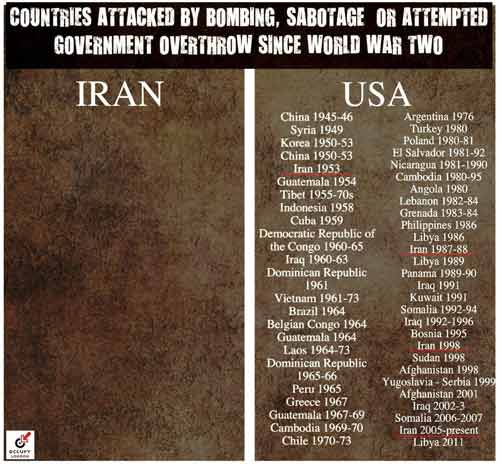
|
We have been trained to think of "anarchy" as a situation where every man is his own god. But if Jesus is Lord, then we ought to obey His command not to be "archists." A world without archists is a world of peace, cooperation, harmony, and Free Markets, with everyone dwelling safely under his own "Vine & Fig Tree."
"Spiritual Exercises"This is not an easy website. Not only are there more than 1,000 webpages, some of them are very controversial. They really make you think. It's like being on an athletic team and the coach ordering you to do 1,000 push-ups. It's not like the coach thinks that at the big game this weekend the teams are going to decide the championship by seeing who can do the most push-ups. The coach just knows that it will be easier to hit a ball over the wall in deep centerfield if you do your exercises before the big game. You don't have to agree with everything on this website to benefit from it. Check everything you read here by the Scriptures; test the spirits (Acts 17:11; 1 John 4:1). But if you stretch your spiritual muscles it will be easier to carry the Cross Christ asks you to carry. There's a lot of spiritual muscle-building here, and it's more entertaining than a Jane Fonda workout video. Examples:
Again, you don't have to agree that we're already in heaven, but if you work through those exercises, you'll find it a lot easier to believe what the Bible says, and you'll agree that after doing these exercises, you'll be strong enough to believe a lot more of what the Bible says than you could before. And isn't it your goal to believe as much of the Bible as you possibly can? That's our goal as well. |
Galantry, gallantry, is defined by Websters Dictionary, 1828 edition as
GAL'LANTRY, noun
1. Splendor of appearance; show; magnificence; ostentatious finery. [Obsolete or obsolescent.]
. . .
5. Vicious love or pretensions to love; civilities paid to females for the purpose of winning favors; hence, lewdness; debauchery.
:
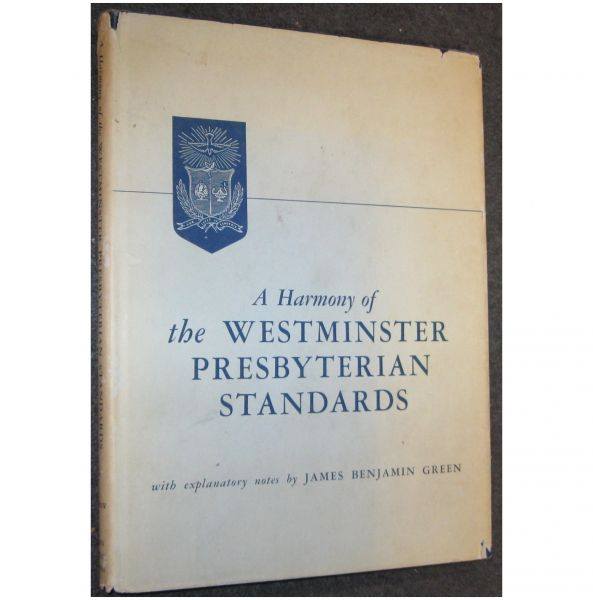

 God never commanded men to abandon Patriarchy and form a State